Report on a Planning Appeal - Written Representations Case By Mrs Jennifer Vyse DipTP, MRTPI, DipPBM Site Inspection carried out on 21 October 2024 ____________________________________________________
The appeal is made by Barry Murphy of Lowline Limited against the decision of the Planning Authority to refuse a planning application for demolition of the existing dwelling and construction of two replacement dwellings, including minor relocation of existing entrance and formation of new entrance.
Description
1. East View is a white-painted detached two-storey Manx stone cottage, with an adjoining single storey garage/outbuilding. The site, which is broadly level, fronts onto Lezayre Road (A3). Mill View, also a traditional detached two-storey dwelling that fronts onto the A3, adjoins the site to the south. A residential cul-de-sac, Carrick Park, winds round behind the appeal site, to the west. Nos 7 and 8 Carrick Park back directly onto the site. The rear garden to No 7 includes a finger of garden land that extends up to the A3, between the northern boundary of the appeal site and the long rear garden to No 6 Carrick Park, which also extends up to the main road.
2. Currently, the site is very overgrown, preventing access. The existing dwelling, which is falling into disrepair, has a footprint of some 10m x 5.6m plus a single storey outbuilding to the side (south) measuring some 6.6m x 5.6m - a total footprint in the region of 93sqm.1
3. It is proposed demolish the existing dwelling and construct a pair of twostorey semi-detached dwellings. The southernmost dwelling (Dwelling A) would have a footprint of some 66.22sqm, plus a porch, and would face onto the main road. The second property (Dwelling B), which would have a footprint of some 61.51sqm plus a porch, would sit gable end onto the road, with its front elevation facing north, across the extended finger of garden to No 7 Carrick Park and the rear garden of No 6. The development would have a combined footprint of some 127.7sqm (plus the two porches) with a height to eaves of about 5.3m and a height to ridge of some 7.5m.
4. The existing access off Lezayre Road would be closed off, with two new accesses proposed, one at each end of the site frontage. Two parking spaces would be provided to the side and front of each property, plus cycle storage within each plot.
5. The plans on which my recommendation is based are listed at Annex A. PLANNING HISTORY
6. In 2020, permission was refused for the erection of a replacement dwelling on the site (PA20/01452/B) on the grounds that the design was at odds with
1 The Committee report, from which the figures are taken refers to a total floor area of some 80sqm.
the character of the surrounding street scene and would harm the living conditions of neighbouring properties.
Relevant Policy And Guidance
7. Within the Sulby Local Plan 1998, the appeal site is shown as located within an area defined as Predominantly Residential. A small part of the site is identified as being at risk from river flooding.
Isle of Man Strategic Plan 2016
8. Spatial Policy 4 identifies Sulby as a village where development should maintain the existing settlement character.
9. Among other things, Strategic Policy 1 seeks to optimise the use of previously developed and under-used land, ensuring efficient use of sites.
10. Together and among other things, Strategic Policy 3(b), Strategic Policy 5, General Policy 2 (b), (c), (g) and (f) and Environment Policy 42 seek to protect the character, appearance and identity of an area by requiring that the design of new development is respectful of the character and identity of its surroundings.
11. Among other things, General Policy 2(g) seeks to protect the amenities of local residents, with 2(k) requiring that development does not prejudice use of adjoining land.
Residential Design Guide 2021
12. The Guide provides advice on the design of new houses and extensions. THE CASE FOR THE APPELLANT
The material points are: Density
13. Spatial Policy 4 of the Strategic Plan identifies Sulby as a village where development should maintain the existing settlement character and should be of an appropriate scale to meet local needs for housing and limited employment opportunities. There is therefore no objection in principle to the very modest scale of development proposed.
14. Strategic Policy 1 that development should make the best use of resources and optimise the use of previously developed land and underused land and buildings. There are no plot density standards on the Island, with each development being considered on its own merits. New dwellings in the village are different from their neighbours, some being less dense in terms of building to plot ratio, with others being of a greater density.2 Indeed, the Residential Design Guide encourages a range of dwelling types, designs, densities and height.
2 18/00210/B - redevelopment of Sabrew on the Sulby Straight, 18/00912/A approval in principle for four dwellings; 21/00515/B erection of 7 dwellings The Old Parsonage on the Sulby Straight; and 15/00795/A approval in principle for erection of a dwelling adjacent to the Old School House, Sulby Straight.
15. Sulby is focussed around a very traditional core, with many buildings dating back to before the 1860s. These buildings, other than the churches, hotels and mills, are notably modest in size, with the majority of dwellings being semi-detached or terraced. Despite this, all of the new dwellings that have been developed in the recent past are detached.
16. Sulby is split into distinct sections, each with its own character and appearance. The appeal site lies to the south of Sulby Bridge, where there is development alongside the western side of the road only, with the streetscene comprising the gable of Riverside, East View, Mill View, “The Shop”, the car park alongside the Ginger Hall Hotel, the hotel itself and its outbuildings and lastly the semi-detached pairing of Lhen View and Holly Bank. No particular type of property is dominant in that vista. To the rear of Mill View and East View, and visible in the streetscene, are the very modern properties of Carrick Park, which contain dormers that look east towards the main road and the rear of Mill View and East View.
17. Simply because the density of the proposed development may be greater than what exists, and greater than other properties in the vicinity, this is not in itself a reason for refusal, given the variety of densities forming the context of the site. The development proposed would provide acceptable levels of private amenity space and adequate car parking in accordance with the relevant standards, and would sit acceptably in the streetscene. It does not represent overdevelopment.
Visual Impact/Design
18. As set out above, the context of this site is very mixed with a variety of sizes, ages, finishes and heights of buildings as well as highly contrasting designs and characters. East View, as it exists, is a traditional dwelling but with a visible backdrop of much more modern properties, with contrasting finish materials, much longer ridge lines and pitched roofed dormers. The development proposed responds to both the traditional context of Riverside and Mill View and the more modern properties to the rear, reflecting the best elements of the existing streetscene in the traditional sections of the properties, with the small area of glazing on Dwelling B representing an interesting and contemporary feature.
Carrick Park Properties
19. The Planning Officer considers that the impact on the living conditions of residents of No 8 Carrick Park would be acceptable, although the occupants of this property disagree. Whilst two-storey, the existing cottage is unusual in that it has no first-floor windows on the rear elevation. The introduction of windows in the rear (west facing) elevation where there are none currently has been avoided. The development proposed has only one first floor window at the rear, at the southern end of Dwelling A, which serves a bathroom and would be obscure glazed. The first-floor accommodation would be lit via roof lights, which would not offer a direct view out towards the properties at the rear. This differs significantly from the previous application, which included six first floor windows in the rear elevation.
20. First floor windows are included on the northern elevation of Dwelling B. This has been designed to have a traditional facade when viewed on the approach heading south from Sulby Bridge. The window closest to the
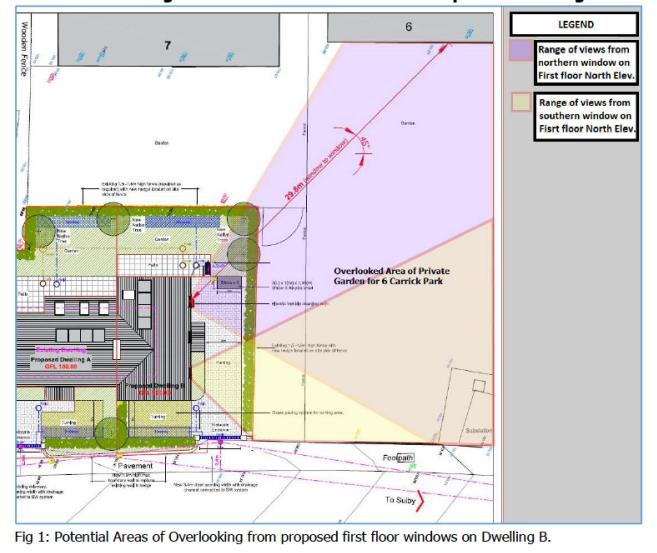
property at the rear (No 6 Carrick Park) would serve a bedroom. The window next along serves a bathroom, with that closest to the road serving a first floor lounge.
21. In terms of privacy, the Residential Design Guide recommends that where elevations contain windows serving habitable rooms that face each other, they should be 20m apart. In this case, the windows in the northern elevation only look directly towards Riverside, which is over 20m away. No 6 Carrick Park is to the rear of the proposed northern elevation and the angle of view towards it is between 35 degrees and 53 degrees and at a distance of between 24m and 35m respectively, considering both ground floor and dormer windows. Based on the Guide, it is not clear how the proposed development would adversely affect the privacy of neighbouring occupiers.
22. The related reason for refusal, and the officer’s concern, relates to overlooking of the rear garden of No 6, rather than of the dwelling itself. Whilst it would be possible to have a view of the rear garden of No 6 from all of the first floor windows in the proposed northern elevation, the closest serve a bedroom and bathroom, rooms which would not generate a significant amount of occupation at times when the garden would be in use. Whilst the third window would serve a lounge, it is not the primary window for this room and is at the far end of the adjacent garden.
23. The development would not result in an adverse impact through overlooking on any of the neighbouring properties, taking into account the existing context where the Carrick Park properties have first floor dormers which enable a clear view towards and into the curtilages of the properties which front onto the main road.
Parking
24. There is no restriction on on-street parking here but, in any event, the proposal provides two off-street parking spaces for each property in accordance with the Strategic Plan standards. Whilst the Commissioners refer to periods of road closures for the Mountain Circuit motorcycle racing, this proposal results in a net increase of just one property, which is insignificant when considering the rest of the properties which are affected by the road closures. None of the other applications in the village (referred to above), which would be affected by road closures, have been refused for this reason.
Conclusion
25. The development optimises use of the site without being overdevelopment, overbearing or having an adverse impact on neighbouring occupiers. It makes good use of an attractive site, in a sustainable location within an existing settlement, close to public transport and within walking distance of shops, school, churches as well as being located in very attractive countryside within a popular village. The design takes cues from the traditional and modern buildings in the vicinity whilst incorporating current contemporary elements to reflect the age of the building.
26. There is no objection to the principle of the loss of the existing dwelling and what is proposed would result in a highly energy efficient building enabling two households to live within Sulby. These are modest dwellings, not
significantly larger in footprint than what exists, but which make much better use of the site.
THE CASE FOR THE PLANNING AUTHORITY The material points are: Character and Appearance
27. The site is zoned for residential use and there is no objection in principle to the development proposed, which accords with the goals of Strategic Policy 1 and Housing Policy 4 of the Strategic Plan.
28. However, at almost three times the density of development in the immediate vicinity, the appeal scheme would be at significant variance with the character of this part of Sulby. Moreover, a large two storey element would be added to the north elevation. The impact of that increased quantum of development would be further exacerbated by the fact that the proposed development would be some 1.2m higher than the existing cottage. When read in the context of the surrounding properties, the two-storey dwellings proposed would result in overdevelopment of the site. The reduction in length and width from the previously refused scheme is not so significant as to diminish the impacts.
29. Additionally, the scheme would introduce a semi-detached property in an area where none presently exists, with the proposed mix of elevation orientations also considered to be at variance with the prevailing layout and design of buildings in the area. The design reflects neither the chalet style bungalows with accommodation in the roof space to the rear, nor the traditional design of the existing cottage and Mill View to the south.
30. When read in the context of Mill View to the south, the development would also appear very dominant, with an overbearing impact on the road side frontage of this street scene, harming the established character and appearance of the streetscene.
31. The harm to the character and appearance of the area brings the development into conflict with General Policy 2(b), (c) and (g), Environment Policy 42, Strategic Policy 3(b), and Strategic Policy 5 of the Strategic Plan, as well as the principles promoted by the Residential Design Guide.
Living Conditions
32. The three north-facing first-floor windows on Dwelling B, two of which would serve a lounge and bedroom, would be some 3.7m above ground level and would directly overlook the rear garden of 6 Carrick Park. It is clear from the analysis at Fig 1 within this statement,3 that overlooking would be significant in terms of the coverage of the neighbouring garden. Moreover, in reality, the human eye has a broader range of view and is not constrained as depicted on the diagram.
33. Whilst Dwg No 1081-12 shows that the proposed bedroom window would be situated about 29.8m from the rear of 6 Carrick Park, the line shown is not to the nearest widows to habitable rooms at the rear of 6 Carrick Park. That
3 INSPECTOR’S NOTE: I have included the Figure in my reasoning below.
said, direct overlooking of bedrooms would not occur, but in any event, the distance would be more than 20m. As such, the distance of the bedroom window to the nearest windows at No 6 is not considered to be a concern.
34. The key concern is the impact on the use of this private garden which, as the main outdoor space for that neighbouring property, would be used frequently as a play area and outdoor amenity area. Whilst it is proposed to plant two trees in the northwestern corner of the garden for Dwelling B, these would provide little screening for large parts of the adjacent garden. Besides, any trees would take a considerable time to be fully mature. Given the above, it is considered that the concerns with overlooking, or perceived overlooking, regarding 6 Carrick Park, are sufficient to warrant refusal of the scheme. The harm in terms of loss of privacy would be contrary to General Policy 2(g) and the principles advocated by the Residential Design Guide.
35. With regard to Nos 7 and 8 Carrick Park, the only rear facing windows at first floor level would be to a bathroom, which would be obscure glazed, and to a stairwell. Whilst the proposed landing area would afford views of both neighbouring gardens, they would not be so significant as to warrant refusal.
36. The separation between the proposed dwellings and Nos 7 and 8 Carrick Park and Mill View, combined with existing vegetation, would be sufficient to ensure that there was no material loss of light or overbearing impacts.
37.Air source heat pumps are proposed. The calculations provided by the appellant confirm that associated noise levels would be lower than the permitted development noise output of 42db(A). This could be controlled by condition were the appeal to succeed.
Highway Safety
38. The access alterations would be appropriate, offering a safe access, offering good visibility in both directions. The provision of at least two on-site spaces for each dwelling accords with Transport Policy 7. Additionally, the site sits on a public transport corridor. There would be no conflict with Strategic Policy 10, Transport Policies 4 and 7 and General Policy 2(h) and (i) of the Strategic Plan.
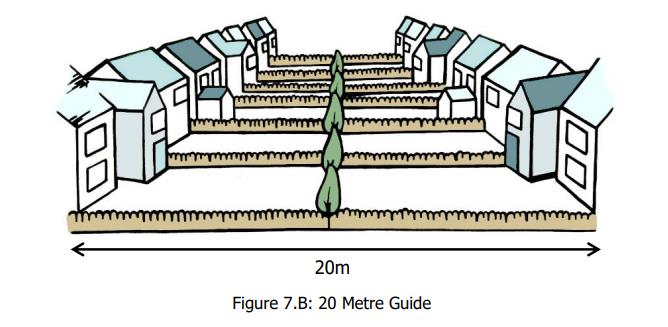
Flood Risk
39. A Flood Risk Assessment was provided. Notwithstanding the concerns of the Commissioners, DOI Flood Risk Management raise no objections to the proposal, subject to conditions, on the basis that the risks of flooding, both on and off site are not unacceptable. The scheme meets the requirements of Environment Policies 10 and 13, as well as General Policy 2 (i).
Biodiversity
40. Biodiversity impacts can be addressed by conditions were the appeal to succeed.
Conclusion
41. Although the proposal seeks to address the concerns raised with the previous proposal, the scheme would still result in significant adverse impacts in relation to the character and appearance of the area and the
living conditions of No 6 Carrick Park. There would be conflict, in this regard, with the relevant policies of the Strategic Plan and the Residential Design Guide.
OTHER REPRESENTATIONS RECEIVED
42. DoI Highway Services: no objection.
43. DoI Flood Risk Management Division: do not oppose subject to conditions securing the mitigation measures in the flood risk assessment.
44. Lezayre Parish Commissioners: object for reasons relating to impact on outlook, privacy and loss of light to house to the west. The northern dwelling will look over the adjacent garden. The proposed dwellings will be at a higher level than their neighbours, potentially affecting flood risk. Dispute the assertion that the existing dwelling has no history of flooding. Unclear as to how high the new dwellings will be. Is the existing foul water connected to the main sewer? Scheme comprises overdevelopment, particularly during road closures, as there is insufficient parking space on the site for two properties. Appreciate that the existing property cannot be saved, but any replacement should be the same size as existing.
45. DEFA Biodiversity: do not oppose subject to conditions relating to bats, nesting birds and landscaping.
46. Manx Utilities: an amended plan was submitted to address initial drainage concerns. No objection.
47. Occupiers of 8 Carrick Park (Hill View): object for reasons relating to overdevelopment, height and width, and creation of an additional access onto the TT Course. Design is not in keeping with properties in the immediate area. Overbearing impact given size and proximity. Noise from the two air source heat pumps proposed. Most of the previous reasons for refusal still apply.
48. Occupiers of 6 Carrick Park: object due to loss of privacy from first floor windows, design not being in keeping with existing properties and prejudice to use of the adjoining garden to No 6, restricting use. The development is little changed from the previous proposal.
ASSESSMENT BY INSPECTOR
49. No issue is taken with the principle of the development proposed, the site lying within Sulby, a village identified in Spatial Policy 4 of the Strategic Plan as being appropriate for some residential development. The main issues in this case therefore, relate to the effect of the development proposed on the character and appearance of the surrounding area, and its effect on the living conditions of adjoining occupiers, in particular the occupiers of No 6 Carrick Park, by reason of outlook and privacy.
Character and Appearance
50. Among other things, the Residential Design Guide seeks to encourage creative, innovative and locally distinctive designs that respond to the changing needs of the Island’s communities. At paragraph 1.1.2 it confirms that it is not intended to stifle creativity, or to promote planning by numbers
and off-the-peg designs. Rather it looks to provide a supportive context for good quality designs, be they traditional or modern. Paragraph 1.2.3 confirms that all applications will be judged on their own merits, taking account of the likely effect on neighbouring properties and the character of the building or street.
51. The Planning Authority describes the appeal scheme as overdevelopment. There is focus too on the mathematical density of development on individual plots in the vicinity, compared with the plots proposed. However, the most meaningful test, it seems to me, is how the development would be experienced on the ground in its site specific context and what harm there might be as a consequence of the scheme. The fact that a development maybe of a different scale or density from its immediate surroundings does not automatically equate to harm.
52. I saw that there is quite a mix in terms of building size, type and style in the locality of the appeal site, with no strong or coherent design theme to the streetscene here. Mill View and East View are of a completely different scale, design, and indeed density, in comparison with the much larger Carrick Park dwellings and plots which are clearly seen behind. Riverside, to the north, sits at a lower level, gable end on to the road, adding further variety to the streetscene. This is not a location therefore, where there is a strong sense of uniformity and consistency in terms of design. Whilst that does not mean that anything goes, it does allow for more flexibility than might otherwise be the case, including a modest, contemporary design approach.
53. I recognise that the proposed dwellings would be semi-detached, whereas the other dwellings here are mainly detached, but I see no harm in that. Indeed, a little further along Lezayre Road to the south, Lhen View and Holly Bank comprise a pair of semi-detached dwellings adjacent to the road. I also saw detached properties sitting quite happily next to semi-detached dwellings around the Sulby Bridge bend.
54. The proposed properties would be much smaller than the Carrick Park dwellings, but then Mill View and East View are already much smaller. Moreover, the building footprints of each of the proposed dwellings are not greatly dissimilar to the existing building footprint for East View. On that basis, albeit that they are semi-detached, the two dwellings proposed would not, in my view, result in any material harm to the established character or appearance of the area. In coming to that view, I am mindful that they would not be visually ‘hemmed in’: Mill View to the south is set some way off the shared boundary, separated by a single-storey detached garage building and vegetation. Moreover, the site is not adjoined by buildings to the north, the rear garden to No 6 Carrick Park separating it from Riverside, roughly 30m away. There are no buildings opposite either, the site facing open fields.
55. As for the proposed design, yes the development would be around 1.5m higher than the cottage it would replace, but it would still only be 7.5m to the ridge, just over 5m to eaves. The frontages to both dwellings would be traditional, with a single window to either side of a central entrance porch, with three first floor windows, all with a vertical emphasis, sitting below a pitched slate roof. Very similar, in fact to the frontages of Mill View and East
View and, further to the south, Lhen View. Each property would also have a chimney.
56. For the most part, the walls would be painted smooth render. However, the gable end to Dwelling B, which would sit adjacent to the main road, would be of a more contemporary design. Half would be in timber/composite cladding and the other half would be recessed to provide for a small balcony area at first floor level, facing east. The recessed part of the gable would be fully glazed. To my mind, the treatment of the roadside gable adds interest to the elevation, creating profile and light and shade. I consider the proposed design to be visually attractive. Whilst this element of the scheme is different, it is sufficiently respectful of the character of the surrounding area so as not to appear jarring or incongruous.
57. All told, I consider that there would be no harm to the character or appearance of the area as a consequence of the size, design or density of the dwellings proposed. There would be no conflict, in this regard, with Strategic Policy 3(b), Strategic Policy 5, General Policy 2 (b), (c), (g) and (f) and Environment Policy 42, which together and among other things seek to protect the character, appearance and identity of an area. There would be no conflict either with the Residential Design Guide, which encourages good quality, contemporary design where it is informed by, and is respectful of, its context.
Living Conditions
58. The main concerns in this regard relate to No 6 Carrick Park, the rear garden to which is laid mainly to lawn, with a large raised decking area at the eastern end, adjacent to the A3. The front elevation of proposed Dwelling B, would face north, looking straight across the rear garden of No 6. Windows to two habitable rooms are shown at first floor level on this elevation, to a bedroom and first floor lounge. There is a third window, but that is to a bathroom and would be obscure glazed.
59. In terms of overlooking and privacy, the Residential Design Guide focuses on windows serving habitable rooms that face each other, suggesting a 20m separation. It does not, so far as I can see, deal with situations such as here, where dwellings are set at right angles to each other - the dwellinghouse at No 6 is offset to the northwest of Dwelling B. It is pertinent to note though, that the minimum 20m separation shown on Figure 7.B in the Design Guide (shown below) implies minimum garden lengths of 10m as being unlikely to give rise to privacy concerns
60. In this instance, the garden in front of Dwelling B would be around 9m from the boundary with the garden to No 6. As is clearly demonstrated on the plan at Fig 1 of the Authority’s appeal statement (shown below) the whole of the rear garden to No 6, including that part of the garden closest to the house which might be expected to be most heavily used, and the decking area, would be in full view of those first floor windows.
61. The appellant suggests that since one of the windows would be to a bedroom, that would minimise overlooking concerns. However, the first floor windows in the figure in the Design Guide would be expected to be bedroom windows and so that is already taken into account. Moreover, one of the windows would be to a lounge, a room likely to be more heavily used than a bedroom, with people sitting for longer and looking out. Indeed, siting the lounge at first floor and including the number of windows shown to that room, suggests that the intention was to maximise the opportunity for views out. I recognise that the other two windows to the lounge would be within the east facing gable elevation of Dwelling B, one of which would comprise sliding doors giving access onto a balcony space. But, even were I to agree with the appellant that the north-facing lounge window proposed would somehow be secondary to those, it would still facilitate direct overlooking of the adjacent garden from a habitable room.
62. In terms of window to window distances, the rear, east facing elevation of No 6 Garrick Park contains three large dormers and a rooflight. As I saw during my site visit, the dormer nearest to the appeal site is to a bedroom, and below that, at ground floor level, is another bedroom window. However,
A technical site plan diagram illustrating potential overlooking areas from proposed first-floor windows onto a neighboring private garden, featuring colored view overlays and property boundaries.
they would be more than 20m away at their closest.4 Moreover, views would be oblique, rather than direct. I find no material harm in this regard.
63. I recognise that the outlook for the occupiers of No 6 would change as a consequence of the development proposed, as it would for the occupiers of Nos 7 and 8 Carrick Park. However, there is already a dwelling on the plot, albeit currently overgrown. The appeal scheme would bring slightly taller built development closer to the site boundaries, but the overall modest scale of the proposed dwellings means that they would not be seen as unduly overbearing in their context. I find no material harm in this regard either.
64. I note concerns in relation the potential for noise from the proposed air source heat pumps. However, as confirmed by the planning officer, that is a matter that could be controlled by condition were the appeal to succeed.
65. To conclude on this issue, whilst I find no harm in relation to any loss of privacy in terms of window to window views, the relationship of the first floor bedroom and lounge windows with the rear garden to No 6 Carrick Park is such that the entire space would be directly overlooked, resulting in a material loss of privacy for the adjoining occupiers. There would be conflict therefore, with General Policy 2(g) and (k) and the Residential Design Guide which seek, among other things, to protect such interests.
Other Matters
66. Whilst a small part of the site is identified as being at risk of flooding, I note that the adjacent main road, which rises here, is not included within the area of flood risk. In any event, the appellant’s Flood Risk Assessment confirms that the floor level of the proposed dwellings would be 0.21m above the existing ground floor level, some 0.2m above the level of the adjacent road. It also confirms that the property benefits from flood defence works carried out in 2005. I am mindful, in this regard, that the DoI Flood Risk Management Team raises no objection. Whilst I note the comments of the Commissioners in relation to flood risk, there is no substantiated evidence before me to support their concerns.
67. The Commissioners also raise concerns about parking provision and highway safety. However, two on-site parking spaces are proposed for each dwelling, in accordance with the standards set out in the Strategic Plan. The existing site access would be closed off and two new accesses formed, one at each end of the site frontage. As confirmed by Highway Services, who raise no objections on highway safety grounds, the visibility splays proposed are appropriate and there is sufficient space within the site to allow drivers to enter and leave in a forward gear. As for road closures during race periods, I am not persuaded that the net increase of one access to a single modest dwelling is likely to have a material impact in safety terms.
OVERALL CONCLUSION AND RECOMMENDATION
68. I have found no harm in relation to the effect of the development proposed on the character and appearance of the area. Neither have I found any
4 The annotated window to window distance shown on the Fig 1 plan above does relate to the nearest habitable room windows at No 6, which are closer. Even so, the distance still exceeds the 20m minimum.
harm in relation to any window to window overlooking or outlook. I have, however, found that overlooking of the entirety of the rear garden to No 6 Carrick Park, and the consequent loss of privacy, would be unacceptable. That is not a matter that could reasonably be overcome by conditions. On balance therefore, for the reasons set out above, and having considered all matters raised, I conclude that the appeal should be dismissed and that the decision of the Authority to refuse planning permission be upheld.
Reason: Whilst there is no objection in principle to residential development of this site, and nor would there be any harm to the established character and appearance of the area, there would be unacceptable harm to the living conditions of the occupiers of No 6 Carrick Park with particular regard to privacy, prejudicing use of the rear garden. That brings the development into conflict with General Policy 2(g) and (k) and the Residential Design Guide, which seek to protect such interests.
69. Should the Minister disagree and grant planning permission, suggested conditions, and the reasons for them, are attached at Annex B below. They are based on those suggested in the Authority’s Statement of Case.
70. One of the suggested conditions required a soft landscaping plan for the dwellings, including mitigation for the loss of the mature garden and other dislodged habitat. However, one of the other conditions requires the implementation of any mitigation measures that might be identified in an ecological survey to be submitted. The suggested landscaping condition is therefore unnecessary.
71. Notwithstanding reference in the officer’s report to the need for a condition relating to the ASHPs, none was included on the list of suggested conditions sent with its statement. I have therefore drafted what I consider to be an appropriate condition (Condition C6). If permission is granted, the Minister may wish to confirm with the Authority that the wording does what was intended.
72. In the interest of precision, I have also altered the wording of the suggested condition in relation to flood risk, to better reflect the conclusions of the Flood Risk Assessment.
Jennifer A Vyse
Independent Inspector
19 November 2024
ANNEX AList of plans on which my recommendation is based
C1. The development hereby approved shall begin before the expiration of four years from the date of this decision.
Reason: To comply with Article 26 of the Town and Country Planning (Development Procedure) Order 2019 and to avoid the accumulation of unimplemented planning approvals.
C2.: No development shall commence, including any works of site clearance and ground preparation, until an ecological survey of the site has been submitted to and approved in writing by the Department. The ecological survey shall identify matters of ecological interest within the site and measures to mitigate ecological impacts where appropriate, including a timetable for their implementation. Development shall be carried out in accordance with the approved mitigation details and timetable. Reason: In the interest of ecology and biodiversity.
C3: Prior to first occupation of either of the dwellings hereby approved, nest bricks/boxes shall be installed on the external elevations in accordance with details that shall previously have been submitted to and approved in writing by the Department. Once provided, the nest bricks/boxes shall be permanently retained thereafter. Reason: In the interest of biodiversity.
C4: The dwellings hereby approved shall not be occupied until the accesses, including visibility splays, and on-site parking spaces, have been provided in accordance with the details shown on Drawing Nos. 1081-11 Rev A and 1081-12. Such areas shall not be used other than for their intended purpose and shall remain free of obstruction to such use at all times. Reason: In the interest of highway safety.
C5: Prior to the commencement of development above ground level, a schedule of external materials and finishes for the walls and roofs, including samples, shall be submitted to and approved in writing by the Department. Development shall be carried out in accordance with the approved details. Reason: In the interest of visual amenity.
C6: At no time shall the noise from the ASHPs shown on the approved plans exceed 42 dB LAeq 5 mins. Reason: In order to protect the living conditions of adjoining occupiers.
C7: Notwithstanding the provisions of the Town and Country Planning (Permitted Development) Order 2012 (or any Order revoking and/or reenacting that Order with or without modification), no development shall be undertaken under the following classes of Schedule 1 of the Order at any time: Class 14 - Extension of dwellinghouse, Class 15 - Garden sheds and
summer-houses, Class 16 - Fences, walls and gates and Class 17 - Private garages and car ports. Reason: In the interest of visual amenity and to protect the outlook of occupiers of adjoining dwellings.
C8: The finished floor level of the dwellings hereby approved shall be at least at 15.62mD02 ie 0.21m above the floor level of the existing dwelling, 0.2m above the level of the adjacent highway, with all services to be fed from above and no outlets within a potential flood height. Reason: In order to protect future occupiers from the risk of flooding.
------------------------End of Schedule-------------------------
Copyright in submitted documents remains with their authors. Request removal