Loading document...
| Received | 22.3.06 | 06 00508 |
| Town and Country Planning Act 1999 PLANNING and BUILDING CONTROL DIRECTORATE | ||
| Decision | Date and Officer initials | |
| Initial | ||
| Appeal | ||
| Amended | ||
| Returned |
RECEIVED ON 22 MAR 2006 DEPT. OF LOCAL GOVERNMENT AND THE ENVIRONMENT
MacOwan Collett Consulting Engineers
February 2006
Ianda House, 4 Mona Terrace, Finch Road, Douglas, Isle of Man. IM1 3NA
Prepared for:
Department of Local Government and the Environment
Murray House
Mount Havelock
Douglas
Isle of Man
Tel: 01624 624738 01624 624822
Fax: 01624 624243
e-mail: [email protected]
1.0 Introduction 2.0 Brief Description of the Buildings 3.0 Observations 4.0 Methodology 5.0 Waste Strategy 6.0 Wildlife 7.0 Conclusions
P.865/01 Location Map P.865/02 Site Plan Pre-Demolition P.865/03 Site Plan Post-Demolition
Aerial photograph showing the buildings to be demolished outlined in red.
P.1 South Wing P.2 South Wing P.3 South Wing P.4 South Wing P.5 West Wing P.6 West Wing P.7 West Wing P.8 West Wing P.9 Seawater Ponds P.10 Seawater Ponds P.11 Seawater Storage Tank
MacOwan Collett Consulting Engineers Limited are instructed by Department of Local Government and the Environment to prepare a scheme for the demolition of an extension and annex buildings forming part of the Marine Biological Station in Port Erin, Isle of Man.
The Marine Biological Station is currently operated by the Biology Department of the University of Liverpool. In September 2006 the University are vacating the site and it is being handed over to the Isle of Man Government, Department of Local Government and the Environment.
The Estates and Housing Directorate of the Department of Local Government and the Environment have undertaken a preliminary survey of the buildings and have concluded that some are no longer fit for purpose and it would not be economically viable to restore them to a usable condition.
The Marine Biological Station is located on the south side of the entrance to Port Erin Bay. Access to the station if from Breakwater Road, part of which is a one-way system turning 180° in front of the station.
The station comprises of a mixture of buildings of differing age, size, facades and forms of construction.
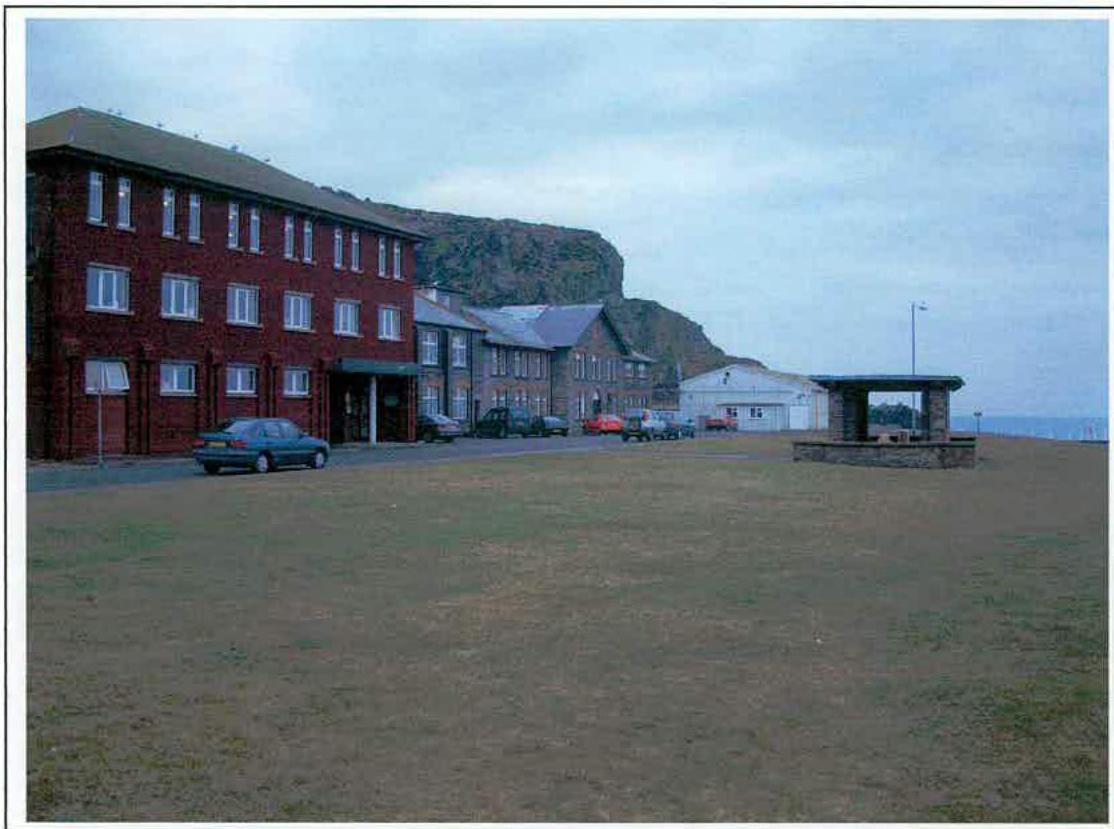
The original laboratory building, which dates from the late 1890's is a two storey structure with random rubble walls and a hipped roof covered in natural slate. This building will be retained.
Attached to the east side of the original laboratory building is a two storey extension with random rubble walls and a hipped roof covered in natural slate. It is understood that this extension was originally single storey and was subsequently extended to two-storey. The lower section of the external walls is in natural stone facing with brick lintels over openings matching the original laboratory building. The upper storey is rendered and painted brown.
This building will be retained.
A separate three storey building was constructed at the east end of the site in the late 1970's and accommodates laboratories and a library. This building comprises of red facing brick external walls beneath a hipped roof covered in natural slate. A brick extension at the rear and side of the east wing links both the original laboratory building and the east wing to the laboratory/library extension.
This building will be retained.
Attached to the rear of the original laboratory building is a three storey modular concrete structure with a flat roof and a single storey extension of traditional masonry construction with a mono pitched roof covered with felt.
These buildings will be demolished.
The collection of single and two storey buildings located at the west end of the site are to be demolished. These buildings are a combination of portal frame structures clad with double skinned asbestos sheeting and traditional masonry structures with flat roofs.
Located to the rear of the original laboratory building is a seawater storage tank balanced on top of a detached storage building. Abutting the cliff face to the rear and side of the original laboratory building are two redundant seawater storage tanks.
All three tanks and the storage building are to be demolished.
The seawater ponds located between the west wing and cliff face are to be backfilled with crushed demolition rubble and graded level with the surrounding ground.
The Marine Biological Station is located in an exposed harsh marine environment which has had a detrimental effect on some of the structural elements of the buildings. The buildings also appear to have suffered from a lack of regular maintenance over the years.
The south wing extension has been strengthened in the past with a series of vertical steel columns inserted on the west façade. The steel columns are showing signs of corrosion.
The portalised steel frames at the west wing are extensively corroded. The fixings securing the wall and roof cladding are also corroded and some of the asbestos sheeting is damaged.
The concrete to the redundant seawater storage tanks is cracked and spalled and their stability could not be guaranteed.
The seawater ponds lack adequate perimeter protection and are considered a hazard.
In addition to the expanse of asbestos cement cladding on the buildings in the west wing, previous surveys have identified the presence of asbestos containing materials, in large quantities, in the other buildings on the site.
Deterioration due to age, weathering and general wear and tear is evident on the remaining buildings to be retained and it is proposed to undertake a condition survey of these buildings to identify the extent of the deterioration and recommend a scheme for the upgrading and refurbishing the fabric and structure.
Prior to the commencement of any demolitions an enabling works contract shall ensure the safe removal and disposal of all asbestos containing materials. The asbestos removal shall be carried out by an approved Contractor.
As part of the enabling works all services to the buildings to be demolished shall be capped off and made safe.
Structural openings at the interface between the buildings to be retained and those to be demolished shall be sealed weather and watertight with dense concrete block masonry smooth rendered externally.
Following removal of the asbestos materials physical demolition shall commence at the west wing and all concrete and masonry rubble arising shall be crushed and placed in the east side of the empty seawater ponds, providing a suitable temporary access for plant etc to the rear of the site.
The physical demolition shall be carried out remote from the buildings using 360° tracked excavators fitted with shear and pulverising attachments. Where the structures to be demolished interface with the retained buildings they shall be taken down by hand from a secure scaffold and/or mobile hoist.
Detailed method statements shall be provided by the successful Demolition Contractor and shall be approved by the Health and Safety Inspectorate and Planning Supervisor prior to the commencement of any enabling or deconstruction works.
The materials arising from the demolition shall be dealt with as follows:
NB – Surplus concrete and masonry arising from the demolitions shall be crushed and stored off site for recycling as hardcore.
NB – No burning shall be allowed on site.
The cliff face behind the Marine Biological Station is a nesting place for several species of birds.
The Wildlife Officer at the Department of Agriculture, Fisheries and Forestry will be consulted to ascertain the most suitable time to carryout the demolitions without affecting the nesting season for the birds.
The buildings to be demolished which are referred to in this report and shown on the attached drawings and photographs are considered to be unsuitable for purpose due to corrosion of the main structural elements and the presence of large quantities of asbestos containing materials.
Approval is sought for the demolition of the aforementioned buildings primary on the ground of Health and Safety of those occupying the buildings and the general public who may have access to the site following closure of the Marine Biological Station.
It is proposed that the retained structures will be temporarily mothballed until a suitable alternative use has been identified.
Copyright in submitted documents remains with their authors. Request removal
View as Markdown