Loading document...
The Design Statement that is suggested here formed part of the Planning Statement that was submitted with the initial Planning Application. The main environmental factors concerned were encouragement to cycle to work with the new cycle lanes in place on Peel Road, Douglas. The design includes bicycle storage and shower facilities for those who wish to cycle, run or walk to work, thus reducing traffic congestion in Douglas. The Planning Statement also highlighted the number of accessible bus stops in close proximity to Exchange House for this purpose, as well as easy access to Douglas Railway Station.
The location of Exchange House is also convenient to walk into Douglas so there will not be a requirement for a specialist bus service as some employers provide, and this will help bring more revenue into the town.
The new extension will take advantage of passive solar gain, adopt a modern air-conditioning system and be suitably insulated to avoid waste energy.
As previously mentioned the construction will be local and 'Kit-Fit' to avoid material waste and reduce the carbon footprint at construction stage.
Lighting will be occupancy sensitive and there is a possibility for grey water collection on the roof for toilets and urinals which can be integrated into the existing system.
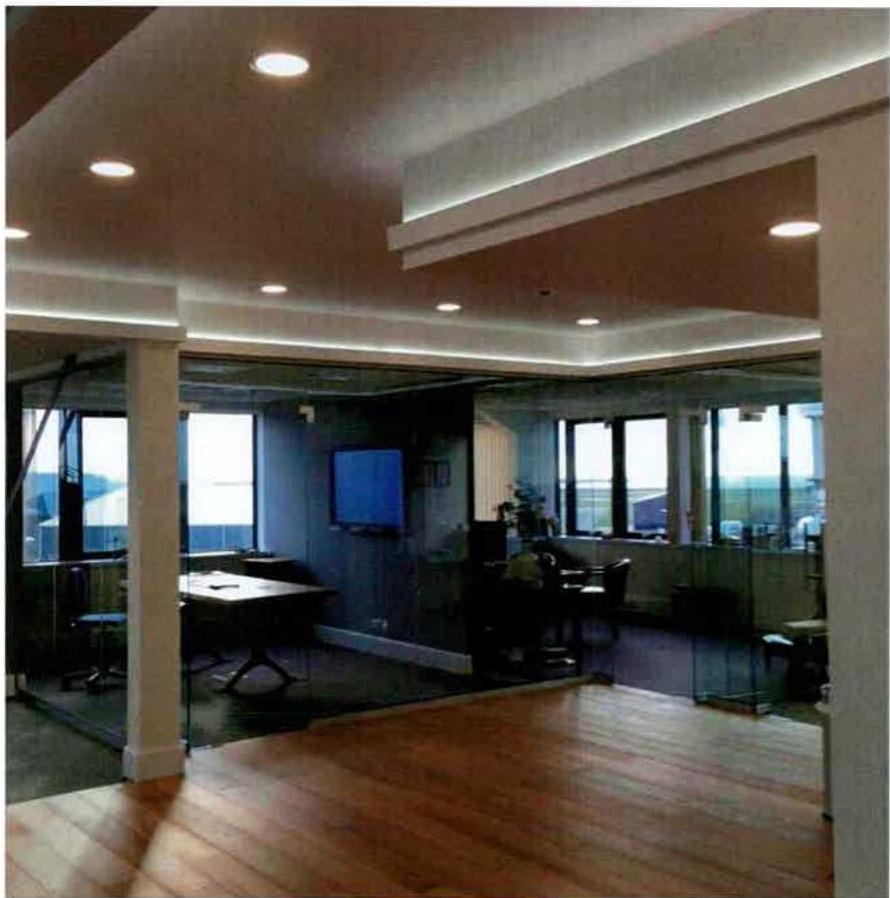
The Client is proposing high-end office space which is a factor for attracting new business to the Island. Examples of this can be seen at Euromanx House, Fig. 10, where one of their current Clients is Shell Oils, who's capacity as a business is well known and their standard of requirements is very high.
Fig. 10: Euromanx House is a modern office which was developed by M.O.P. Holdings, in the Freeport in Ballasalla. Attracting Clients such as Shell to the Island requires modern facilities, and M.O.P aim to add this standard of Modern Design into Central Douglas. See www.mop.im
The submitted Planning Statement advised that there were 19 car parking spaces available in the basement of Exchange House, 5 no. further spaces within the curtilage of the building off St. George's Walk and had a further 22 no. parking spaces at Banks Circus which is at the bottom of Railway Hill. This is in accordance with the Strategic Plan 2007 guidance notes at Appendix 7 and the Planning Report where 18 additional parking spaces are required for this development.
In addition to this, the transport strategy includes bicycle storage and shower facilities, as well as amenity to several bus routes and other car parks or disc zones within the immediate vicinity as discussed under Strategic policy 5.
This strategy set out in the Planning Statement provided no issues for The Highways division and works in accordance with:
Policy 7: The Department will require that in all new development, parking provision must be in accordance with the Department's current standards.
and
Policy 2: Development which is in accordance with the land-use zoning and proposals in the appropriate Area Plan and with other policies of this Strategic Plan will normally be permitted, provided that the development:
(h) Provides satisfactory amenity standards in itself, including where appropriate safe and convenient access for all highway users, together with adequate parking, servicing and manoeuvring space;
There are a number of parking spaces on site and easy access for cyclists, runners and walkers to get to work. There are pedestrian crossings at both ends of Athol Street for people who use the bus or get the train, as well as those using Banks Circus car park. There are also a number of disc zones and car parks within the vicinity of Athol Street.
The reasons for this Appeal have been stated in each of the Three Sections denoting the reasons for refusal with a subsequent response. With the current trend of buildings either built or approved within and around the vicinity of the Conservation Area of Athol Street it is difficult to see how the development of Exchange House differs in many respects to its predecessors. The reasons for refusal that have been given do not wholly reflect the scheme in terms of the Planning Policies stated in the Strategic Plan 2007, considering the precedents set.
If we refer to the Planning Officers Report and the subsequent suggestion to Refuse Planning Approval for Exchange House, the following comments apply:
1.1 The fifth floor of Exchange House appears distant from the main street facade despite being a full storey high and becomes relevant to the proposal when we consider its context. Athol Street has evolved considerably since the development of Exchange House and it is this evolution that has given rise to the proposal in question.
In terms of the context of the proposal I disagree with the Planning Officers Report at Point 1.3 stating that the current street scenes have key unifying features in 'height and mass'. The submitted Planning Statement illustrates photographs to show that both modern and traditional forms vary in height along Athol Street whilst the mass of buildings is sporadic when you look at the street plan. These varying forms stem from the addition of new extensions, interiors, dormers as well as demolition & re-building to diversify the ever-changing business environment that has become a trademark of Athol Street.
I believe that Exchange House formed a precedent to the more recent developments at the buildings occupied by Appleby, KPMG, Zurich, and new builds on Circular Road and St. Georges Street where larger, open plan buildings have become more prominent. The building currently occupied by Appleby is of a contemporary form. (New Build PA 09/01839/GB & Demolition of a Registered Building PA 09/01840/CON).
The new render works of the previously Approved Application (PA 12/00732/B Approved 13th July 2012) will be scheduled to be undertaken in conjunction with the new proposal.
The Officers Report advises that the proposal fulfils Planning Policy, except where mass and height are involved, however the design has articulated both the mass and the height to maintain the street context. However the Planning Report states in point 1.3 that 'it would be difficult to argue there was a clear architectural vernacular'
6.6 – The trees to the rear of Exchange House are between filtered to full mask in winter and summer respectively and this dilutes the impact of the extension. On Athol Street the proposal cascades to lessen its impact on the streetscape. The reality of the proposal will never be seen in its illustrative Elevation form and therefore the street views offer a more realistic view of the proposal.
6.8 The glazing is designed to reflect the trees, sky and church. Developments around St. Georges Church show precedents for developments within this context. St. Georges Court
and its neighbouring building which subsequently sits next to St. Mary's Church, as well as an approved scheme at 19-20 St. Georges Street (PA 12/01090/B) (Fig 2). Although not within the Conservation Area, there appears to be a suggestion that contemporary design is acceptable in the vicinity.
6.11 There is a 50% height increase in the building in part; however allowance for the terrace area should be taken into consideration when reviewing the project. This is contrary to the 'towering' impression the Report envisages.
6.12 Furthermore, the cornice line mentioned in the Planning Report will not be altered or lost on Exchange House for purposes of record.
6.13 New glazing mullions protrude from the existing buttress structure which provides a link between the new and old portions of the building for design purposes.
6.14 Initial pre-planning advice was sought with Mr Baker in advance of Mr Riley undertaking the role of Planning Officer and it must be stated that the design has evolved under both Officers.
6.17 Interest by an end-user in the development has been expressed by:
6.18 The development is Grade A Office Accommodation. What are modern office developers building throughout the UK at the moment and what sort of space are the larger corporate companies in Douglas in? It is very hard in fact to argue that there is any other type of space requirement desired in the market today, especially if the Isle of Man is to compete in a Global market.
Note Shell moved out of a Georgian Building in Castletown to come to the Clients open plan building in the Freeport. Shell as a company pay attention only to their internal policies which go beyond local building regulations. They quite simply could not move into 80% of the building provision in central Douglas as it stands currently as their regulations would not permit it. This is the blueprint for all larger companies and essentially a precedent for planning Policy
7.1 The proposal at Exchange House has been carefully designed to minimise any impact within its new form by adopting transparent and reflective materials to identify itself within the context it stands. The extension has several different layers and heights which identify its surroundings and this context with a modern feel in tune with recent developments on Athol Street.
The design enhances an existing building, causing minimum disruption to the locale, within an area ear-marked for office space. From an economic perspective the scheme will bring revenue to the capital, and potentially encourage further development in Douglas in line with Vision 2020 and the Douglas Master Plan. There is demand for prestige office space within Athol Street considering the previous and continuing development in and around this area as the central business hub.
Generally, on walking down Athol Street the views of the upper floors can be deemed irrelevant because there are such focal points as Douglas Railway station & The Lloyds Bank Building prominently show at either end of the street and I believe this extension will prove to blend in also because it has been designed to be low impact.
The scheme encourages cycling to work, promoting healthier lifestyles and helping to reduce congestion in Douglas. The scheme is a modern investment in the capital which encourages more open plan, and environmentally efficient proposals to create a precedent for the Isle of Man both now and in the future development of the Island.
Further comments for refusal at Planning Committee Stage included:
‘Parking’ – Already discussed in this document.
‘Too many Offices already exist in Douglas’ – A developing town needs to continue to progress to attract further business and revenue into the economy and prior to bold ideas of a Master Plan taking shape from investment, there needs to be some form of attraction to the Island in the first instance to encourage development.
The extension to Exchange House offers a floor plate that can support the ambitions of developers and confidence that can attract new business to the island as well as expanding local businesses also.
The proposal has shown a carefully considered design with a business case that supports the Government’s ambitions, by a Client who has a history of investment in good modern design to attract business to the Island. The scheme has benefits for the local community and Douglas itself and fits in with all of the Planning Policies expressed in its refusal.
Copyright in submitted documents remains with their authors. Request removal
View as Markdown