Loading document...
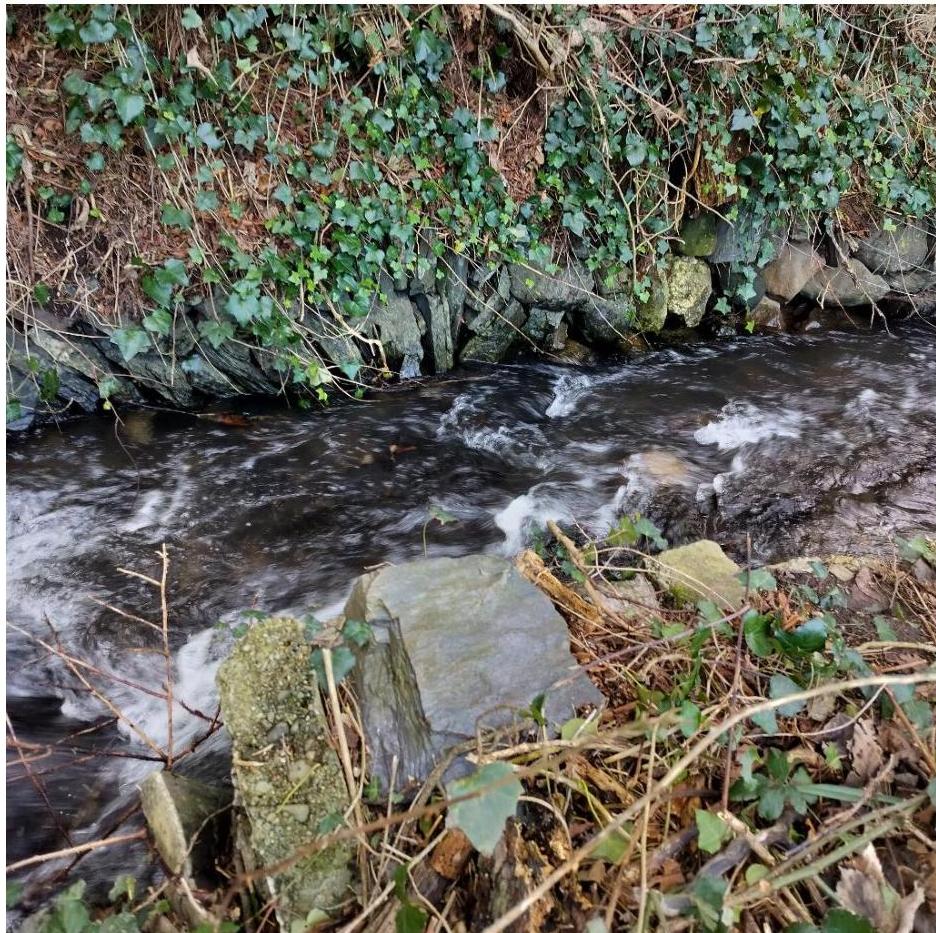
Figure 1. The Glen Stream as it passes through Bishopscourt – one of several instances of natural but historically managed water features on the site.
This statement supports a request for permission to provide two new bore-holes for Bishopscourt. The site of the Isle of Man’s historical episcopal palace and its old theological college buildings, staff cottages and ornamental and kitchen gardens is presently under an extensive programme of restoration and improvement, of which this application forms one part of the modernisation of services approved in previous applications. Bishopscourt’s water needs were historically met by the spring in the Bishopscourt Glen, in the form of the stream which runs through the Bishopscourt gardens and the culvert which runs beneath the house. By 1902 spring water was piped via a four-inch iron pipe from the lowest of the millponds in the Glen directly to Bishopscourt, a connection since lost after the Glen passed into the hands of the Manx Government, the fields to the south of the main Michael-Ballaugh road were sold off and the route of the pipe was interrupted by a new house beside the Glen. In the later 20th century Bishopscourt was provided with mains water from Kirk Michael, a connection the applicant wishes to retain.
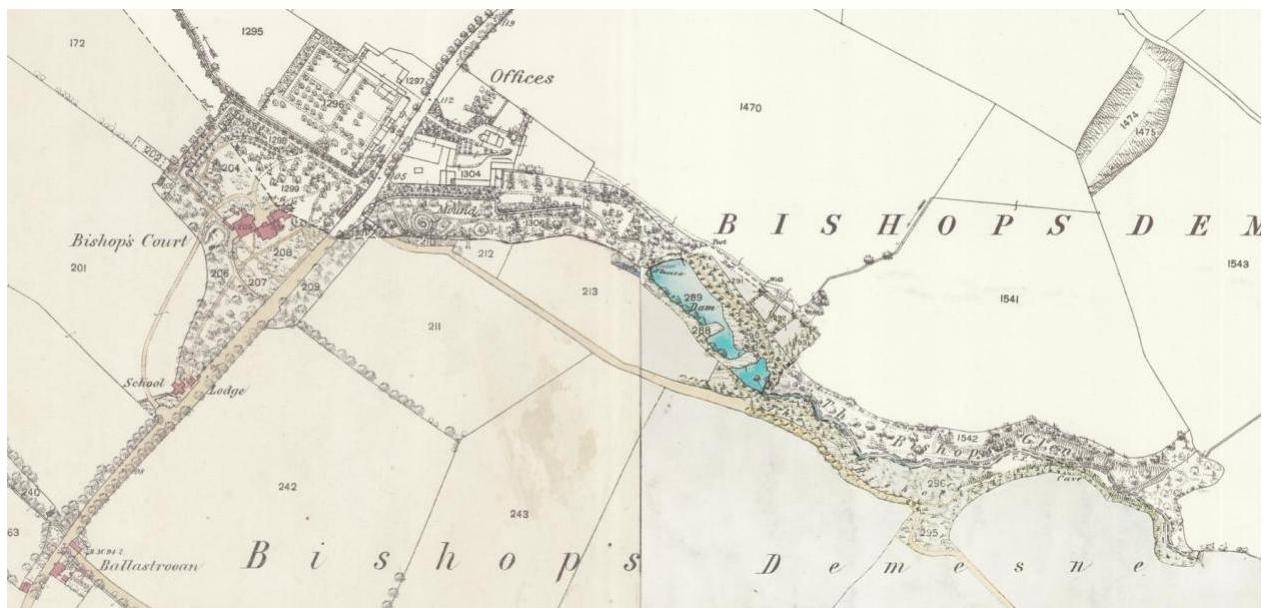
Figure 2. The 1870 Ordnance Survey showing Bishopscourt (left) and the Glen (right) with its stream, mill-ponds and spring which provided water to Bishopscourt, its gardens and two home farms. [National Libraries of Scotland]
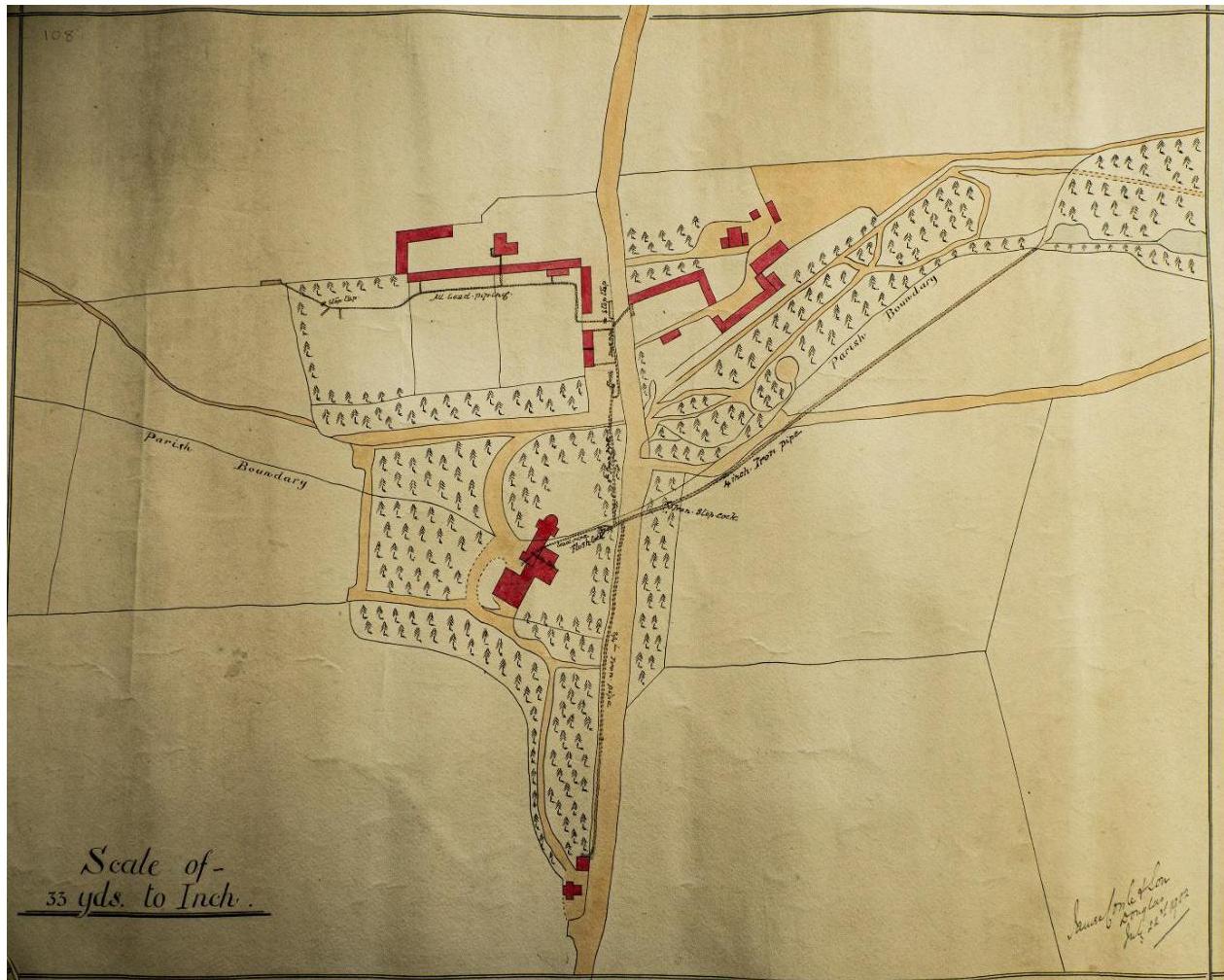
Figure 3. The 1902 water plan for Bishopscourt, showing a network of iron and lead pipes taking water directly to the episcopal palace and its outbuildings and troughs. [Manx Museum]
Ongoing field and archival research into the history of Bishopscourt’s landscape is informing the development of proposals for the restoration of the ornamental and kitchen gardens. This has led to a better understanding of surviving and historical water features, some of which were visible and ornamental and some hidden and utilitarian but including: the spring, stream and mill-ponds; stone and brick-built culverts; ceramic, iron and lead pipes; utilitarian and ornamental wells; troughs; stopcocks and drainage ditches.
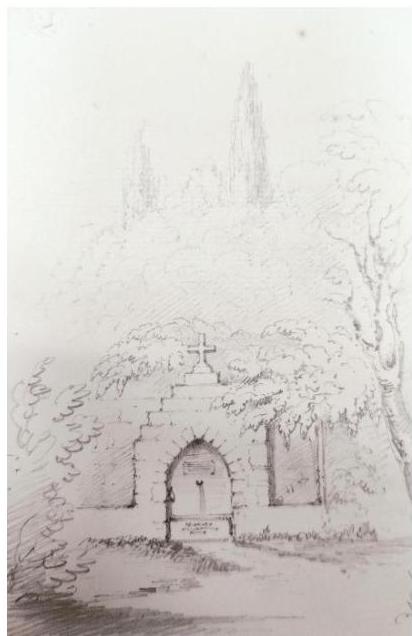
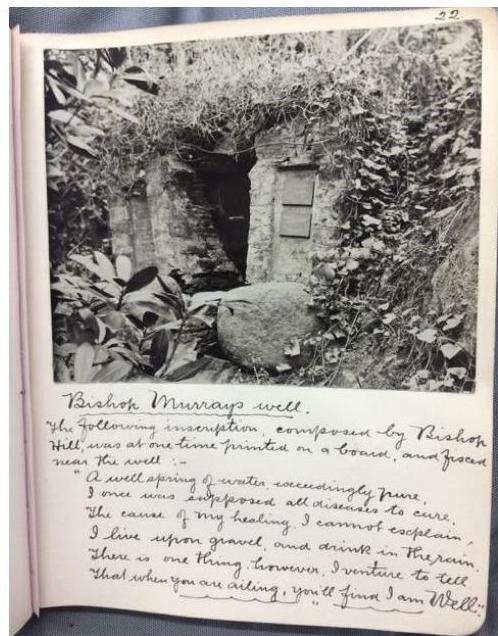
Figure 4. & 5. A drawing of a holy or picturesque well found at Keble College, filed with papers associated with Bishopscourt and not yet understood; a photograph of an ornamental well in the Bishopscourt Glen, loaded with poetic inscriptions and by tradition associated with Bishop Murray [Keble College & the Manx Museum]
The restoration of the buildings and gardens – which includes modernisation and rationalisation of the water supply, drainage, rainwater goods and rainwater harvesting would benefit from the extra provision of bore-hole water, relieving consumption of mains water and taking responsibility for Bishopscourt’s own supply. Hydrological factors which require consideration are detailed in the accompanying report by hydrogeologist Nick Mannix. The locations of the proposed pair of boreholes are shown on the accompanying drawings: one within the new plant farm behind the 2001 garage, the other within the walled kitchen garden. The built form of each bore-hole will be a drum-shaped masonry structure 1m tall and 1.2m in diameter – these will follow best practice guidance for the construction of bore-hole well-heads. In due course, separate applications will be submitted for small ornamental structures to encompass these utilitarian features and tie them into the restored historical landscape. Subterranean tanks are proposed adjacent to the bore-holes, one buried beneath the 2001 garage, the other buried in the ground of the Kitchen Garden. Their sizes will be determined after initial drilling provides more information as to the nature of the expected water supply.
It is hoped that the responsible provision of another layer to Bishopscourt’s water supply will support the comprehensive restoration of its buildings and gardens, an endeavour of great benefit to built heritage on the Isle of Man generally and for the biodiversity locally.
RK/6296 RP March 2025
Copyright in submitted documents remains with their authors. Request removal
View as Markdown