Planning Statement In Support Of Installation Of A Replacement Garage Door, 12/14, Back Berkeley Street/Albany Lane Douglas
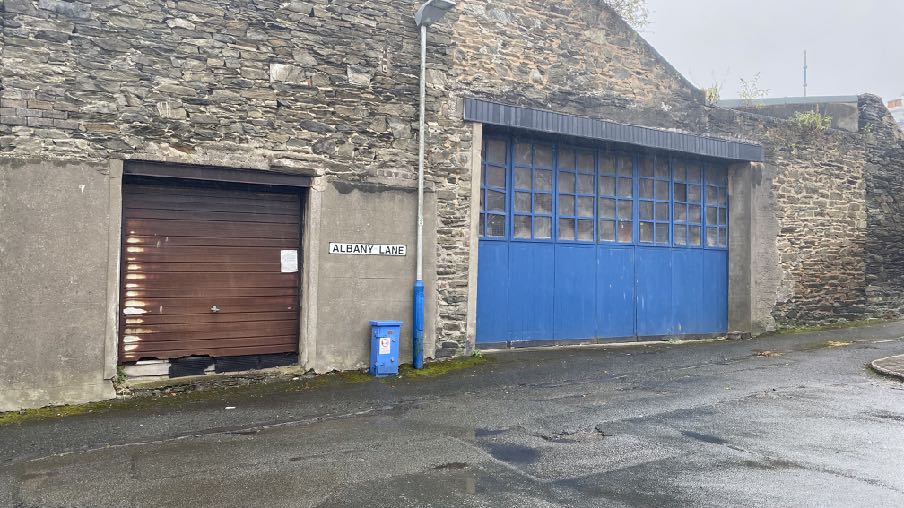
A street-level photograph showing a stone building with two large garage doors, one brown and one blue, located on Albany Lane.
1.0 INTRODUCTION
1.1 The application site is the footprint of an existing industrial building which fronts onto Albany Lane and backs onto Berkeley Street Lane in Douglas. Albany Lane runs perpendicular to Albany Street to the north, the latter being a residential street with no on site vehicular access or parking from Albany Street and each property having low rendered walls with railings atop.
1.2 The residential properties to the north east of the application site are arranged in a long terrace of almost identical (apart from some properties having pitched roofed dormers in the front pitch) two storey dwellings with single storey angled bays with slated roofed, otherwise flat frontages and vertical window and door openings, some with the original sliding sashes and many with more modern casement replacements.
1.3 The terrace on the north western side of the application site - odd numbers 1-17 - is finished in brick with round headed front doors, curved headed first floor windows and all have dormers.
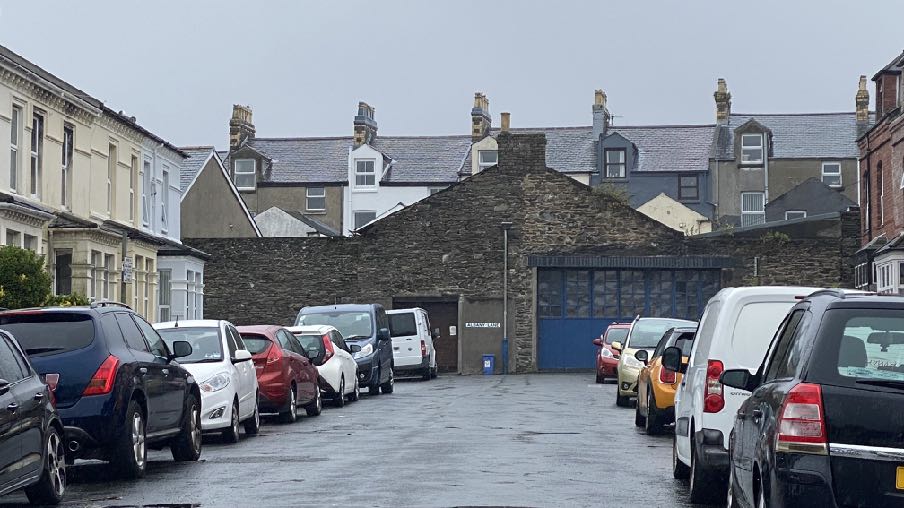
1.4 The industrial buildings contrast with the dwellings inasmuch as they are mostly stone faced, of differing heights and with a variety of roof pitches. The buildings on Albany Lane towards Brunswick
A street-level photograph showing a row of parked cars in front of a stone building with a blue garage door and a smaller pedestrian door, with terraced houses in the background.
Road are relatively plain with no doors and with the rendered side elevation of 6, Brunswick Road at the end. Towards Woodbourne Road, the buildings become smaller units from the application side to the north east, with more residential proportions and a shop frontage appearing on the corner of Albany Lane and the short lane which links Albany Lane and Berkeley Street with Berkeley Street Lane running parallel to and between the two.
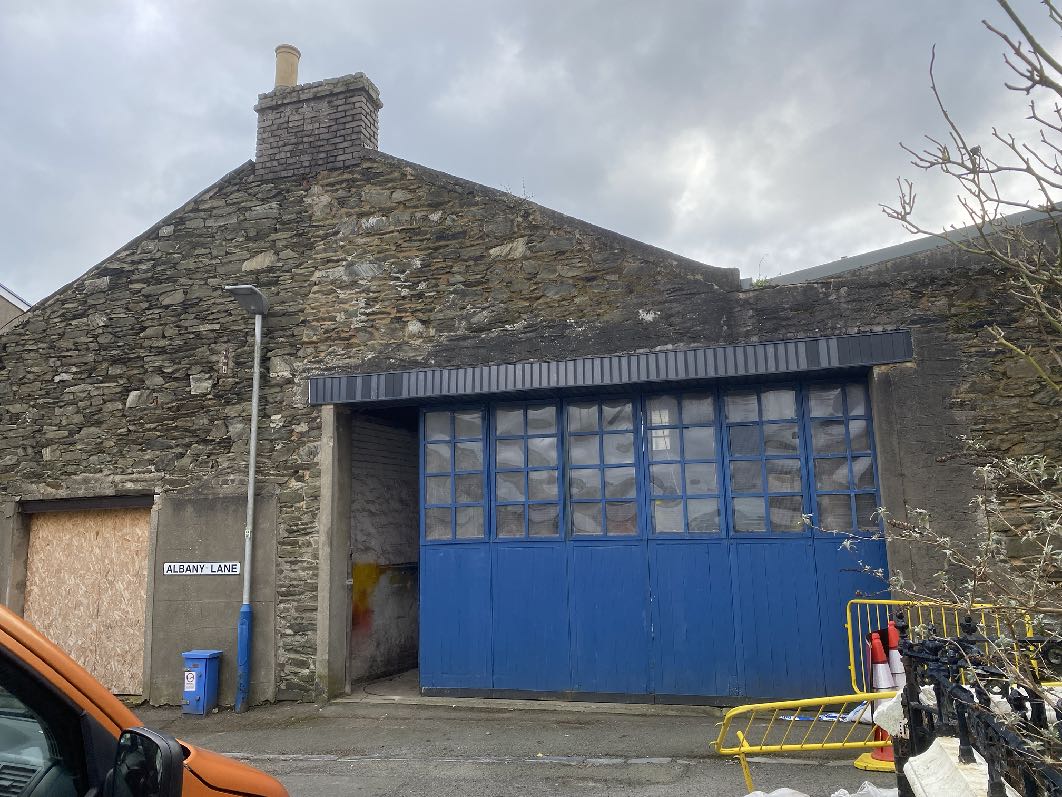
1.5 The application site building is a stone faced structure with a pitched roof whose gable faces Albany Street. Within this front elevation are two doors - a large garage door which has a long concrete lintel above it and the door is sectional and slides around to open. The other door is smaller and to the north east and is a simple up and over garage door. The existing door has been in situ since approximately 1950. The building has historically been used for garaging coaches, a taxi and a minibus in the 1950s and 60s and as a workshop for the maintenance of the owner’s vehicles. Since the late 1980s the building has been used for commercial storage as well as vehicle storage and workshop and by an electrical contractor for storage purposes.
1.6 The most recent use of the building is for the storage of vehicles plant and equipment by a local commercial garage owner. The existing old heavy wooden doors which are in poor repair and highly difficult to open and close rendering the garage effectively unusable and the doors are not secured on their rails.
2.0 PLANNING POLICY CONTEXT
2.1 The site lies within an area designated on the Area Plan for the East as Predominantly Residential. The site lies within the Selborne Drive Conservation Area. The Conservation Area Appraisal refers to the Albany Street and Berkeley Street area as being “quite tightly packed” (paragraph 3.9) and development occurring in the 1880s an onwards with the 1860s maps showing this area as rural hinterland to what was Douglas at that time.
2.2 There are no references to the stone buildings along Albany Lane.
2.3 The site is not shown as being at risk of flooding other than a low risk of surface water flooding from a route running along Albany Lane not dissimilar to the other lanes in the area.
2.4 The site is not shown as being of ecological or any other particular interest on or in any published planning document.
2.5 Development within Conservation Areas (CAs) is expected to preserve or enhance the character and appearance of the CA (Environment Policy 35 and Planning Policy Statement 1/01 - Conservation
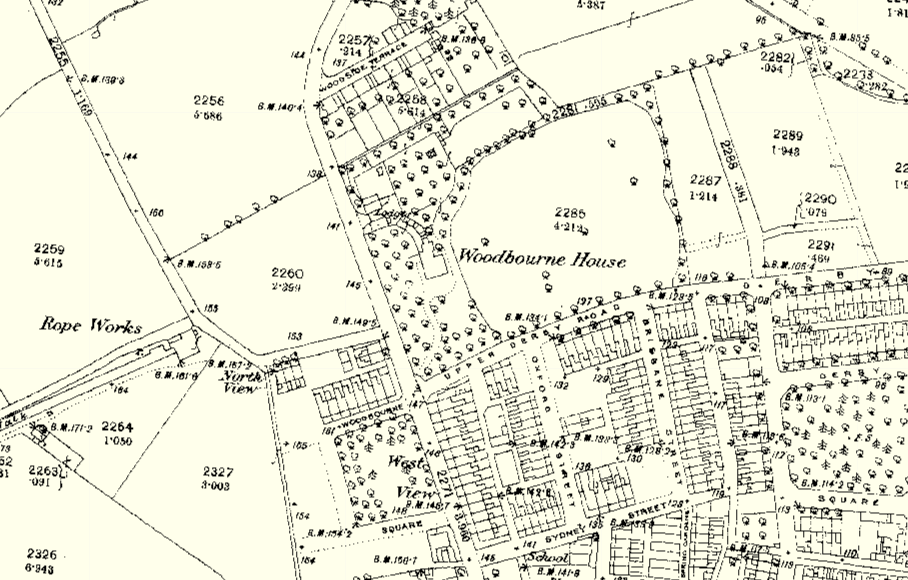
This image displays a historical site plan or OS map extract featuring 'Woodbourne House' and surrounding properties. It illustrates property boundaries, tree symbols, and road layouts in a rural context.
of the Historic Environment of the Isle of Man CA/2) and development within CAs is expected to protect the fabric and setting thereof (Strategic Policy 4).
2.6 “In the maintenance, alteration or extension of pre-1920 buildings, the use of traditional materials will be preferred” (Environment Policy 34).
2.7 There is a “general presumption will be in favour of retaining buildings which make a positive contribution to the character or appearance of the Conservation Area.” (Environment Policy 39).
2.8 There is a drive to support brownfield development rather than building on undeveloped land. Strategic Policy 1 promotes the optimisation of the use of previously developed land, redundant buildings, unused and under-used land and buildings, and reusing scarce indigenous building materials. Strategic Policies 2 and 10, Spatial Policy 5 and Transport Policy 1 direct new development to existing settlements and are further supported by various additional initiatives such as the Unoccupied Urban Sites programme, Comprehensive Treatment Areas and the Island Infrastructure Scheme. Whilst the site does not lie within a specifically identified regeneration area, these initiatives nevertheless demonstrate Government’s commitment to brownfield development and urban regeneration.
3.0 PLANNING HISTORY
3.1 Albany Lane has seen a number of applications considered for alteration and in some cases, complete redevelopment of the existing buildings.
3.2 The application site itself has been the subject of these applications:
85/00323/C - use of premises for taxi repairs and servicing and first floor office and erection of aerial
refused
87/00061/C - change of use to building trades store and workshop - permitted
04/02162/C - change of use of existing premise for the fabrication of railings, gates, walkways and fire escapes - refused for reasons relating to noise, parking and traffic in a predominantly residential area
3.3 The most pertinent application is 06/02173/B which relates to the current application site and proposed the replacement of the existing wooden door fronting onto Albany Street with a metal roller shutter door which was refused at appeal on 25.09.2007. The reason for refusal was as follows:
“The installation of a metal roller shutter door would be contrary to Planning Policy Statement 1/01 and Environment Policy 39 [sic - should be EP 35] of the emerging Isle of Man Strategic Plan in that the replacement door is a poor substitute to [sic] the existing timber doors, in terms of design, external appearance and use of materials, particularly within a Conservation Area. The proposed development will not preserve or enhance the character and appearance of the Conservation Are to the detriment to [sic] the visual amenities of the street scene.”
The inspector reaches the following conclusions:
“The arguments about finance, vandalism, future redevelopment and maintenance are understood. They are material considerations. But when these arguments are balanced against the planning merits of this scheme they only have limited weight. It would often be argued that it would be cheaper and easier to place an unattractive structure in a Conservation Area, rather than place a suitable structure that enhanced and preserved the character and appearance of the Conservation Area. The argument about the nearby smaller roller shutter door and the fibre glass roof are also not sufficiently convincing just because they are modern and rather unattractive features on a building is not a good reason to provide more unacceptable features on the same building in the Conservation Area. It follows that the proposed metal roller shutter door would not enhance or
preserve the appearance and character of the Douglas (Selborne Drive) Conservation Area - and thus the metal door would be unacceptable.
One final matter is the precise design of the proposed metal roller shutter door. At the inquiry the precise colour and design of the proposed were not known. Colour was suggested - dark grey - and wooden panels were mentioned. But precise details were not submitted to the inquiry. In a Conservation Area, it is invariably important to know the precise details of new development, in order to accurately assessment the impact. Absence of these details did not help consideration of the proposal”.
3.4 The site to the south west - the workshop and store that sit alongside 6, Brunswick Road has been the subject of these applications:
13/91190/B - Demolition of existing light industrial units and erection of two light industrial units with ground floor storage, first floor offices and associated parking and drainage - permitted at appeal
20/00932/B and 20/00933/CON - partial demolition of the existing building and filling of external walls - permitted
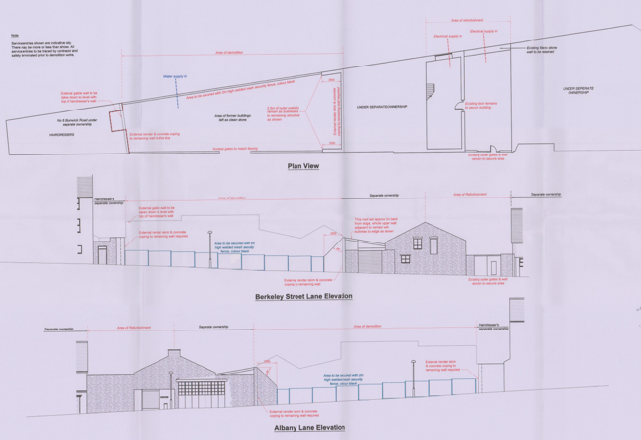
Architectural drawing displaying a plan view and elevations of a property at a street junction with boundary and fence details.
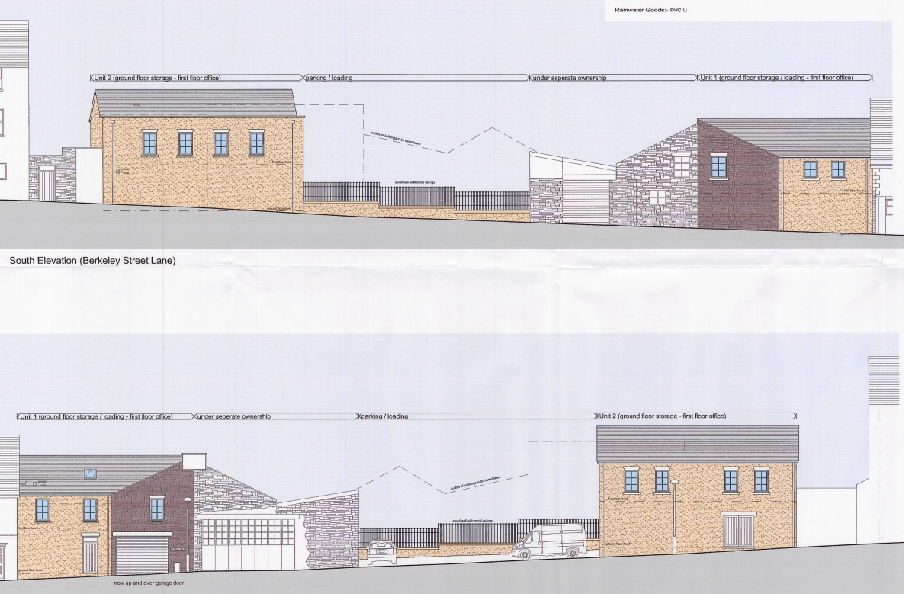
3.5 The workshop alongside the application site, 4, Berkeley Street Lane - was the subject of thefollowing applications:
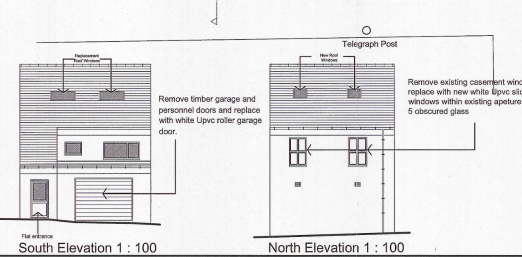
Architectural elevations showing the South and North facades of a residential property with annotations for replacing a garage door and windows.
86/01192/B - alterations and extensions to enlarge premises - permitted 90/00863/A - approval in principle for conversion of workshop/store to dwelling - refused
3.6 The building alongside 4, Berkeley Street Lane - 3, Albany Lane - was the subject of an application for the conversion of the garage to additional office space - 01/00220/B and was refused.
Prior to that, 96/01394/C proposed the change of use of the workshop offices for use by the Manx Churches Adoption and Welfare Society and was permitted. A subsequent application to vary the condition of this approval to allow the use of the building by other people was permitted - 14/00805/ C.
3.7 2A, Berkeley Street Lane, the penultimate building in the terrace to the north east of the application site, was the subject of an application for the conversion of the joinery workshop into residential accommodation including the installation of a replacement garage door - 13/90961/B - and was permitted.
Prior to this, the site was permitted for the roofing over of the yard and installation of fire exit -
87/00339/B.
3.8 Finally, the end building which sits on the corner of Albany Lane and the short lane linking this to Berkeley Street and Berkeley Street Lane, was the subject of the following applications:
08/02133/B - subdivision of existing shop unit and existing self contained residential accommodation permitted.
4.0 THE PROPOSAL
4.1 Proposed is the replacement of the side sliding door on the front of the building.
4.2 The proposed door will be sectional and open up and over as shown in the attached details. The door will be coloured blue similar to the existing and will include windows in the top section and a pedestrian door within the main frontage.
4.3 As the proposed door is slightly smaller than that which it replaces, the opening will be reduced by 864mm and a new rendered panel is proposed on the left hand side, matching that already on the right where the original opening has already been reduced in size and brickwork introduced. Both panels are and will remain unpainted.
A street-level photograph of a stone building featuring a large blue garage door and a smaller boarded opening, situated on Albany Lane with construction barriers nearby.
5.0 ASSESSMENT
5.1 The retention of this building should be encouraged and in order for the building to be retained, it needs to be secure and fit for purpose. Whatever the building is used for, the means of access needs to be secure and the current door, dating back several decades, is not so.
5.2 Following the previous refusal, the applicant has reconsidered the proposal and has sourced a door which provides the ease of use and security which they require whilst at the same time, providing something which achieves an acceptable visual impact. The proposal will preserve the building through enabling its secure use and will have a neutral impact on its appearance - retaining the colour of the existing but in a style which retains the style of sections below and glazing above, in a form which takes up the least space internally.
5.3 Pre-submission discussion with the Registered Buildings Officer - where we provided the details shown in the application - resulted in his comment that “Whilst the proposed door is not as traditional in its form that those I suggested (as you say), given the location and the modest scale of the door in question, I would consider the proposed door to be acceptable in terms of preserving the special character and appearance of the conservation area.”
5.4 The installation of this door will contribute positively to the character and appearance of the area, thus complying with Strategic Policy 4, Environment Policy 35 and Planning Policy Statement 1/01 Conservation of the Historic Environment of the Isle of Man CA/2. Whilst the material to be used is not traditional, it contains a textured effect which will provide a more subdued finish. The use of plain unpainted render on the left hand side to account for the slight reduction in the size of the opening is considered acceptable as it matches that on the other side of the opening and we also considered that trying to match new stone work in with older fabric is likely to be unsuccessful.
5.5 The continued use of the building, facilitated by the replacement door, will support Strategic Policies 1, 2 and 10, Spatial Policy 5 and Transport Policy 1 of the Strategic Plan and the brownfield initiatives for the Island and enabling the site to continue to provide an increasingly rare opportunity for a light industrial use in a old building within the capital city.
Sarah Corlett 24.02.25
Copyright in submitted documents remains with their authors. Request removal