Loading document...
Our Ref: CW20-921-LS 001
11th November 2024
Collington Winter Environmental Ltd were instructed by Mr and Mrs Williams to produce a letter statement to discharge Condition 6 which forms part of the proposed planning application, to allow for the conversion of the northern aspect of the barn into new holiday lets. The southern aspect of the barn is currently used as a holiday let and therefore is not subject to the development. The condition states:
“Prior to the installation of external lighting within the site, a Lighting Plan shall be submitted and approved in writing by the Department. The lighting of the site will be designed utilising inward directed led lighting columns to provide required site illumination without creating light pollution. The development shall not be carried out other than in accordance with the approved plan and shall be retained as such thereafter.” Reason: To provide adequate safeguards for the ecological species existing on the site.
The site was found to support roosting soprano pipistrelles (Pipistrellus pygmaeus), common pipistrelles (Pipistrellus pipistrellus), natterers myotis (Myotis nattereri) and brown long-eared bats (Plecotus auritus) from nocturnal bat surveys undertaken in 2022 and 2023 (Please refer to the Bat Survey Report for further details). It is understood that the natterers myotis roost is not to be impacted by the proposed development, however, they are anticipated to utilise the surrounding site for commuting and foraging purposes.
Roosting soprano pipistrelle, common pipistrelle and brown-long eared bats will be impacted by the proposed development. All roosting species were also identified commuting and forging over the grassland and within the adjacent habitats confirming its value for local bats. A woodland with a large pond (also under the client ownership) adjacent to the barns is anticipated to be of high value for foraging bats and may provide further roosting opportunities.
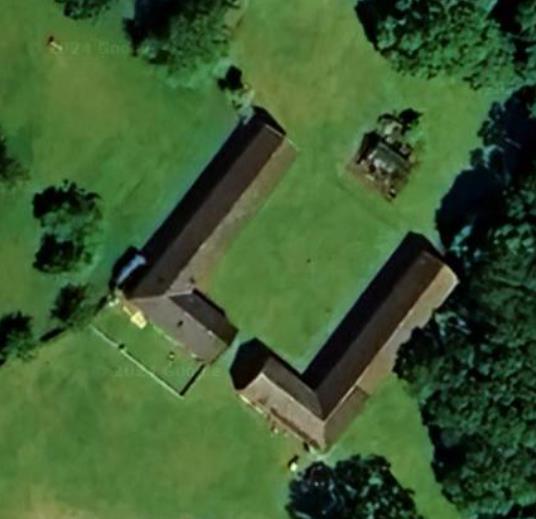
A second barn is located adjacent to the site (see Figure 1) this is not a part of the proposed developments. An access window has been installed on the northwestern aspect of the building to allow bats to access this barn. Bat droppings have been identified within the barn which are to be sent for eDNA analysis, these confirm that bats are present within this building also.
As bats are known to roost in both buildings within the client’s ownership it is anticipated that bats will commute between the buildings. The second barn is not to be impacted by the proposed development and a bat barn is to be constructed nearby in the woodland adjacent as part of the mitigation and EPSML bat licence.
Figure 2.1 Blue indicates barn section to be converted, and the red indicates the existing holiday unit. Yellow indicates the adjacent barn which also support roosting bats (Roosting area marked with circle).
The proposed development holds the risk of disturbance to foraging and commuting bats in the event of poorly designed lighting and without a detailed lighting mitigation plan.
There is a risk that without the correct lighting design the bat roosts already present could become unfavourable to bats or indeed cause an overall loss of bat roosting opportunities which is not permitted. It may also affect the uptake of the new bat barn should ambient light levels fundamentally change the existing site conditions.
Whilst foraging and commuting behaviour may be affected (BCT 2018), particularly on slow-flying species (i.e., brown long-eared bats and myotis species) which are less tolerant to light. UK species have been recorded avoiding gaps that are well lit, thereby creating a barrier effect (Hale et al 2015). Green light has been shown to not only impact upon foraging bats but also those which migrate throughout Europe.
However, it should be acknowledged that artificial lighting has some benefits for more light tolerant species such as pipistrelles which are known to be present onsite. The lighting is known to attract night-flying insects an important food resource.
Artificial lighting is currently present on the external aspect of the southern cottage however this is on a manual switch used by the residents and is not left switched on throughout the night.
It is anticipated that the areas of highest lux levels will be during the construction phase on site to allow the removal of the roof and remediation works to the stone walls. The proposals do not include the introduction of any external lighting post development, therefore, as per the guidance of Bats and Artificial Lighting at Night (2023) the following measures are to be followed (Parts of this have been completed prior to writing this letter statement):
STEP THREE
Potential sources of lighting which can disturb bats are not limited to, streetlights, footpath or external security lighting, they also include light spill via windows. Glare (extremely high contrast between a source of light and the surrounding darkness — linked to the intensity of a luminaire) may affect bats over a greater distance than the target area directly illuminated.
The potential adverse impacts on the favourable habitats have also been considered. The habitats onsite and adjacent known roosting location will require an absence of artificial illumination of any sort throughout the construction phase and post development, no new lighting will be used between the buildings and in the direction of the wooded area and new bat barn to maintain a dark feeding corridor from the existing roosts and foraging areas to the new roosting provisions.
STEP FOUR
The following luminaire specifications are to be followed to ensure the adjacent habitats and roost locations remain free from additional lighting. It is understood that manual lighting is currently present within the adjacent barn (marked in yellow) and is a known roost location therefore, the proposals are not anticipated to cause impacts that are considered significant.
It is understood that the barns to be converted do currently have lighting internally on the ground floor that is used on occasion. Therefore, the introduction of converted lit cottages are not anticipated to have a significant negative impact on local bats roosting in the area. Internal designs will aim to minimise the light spill outside windows with lights that do not point towards the windows.
Lighting is not to be introduced to the front of the proposed cottages. If lighting is to be introduced to the front of both cottages externally. These lights are to be on short PIR timers and down-ward-directional, these are not to be pointed towards any adjacent habitats or potential/ known roosts. These lights will be on Part Night Control is proposed whereby the lights will switch off between 00:30 and 05:30. There is to be no further external lighting introduced into the site other than security lighting.
The lighting throughout the construction phase of the works should be kept to a minimum. There should be no lights throughout the works directed towards the adjacent barn, the proposed bat barn and the woodland adjacent to the site. The grassland surrounding the building provides foraging opportunities therefore lighting in this area should be kept to a minimum and there should be no lighting at any time pointed towards the adjacent grassland. There
are to be no works from 30 minutes before sunset to 30 minutes before sunrise to allow the known bat roosts to utilise the site for commuting and foraging purposes.
Overall, this lighting strategy has considered the presence of roosting bats as well as foraging and commuting bats within the site and adjacent areas and there is not anticipated to be any significant impact by the proposed lighting strategy, if the following conditions are considered and implemented at design and constructions phase.
Yours sincerely, Katie Brewer BSc (Hons) Level One Bat Licenced Ecologist Consultant Ecologist. Jonathan Hayter Level Two Bat Licenced Ecologist Senior Ecologist. For and on behalf of Collington Winter Environmental
Copyright in submitted documents remains with their authors. Request removal
View as Markdown