A vintage sepia-toned photograph depicting a large stone building complex labeled 'Bishopscourt, I.O.M.', featuring a chapel-like structure with Gothic windows and an adjacent house.
TO SUPPORT A PLANNING APPLICATION AND REGISTERED BUILDING CONSENT APPLICATION FOR MINOR AMENDMENTS TO APPROVED APPLICATIONS AT
Bishopscourt Kirk Michael
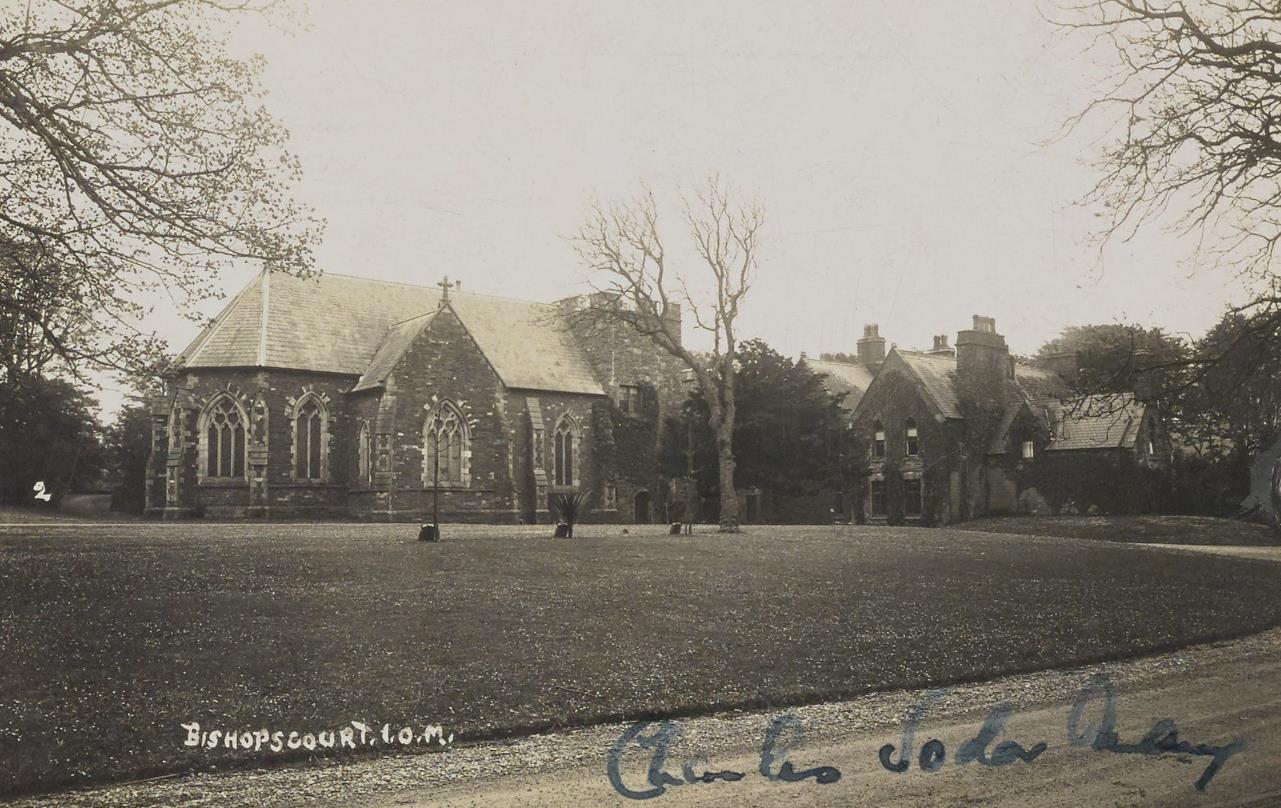
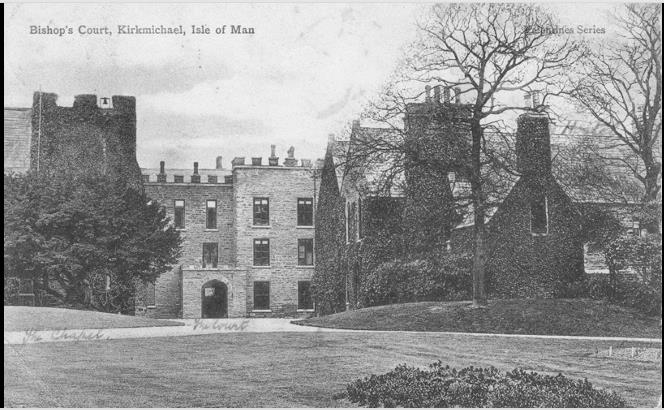
Figure 1. Bishopscourt from the North, signed by Bishop Thornton-Duesbury (Charles Sodor Man) between 1925 to 1928. Despite a short episcopate he made practical improvements to Bishopscourt, installing electricity and upgrading the Kitchens. The trees planted by the Royal Family in 1920 and the plaques which mark them have not yet been moved to their present-day positions. The Bake House wing with its chimney (far right) has not yet been truncated by 2.4m nor the gable rebuilt without the chimney.
RK/6296 17 September 2024
Planning Statement For proposed amendments to approved applications at Bishopscourt Kirk Michael, Isle of Man IM6 2EZ
Contents
1.0 Introduction & Site Context page 03
2.0 Historical Background page 05
3.0 Proposals page 06
4.0 Conclusion page 15
1.0 INTRODUCTION & SITE CONTEXT
1.1 This planning statement has been prepared for the purpose of supporting a planning application and registered building consent application for these three areas:
• The installation of a man-safe system to the roof of the Main House;
• The conservation, repair and renewal of existing external lintels; and
• The reinstatement of a mid-nineteenth century internal wall and baking oven with chimney to the existing gable wall of the Bake House.
• The introduction of a ventilation grille for new fireplace in the Great Hall and a new rainwater pipe and hopper to the Tower.
1.2 The application is submitted by ADAM Architecture, acting as Agents for the Applicants, the present owners of Bishopscourt.
1.3 This document aims to explain the methodology and justification for the proposals in design and heritage terms, and should be read in conjunction with the application drawings.
1.4 Bishopscourt comprises the episcopal palace associated with the Bishops of Sodor and Man and, with a collection of associated structures including utilitarian outhouses, as well as the Chapel to the north east side of the group is designated a Registered Building by the Isle of Man Government (RB No. 1, 23rd May 1983). The estate is located to the north west side of the Main Road (A3) leading north from Kirk Michael to Ramsey and close to the west coast of the island in a relatively open landscape close characterised by agricultural enclosures, pastures, woodland and scattered dwellings.
1.5 Bishopscourt is a Registered Building (Isle of Man Government, Code MH/H/R/A, RB No. 1, 23rd May 1983) comprising the principal mansion house and the ‘buildings contiguous therewith’. It is located beyond the boundaries of the nearest Conservation Areas, including Kirk Michael to the south (designated 2006) and Glen Wyllin Conservation Area (also designated 2006); and the Ramsey Conservation Area (Planning Amendment Order, 1992), albeit at some distance to the east. Each is beyond the scope of the subject site, and their setting is not affected.
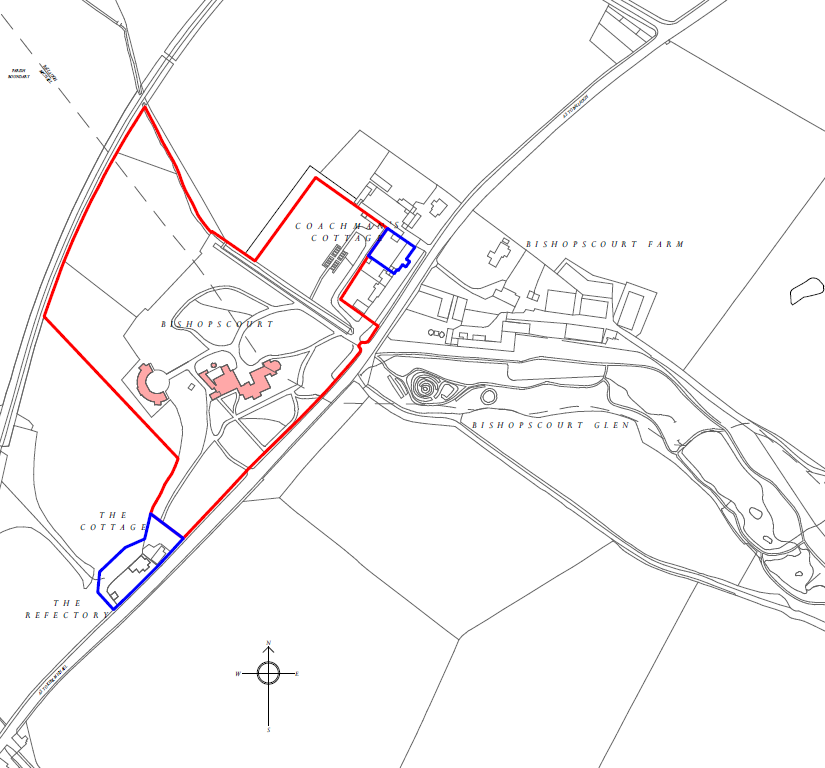
Figure 2. Existing site plan showing the location and context of Bishopscourt
A black and white site plan showing the layout of Bishopscourt, Coach House, and surrounding properties with red and blue boundary lines.
2.0 HISTORICAL BACKGROUND
2.1 The extant structures at Bishopscourt constitute an exceptional group of buildings, including the main house and the Chapel of St Nicholas, the former private chapel to the Bishop of Sodor and Man. It was designated a pro-cathedral in 1895 (until 1979 when the house was sold.) On initial inspection the buildings collectively appear to date from the 17th to the 19th and up to the late 20th centuries, although the original peel tower, much altered and ‘domesticated’, retains 14th century fabric.
2.2 Segments of the principal structure suggest a style which is redolent of the defensive towers in Cumbrian style built to withstand unrelenting border raids, infused with an eccentric fusion of Scottish Baronial architectural vigour and the unadorned vernacular form. If there is a distinctive heterogeneity in the historic demographic of the island characterised by a mingling of populations from Scotland, Ireland, and England, then Bishopscourt represents their collective aesthetic input, alongside the patronage of a succession of episcopal tenants, some more determined contributors than others to the form of the building; others apparently never even visited, considering the island ‘barbaric’.
2.3 The historical evolution of the site at Bishopscourt is elaborate in its complexity and it has been significantly transformed since its inception in the 13th century as a timber edifice, of which no obvious trace survives. Its 17th century form would have resembled a structure similar to the extant Yanwath Hall in Cumbria, although there have been multiple changes to the external form and interior aesthetics, especially after the 1893 fire at Bishopscourt, which ‘completely gutted the central portion of the interesting historic building… [it] appears to have originated in the Bishop’s study, in which were stored valuable and historic Church documents and records which have been destroyed.’ Early views of Bishopscourt of the mid-17th century by Daniel King prepared post-surrender of the Isle of Man during the Civil War ‘formed a visual supplement to a written report commissioned by the Lord Mann, Thomas, Lord Fairfax appointed by Parliament in the place of James Stanley, 7th Earl of Derby, staunch Royalist’ and confirm substantial modifications to a structure which is labyrinthine in its complexity, chronology, and surviving elements. Many additions and alterations were made throughout the 19th century and the early 20th century, all of them detailed in previously submitted heritage reports.
2.4 The proposals included in this application have arisen from a combination of new research into Bishopscourt’s history, on-site discoveries made during the construction phase and the need for the provision of safety installations to provide maintenance access. In line with previous proposals, maintaining, restoring and re-instating fabric of historical value has been the primary aim.
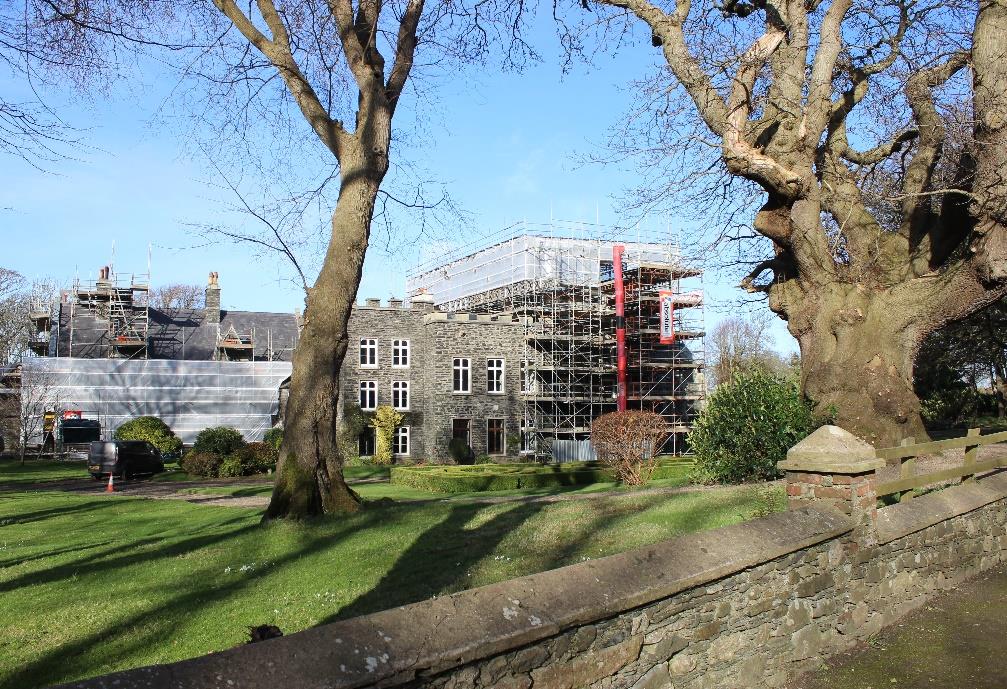
Figure 3. The restoration of Bishopscourt in progress in February 2023.
A photograph showing a large stone building undergoing significant renovation with extensive scaffolding and a red cherry picker visible against a blue sky.
3.0 PROPOSALS
3.1 Installation of a man-safe system to the roof of the old Episcopal Palace
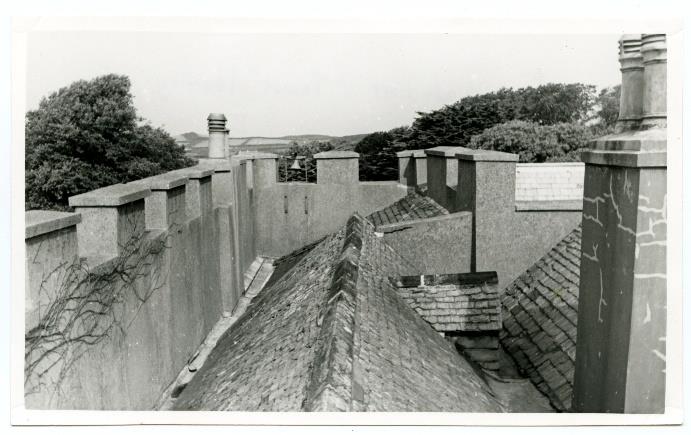
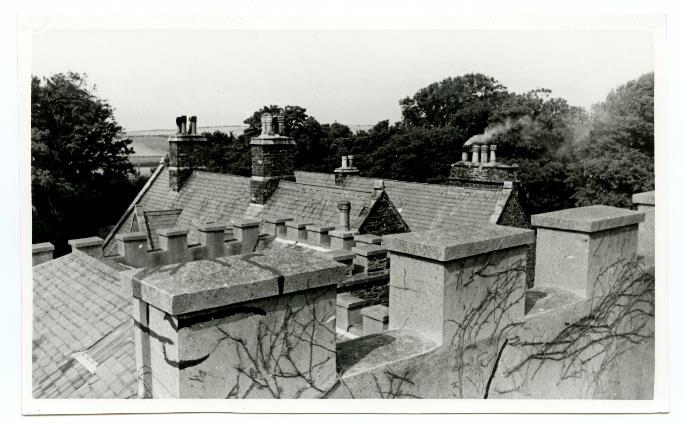
Bishopscourt’s Main House is made up of different volumes which rise at different heights – therefore creating several separate roofs which require safe access for maintenance, which the existing situation is without.
The applicant proposes to place a man-safe system incorporating a series of ridge ladders, wire fall protection systems and indicative hazard signage to ensure safe access to maintain the historic roofs, allow for leaf clearance and cleaning to all roof locations. Many of the existing roofs need repair due to limited access.
Figure’s 4 & 5. Photos dating from 1953 showing the many different roof volumes at Bishopscourt.
The proposed locations of the man-safe system are to all high roofs of the old Episcopal Palace, as shown on ADAM drawings 6296 PL 1007, 6296 PL 1008, 6296 PL 2010, 6296 PL 2011 and 6296 PL 2020. The locations have been decided by ADAM Architecture, Integral engineering and specialist man-safe consultant Arco to provide safe and optimum access to suit the requirements of the client whilst having been designed to ensure that their visibility is limited from ground level and when looking at the building’s facades.
The historical nature of the old Episcopal Palace, surrounding buildings and the wider estate has been a fundamental consideration in the design of the proposal; all materials and methods of construction proposed are sensitive to this to ensure there is no detrimental impact to the existing fabric. The proposed ridge ladders give access up and over the roofs without damaging existing slates and are powder-coated to match RAL 000-30-00 (Medium Black) to match these. The fall-restraint system uses stainless steel channels along the length of the existing purlins to ensure their stability and that they are obscured.
The proposals are minimal and do not alter the design intent of the consented scheme yet ensure the longevity and protection of the roofs and dormers. This proposed scheme has been approved in principle by the conservation officer and this application seeks to gain formal approval.
3.2 The conservation, repair and renewal of existing external lintels
The lintels to the facades of the old Episcopal Palace have in the past borne many alterations. A number of the lintels appear to be in poor condition and need repairing or replacing, many having poor repairs which are not historically appropriate for this building’s fabric.
Following a full survey and analysis from the architects and the structural engineers the applicant proposes to replace the modern concrete, brick and modern stone lintels with appropriate Manx stone lintels. These will match the historical, existing lintels and restore consistency to the facade. All new lintels are to follow the existing stone course lines and to be hand-tooled to match existing stone wall. Existing Manx stone lintels which are cracked or have lost their structural integrity will not be removed but be re-supported by stainless steel angle brackets to the enclosed Structural Engineer details on drawings 1405 SK012 and
A black and white photograph showing a high-angle view of roof tiles, a prominent chimney stack, and a long wall with a stepped parapet.A black and white photograph depicting a cluster of slate rooftops with multiple brick chimneys, set against a backdrop of trees and a stone wall in the foreground.
1405 SK002. The existing wall over them will be retained, reconsolidated and repointed in lime mortar to match the historical existing.
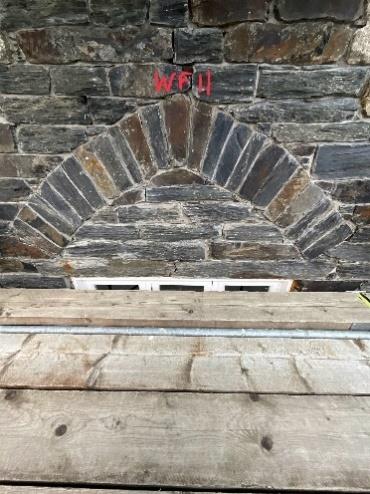
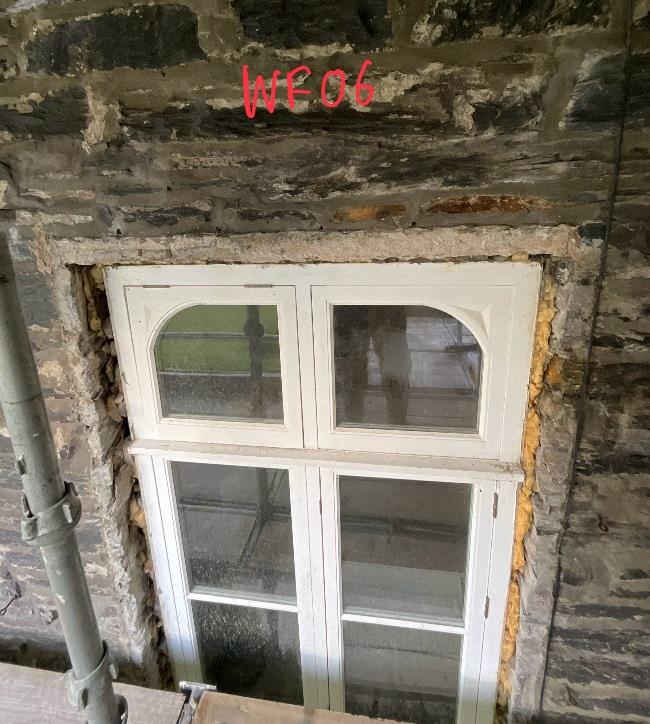
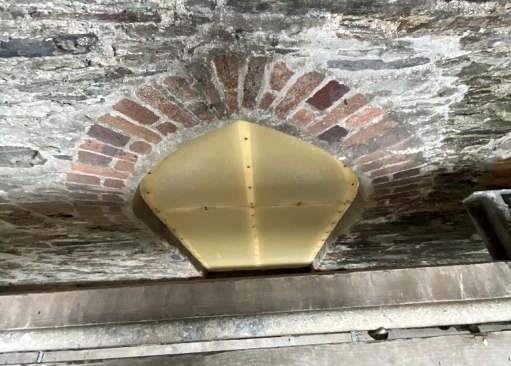
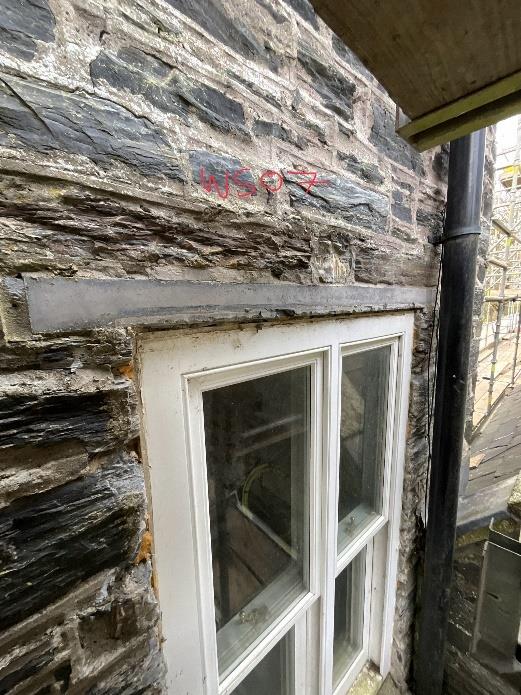
The proposed locations of the lintel repairs and replacements are shown on ADAM drawings 6296 PL 1004 – PL 1009. The modern concrete and modern stone lintels to be replaced with historically appropriate Manx Stone lintels to match the existing are predominately to the South, North and West elevations, shown on drawing PL 1005 and an example of which is shown in Figure 7. An example of an modern brick arch lintel due for replacement to the West Elevation II is shown in Figure 8, with an example of a damaged original stone lintel to the South Elevation shown in Figure 6. Here a series of existing stone lintels are to have a steel plate introduced for their support.
Figure 6. An example of an early damaged/cracked original stone lintel to the South Elevation, as shown on ADAM drawing PL 1005. It is to have a steel plate introduced for its support.
Figure 7. Example of a modern concrete lintel to the South Elevation to be replaced with Manx Stone lintels to match existing historical lintels.
Figure 8. Example of a modern brick and cement arch on West Elevation II to be replaced with Manx stone arch to match existing examples.
A close-up photograph of a white sash window set into a rough stone wall, showing scaffolding and yellow insulation foam around the frame.A close-up photograph of a weathered brick wall featuring a relieving arch and a brass metal cover plate.
Figure 9. Example of a modern slate band lintel to the North Elevation, to be replaced withManx stone to match existing.
A close-up photograph of a traditional stone wall featuring a white window frame, a grey lintel, and a black drainpipe.
3.3 Reinstatement of a mid 19thC internal wall and baking oven with chimney to the existing gablewall of the Bake House
A black and white historical photograph showing a large stone building complex labeled 'Bishop's Court, Kirkmichael, Isle of Man'. The image features a substantial property with multiple chimneys and a tower-like structure on the left.A vintage black and white postcard photograph showing a large stone building complex labeled 'Bishopscourt, I.O.M.' featuring a chapel-like structure and a residential building separated by a lawn.
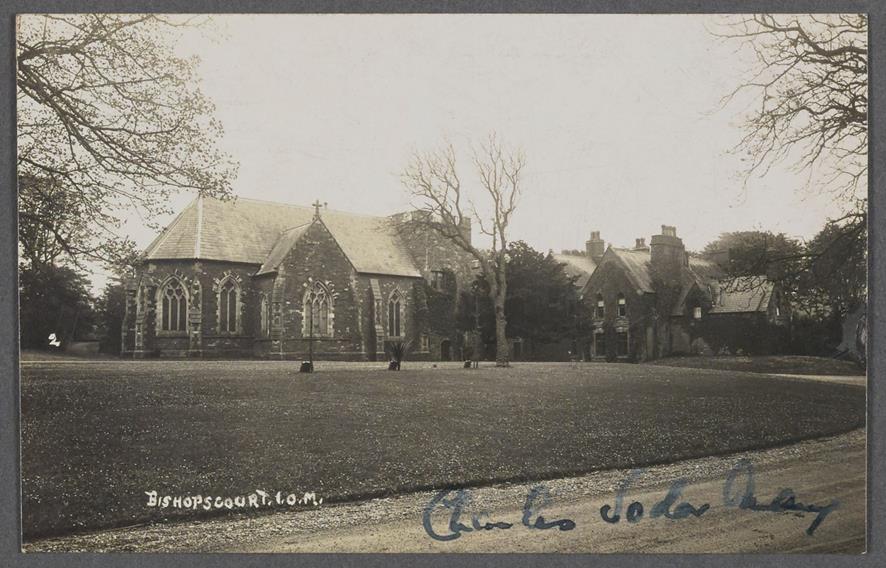
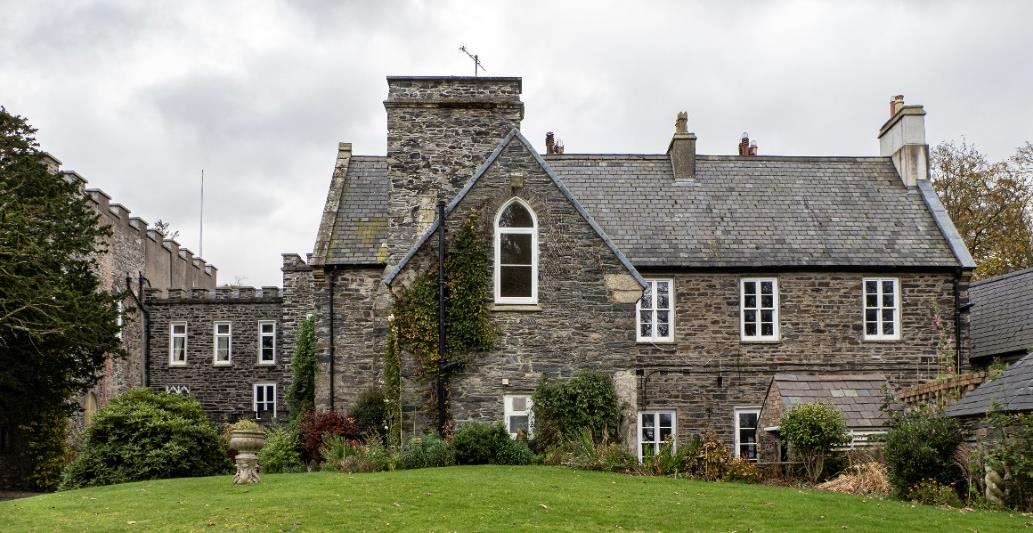
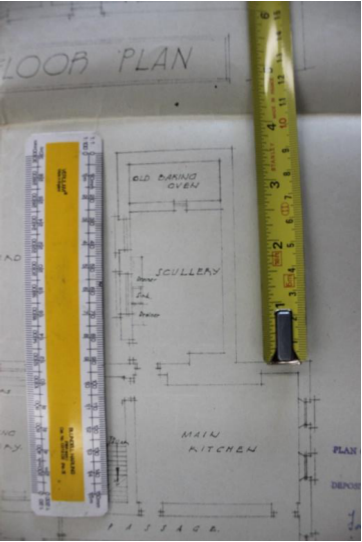
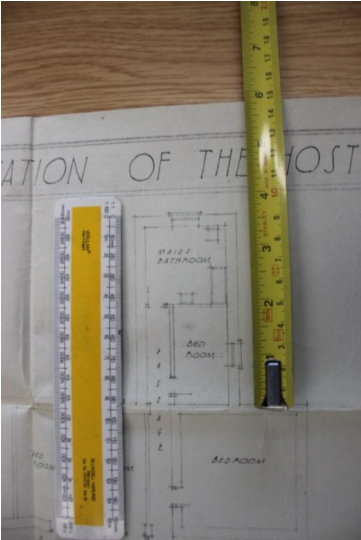
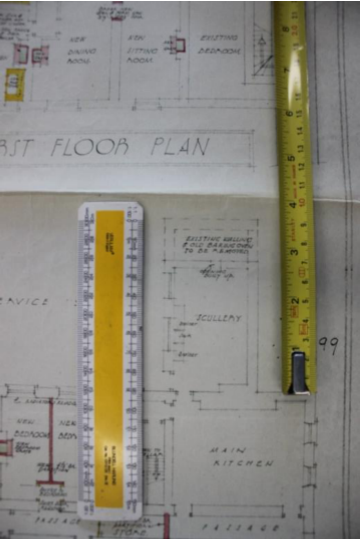
Located at the end of the Scullery Wing, the original Bake House was shortened by 2.4m in 1948, meaning that the original baking oven at the back of the Scullery, half the maids’ bath room on the first floor as well as the original gable with the large baking oven chimney were all lost. The original Scullery wing, gable end and chimney from before 1948 can be seen below in figures 10 & 11, with the shortened Scullery wing today shown in figure 12.
Figure 10. A postcard showing the original pre-1948 Scullery wing gable and chimney.
Figure 11. Photo dating between 1925-1928 showing the original pre-1948 Scullery wing’s gable and baking oven chimney. The 1948 2.4m truncation of the gable end and chimney can be compared to the
photo of the Scullery wing today below in Figure 12.
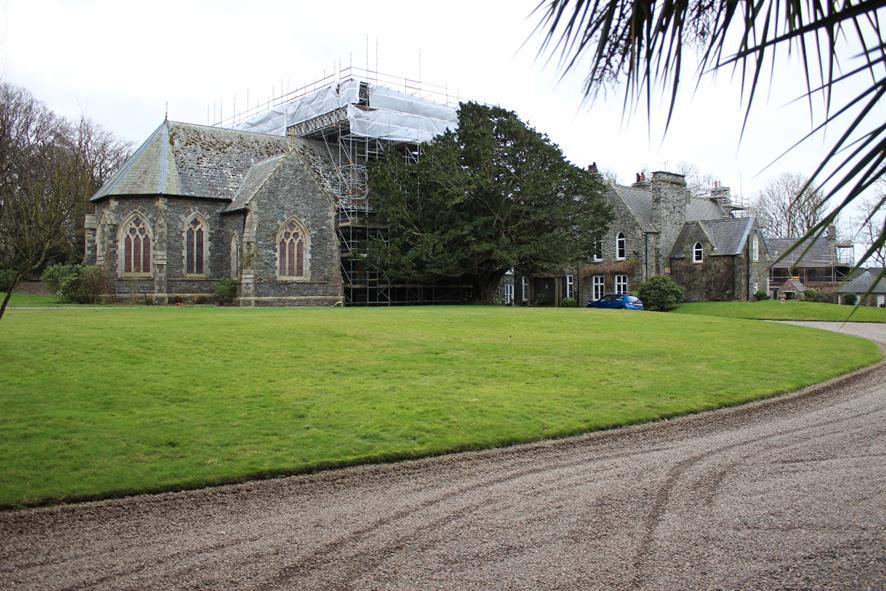
Figure 12. The Scullery wing today. The new baking oven chimney is proposed to be built rising from this existing gable to match the pre-1948 gable end as shown in figures 8 & 9.
Following the loss of the baking oven, the present gable wall was built in 1949 from the level of the first floor finished floor level up, sitting on top of the surviving old wall which divided the scullery from the bake house. The possible hatch to the baking oven in the wall was blocked up. This was then unblocked in 1958 and made into a small window, as shown in the figure below.
Figure 13. North elevation of the existing Scullery and Bake House wing showing the existing re-built gable and small window in place of the assumed baking oven hatch.
A photograph showing the exterior of a large stone building, likely a converted historic structure, featuring a prominent chimney stack on the gable end and slate roofing.A photograph showing a large stone building complex with Gothic-style windows and extensive roof scaffolding, set against a rural backdrop with a large lawn.
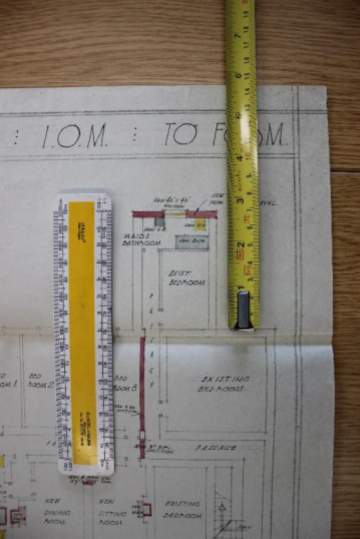
Figure 14. The Scullery wing at ground and first floor shown as being 9.2m in length on existing 1949 plans prior to the amendments.
Figure 15. The Scullery wing at ground and first floor, as shown on proposed 1949 plans. These show the proposal to shorten the wing by 2.4m to 6.8m in length, as per the existing situation on site today.
An architectural floor plan showing room layouts including a scullery and main kitchen, with rulers placed on top for scale.A photograph of an architectural floor plan showing room layouts like 'Main Bathroom' and 'Bed Room', with rulers and a tape measure placed on top for scale.A close-up photograph of an architectural floor plan showing room layouts like a scullery and kitchen, with rulers placed on top for scale.A close-up photograph of an architectural floor plan showing room layouts such as 'Existing Bedroom' and 'Existing Bathroom', with a ruler and tape measure placed on top for scale.
Permission was granted in the recent phase 10b amendment application, references 23/00253/CON and 23/00254/GB, to replace this existing small window with a timber casement window in the shape of a 19th century baking oven door, as a more intentional reminder of the opening’s former purpose and the lost structure beyond it in 1948.
Following this permission, the applicant now seeks to re-establish the original gable end and chimney, returning the far end of the Scullery wing to its original use as Bake House, with a full traditional working Baking Oven. The gable wall and chimney are proposed to be built off the existing 1949 gable end (as shown in figure 12) due to the full reinstatement of the 2.4m extension being too disruptive to the fabric. Building from the existing wall means one may match the Scullery’s original gable end and chimney in an adjusted location of the former Bake House and restore its use without extending the building footprint.
The full extent of the proposal is shown on enclosed ADAM drawing PL 3010. The drawings in both plan, section and elevation include the new working baking oven and chimney.
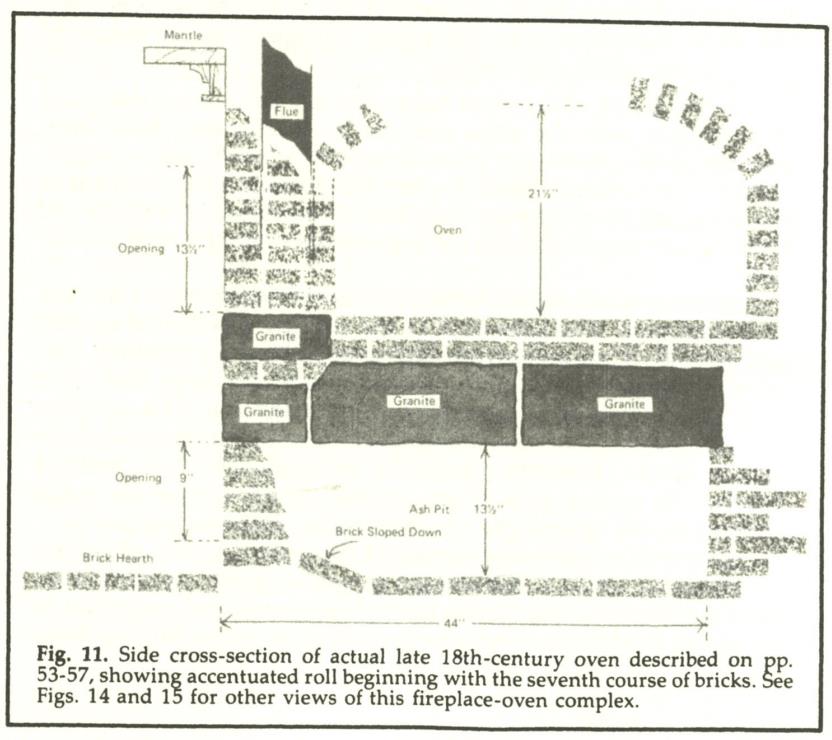
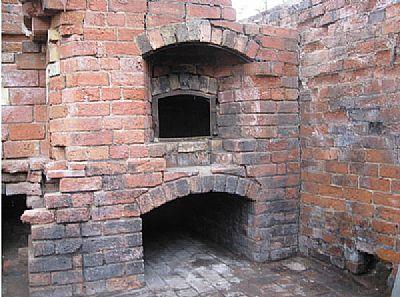
The proposed baking oven has been designed as a traditional brick-built structure with a working flue for a wood-burning fire. Extensive research has been undertaken on historical 18th and 19th Century British baking ovens. As shown on drawing PL 3010, the proposed design includes the traditional oven above with a recessed opening below for the temporary ash dump. Examples of this are shown in figure’s 16, 17 and 18 below.
Figure 16. Section of a baking oven on which the design proposal is based, taken from Richard M Bacon’s ‘The Forgotten Art of Building and Using a Brick Bake Oven.’
A technical cross-section drawing illustrating the construction details of a late 18th-century brick oven, including dimensions and material labels.
Figure 17. A brick-built Victorian Baking Oven, showing the oven opening above – missing its cast iron door – with a recessed opening below for the temporary storage of the ash scraped out from the oven.
Once cool, this was then carried out of the building.
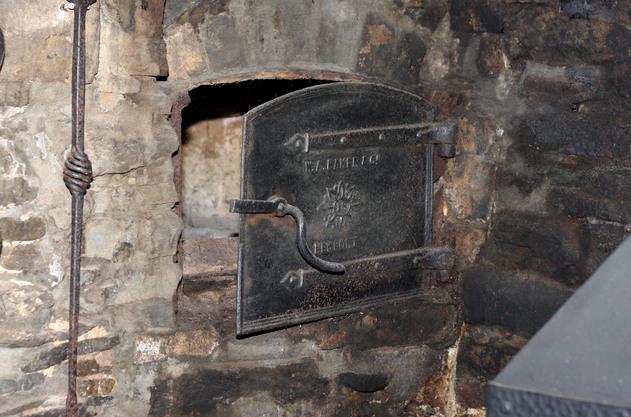
Figure 18. An example of a cast-iron baking oven door which the proposed design seeks to re-introduce.
The chimney to the baking oven is proposed to be built using coursed Manx stone to match the existing West Wing chimneys and the lost original, with a granite coping and buff clay chimney-pots. In order to reflect the original chimney design, a second flue is proposed although this is no longer required.
The proposal also shows the reinstatement of an internal wall, shown on a dated 1857 plan. This was shown to be demolished between 1857 and 1948, likely to enlarge the scullery. The plans show the proposal to include the reinstatement of this original wall to allow for the proposed baking oven to be suitably housed and separate at the end of the Scullery wing.
4.0 CONCLUSION
4.1 These proposals are based on site and archive discoveries which uncover previously unknown aspects of the building’s history and details. They provide an opportunity to re-instate original historical features and better communicate its architectural and social history.
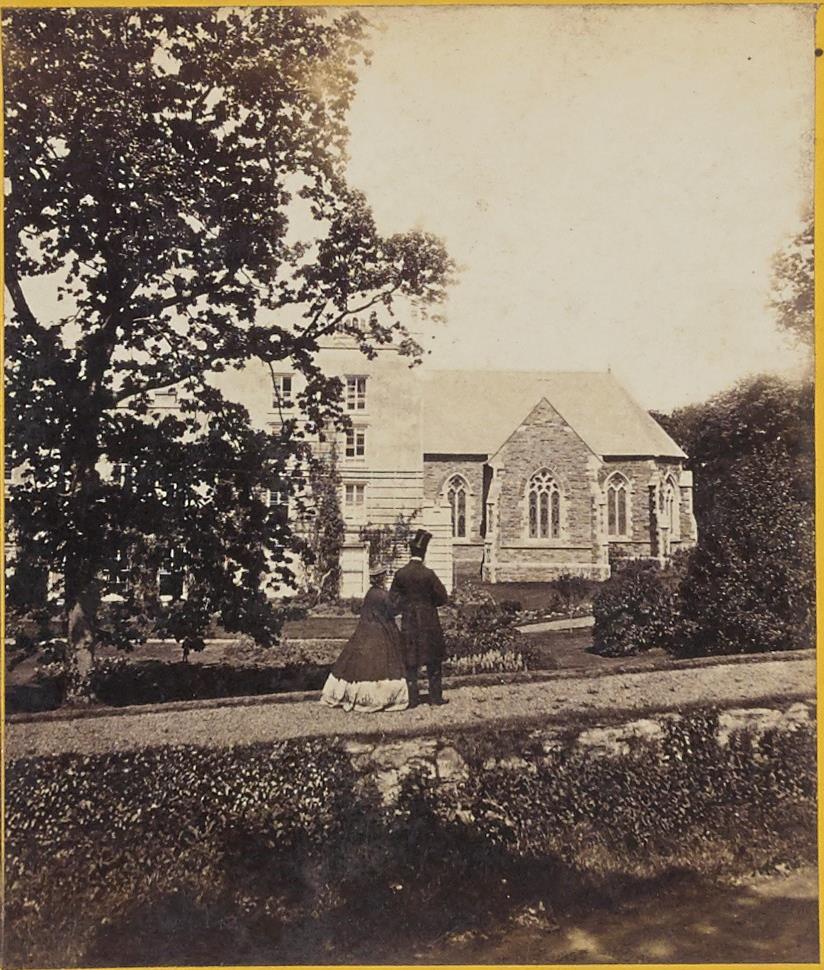
Figure 49. Bishopscourt in Denn’s Views of the Isle of Man, mid-19th Century.
A vintage sepia-toned photograph showing a large stone building complex featuring a chapel-like structure with Gothic windows, viewed from a garden path with two Victorian-era figures in the foreground.
Copyright in submitted documents remains with their authors. Request removal