Loading document...
Proposal:
Relevant to this application is the current approval for the construction of a two storey Cloister building with glazed links to the south elevation of the Cathedral (Planning references: 14/00066/GB \& 14/00067/CON). Phase 1 of the work to clear the site and cast the foundations for the cloister has been completed. Phase 2 to complete the main structure is currently pending an ongoing programme of fund raising.
Pending Phase 2, the original proposal was to construct the approved oak frame glazed link between the south transept and new Cloister as part of the proposed reordering programme. The link would be used as a garden room serving the new Cathedral cafe area. The Registered Buildings Officer and Planning Officer had concerns that, although approved as part of the Cloister scheme, the link was not appropriate in scale or appearance as a stand alone structure. This element of the scheme has therefore been omitted from this current application.
The south transept is currently undergoing structural monitoring due to cracks in the stonework. A package of remedial work involving stainless steel anchors and tie bars, together with re-pointing with lime mortar, has been put together by John Gray Consulting Structural Engineer. Relevant approvals for this work will be applied for under a separate application. It would be beneficial to carry out all the structural work as part of a single contract that can be monitored by the structural consultant. Therefore, in lieu of the omitted garden room this application seeks to carry out the work to create the opening below the south transept window as approved for the Cloister building.
The existing baptismal font is located by the entrance porch (Photograph 9). It was proposed to incorporate this within a new full immersion font intended to serve the needs of the wider adult congregation. The font would also create a focal point and a sign of 'living water' within the building along the lines of other Cathedrals such as Salisbury, where the font has been designed to be a sculptural feature.
The Registered Buildings Officer, although having no concerns regarding the principle of the proposed immersion font, had requested additional information as to how it would be constructed and possible impact on the Cathedral structure. Following further research regarding the amount of specialist construction work and associated costs involved, it was concluded by the applicant that this element should be omitted from the current planning application. The existing baptismal font will therefore not be modified and will remain in its current location.
There are several ancillary areas to the rear of the south \& east elevations that require repair or further consideration for the purposes of safety as well as screening new storage areas from view.
Proposal:
The existing freestanding pews are not fixed to the timber plinths and are often moved to accommodate functions and exhibitions etc. The Registered Buildings Officer confirmed that as the pews are not fixed they do not require Registered Building Consent for their permanent removal. While the replacement chairs are not particularly a planning issue Mr. Brazier did request that they were carefully considered with regard to appearance, functionality and comfort for a range of age groups.
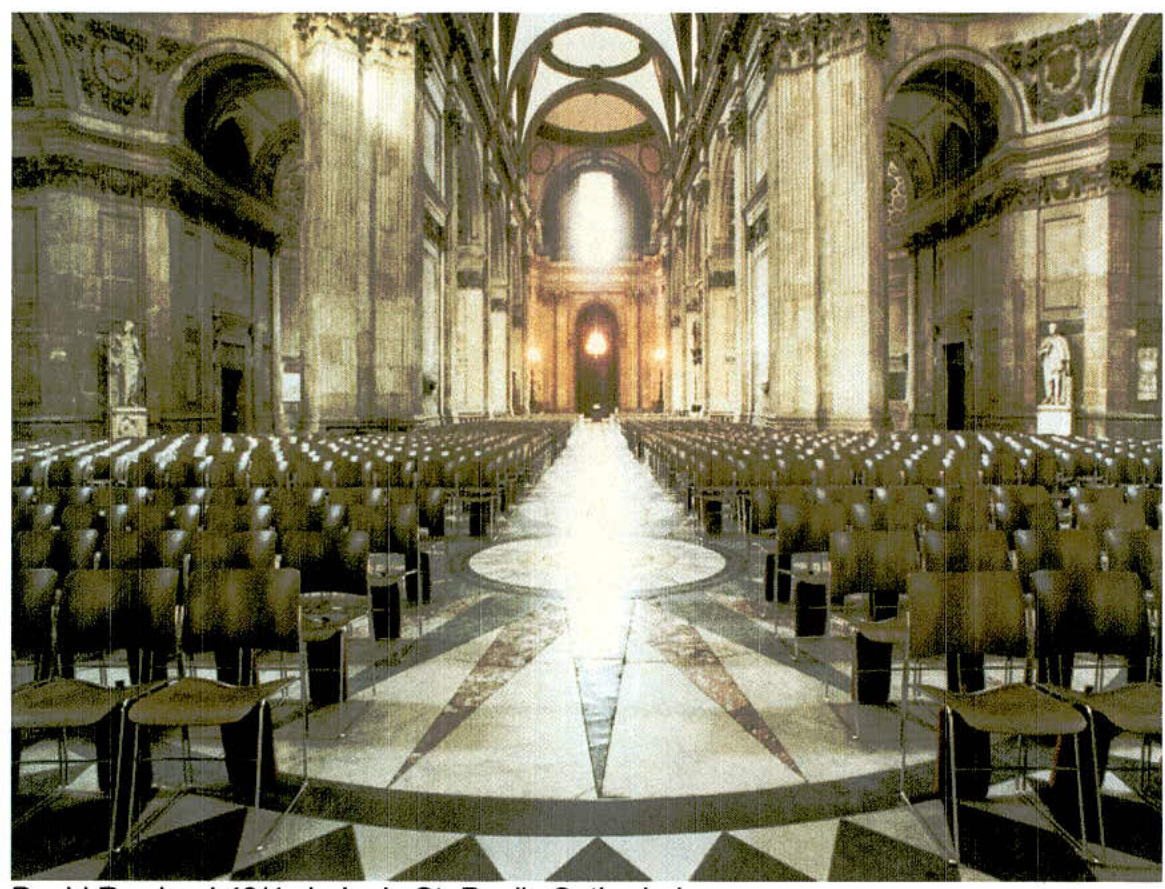
The proposed chairs are to be 'David Rowland 40/4' stackable chairs as illustrated on the next page. These are used in the likes of Salisbury, Canterbury and St. Paul's Cathedrals. They are stylish and highly practical and can be efficiently stacked on purpose built trolleys in groups of 40 . If required these can be moved across to Corrin Hall for other functions or if the Cathedral floor space has to be completely emptied for an exhibition or function.
While the standard 'David Rowland' chair is far more comfortable than traditional pews, we have considered the need to provide a range of seating that can accommodate additional comfort for more elderly members of the congregation. The proposed range of chair provides various options including seats with arm rests. Therefore, while a majority of the seating will be the standard range to cater for the larger events and functions, there will be sufficient of the more comfortable chairs to cater for the elderly.
David Rowland 40/4 chairs in St. Paul's Cathedral
3.1 Drainage - As part of the Planning Approval and Registered Building Consent for the adjacent Cloister building it was proposed to provide rainwater attenuation storage as well as installing a foul water treatment plant. This was deemed necessary as the proposed new building created substantial additional loadings on the existing drainage infrastructure. These works will be carried out during Phase 2 of the Cloister construction which is currently on hold pending fund raising.
The works proposed as part of this application for the re-ordering of the Cathedral are only upgrading facilities that already exist within the building and as such there will be minimal increased loadings on the foul drainage system. It is proposed that the foul water from the upgraded toilets and relocated kitchen facilities will discharge into the existing foul drainage system.
This application has no impact on the existing surface water drainage. 3.2 Heating: The original oil fired boilers have now been replaced with a new gas fired system. The oil tank has been removed and the concrete base will be removed as part of the on going garden landscaping works.
The existing above ground cast iron pipe heating system within the Cathedral is inefficient and also creates step hazards and requires raised timber platforms as the pipework 'snakes' it's way around the building. The cast iron pipework will be removed and replaced with new underfloor heating with suitable zoned control systems. This will provide a more even temperature spread throughout the building for the comfort of all users. The additional thermal mass within the floor structure will also retain residual heat longer to provide a constant background heat source that will benefit the internal fabric of the building.
3.3 Air Source Heat Pumps: A supplementary heat source will be provided by air source heat pumps located in the gardens towards the east elevation. These will reduce the overall running costs for the heating of the Cathedral as well as working towards a 'greener' policy for the protection of the environment.
4.0 Pre-application planning advice*
The initial design, consultation and pre-application planning process had originally taken many months prior to the scheme being submitted. The pre-application meeting was held with the Planning Officer (Mr. E. Riley) and the Conservation Officer (Mr. S. Moore). Following the meeting the scheme was refined for final review and approval by the relevant Cathedral representatives.
Since the application was submitted both the original Planning Officer and Conservation Officer have left the Planning Department. The application has now been reviewed by the Senior Planning Officer (Ms. S. Corlett) and the Register Buildings Officer (Mr. R. Brazier).
Mr. Brazier's background and experience in Registered Buildings resulted in a full review of all the elements of the proposed scheme and requests for additional supporting information or reconsideration of some of the design choices. Through a long process of discussions with the Cathedral representatives to consider alternative design options, the scheme has been revised as detailed in this statement.
A final meeting was held with Ms. Corlett and Mr. Brazier at the end of February. This was very positive and agreed a mutually acceptable way forward. Based on that meeting the scheme drawings and supporting information have been revised and resubmitted.
5.0 Summary*
The proposed works to the interior of the Cathedral addresses some of ad-hoc modifications that have taken place over the years. These modifications have often been necessary to overcome inherent problems such as ramps and steps to avoid the raised heating pipes.
The re-ordering work creates a multi-functional space within the main body of the Cathedral, as well as ancillary spaces that are now better placed or more easily accessible to serve the main functions of the building. The proposed flooring materials and general finishes will create a more coherent palette of materials and colours throughout the building.
Certain elements of the scheme, such as the decorative screens to the entrance lobby or external screens to the south transept, will require additional detailing and design input from local artists when commissioned. We would have no issue with any conditions of the Planning or Registered Building Consent approvals requiring final detailed drawings to be submitted and approved prior to such work being carried out.
Overall the proposals create an interior that can adapt to modern services, as well as serve the community and provide the Island's only Cathedral with the facilities, quality of finish and visitor experience that it is expected from it as the mother church of the Diocese of Sodor of Man.
Copyright in submitted documents remains with their authors. Request removal
View as Markdown