Loading document...
Many existing installations appear to be primarily motivated by art and the visual impact they provide or mitigate. This is, of course, important but we believe that aesthetics should be secondary to the sound ecological reasons for installing green walls:
At the right scale living wall systems will have a dramatic and permanent impact in tackling climate change both at the level of reducing emissions and providing resilience to climate change impacts.
Biotecture Living Wall @ Royal Institute of British Architects, London BDL Ashdown House - BDL/620/001 - February 2012 BDL Ashdown House - BDL/620/001 - February 2012
There are three basic living wall systems:
At Biotecture Design we are of the opinion that whilst all systems can be shown to work successfully, the hydroponic modular systems have a number of advantages over the other two methods.
A hydroponic modular system such as the biowall contains an inorganic, chemically inert and dimensionally stable growing medium. Whilst the capillary felt systems are also hydroponic their water use is excessive and unpredictable and there is an inherent lack of resilience in the very thin growing media zone, which is unable to retain a store of water.
More detailed reasons for selecting hydroponics as the basis for living wall systems can be found at http://www.biotecture.uk.com/hydroponics.html
{{image:46169}} The standard detail for a BioWall hydroponic modular system is shown in the following sketch: {{image:46171}}
From the agreed planting design, plants are planted into the growing medium. The growing medium is held inside cladding panels which are fabricated from 3mm regenerated plastic panels. These panels are then in turn fixed back to a waterproof backing sheet such as Ecosheet (an 18mm closed loop UK manufactured recycled plastic board).
Above each row of panels a line of irrigation dripline is installed and between the planted panels and the backing board there is a drainage geocomposite 5mm void former. The panels have solid bottoms and are beckless hence water from the irrigation lines drips down through the panels where it is made available to the plants via the growing media.
Excess water exits the bottom of the panels at the rear only and drains directly to the base of the wall via the void former. In this way excess water (and nutrients) from one panel row does not work its way down through the next layer of panels. This allows for the moisture and nutrient content to be more easily controlled throughout the wall.
The modular nature allows for the panels to be planted up off site in advance of the installation itself. Immature plants can therefore be cared for and established under nursery conditions.
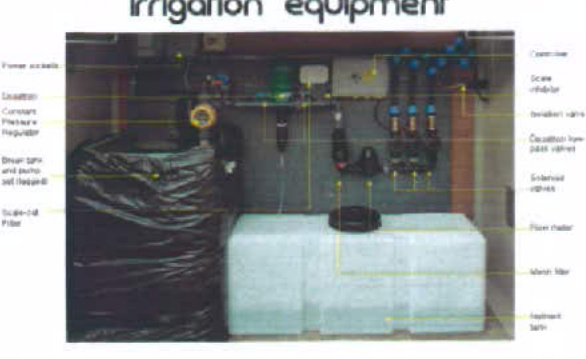
Living walls require irrigation as an input to the system. Modular hydroponic living walls will typically require 1 litre per m2 per day. The irrigation water reaches the panels via pressure compensated drippers contained within the irrigation lines. These drippers offer a reliable output and are controlled by pumped systems.
1008/X/28/01
A3HOOWNE HOUSE
Richmond Square
Page 32
Nutrients are added to the system by means of an impeller device and different conditions can be catered for with different zones operated by solenoid valves.
Following installation, living walls require maintenance to ensure that they continue to survive and thrive. Maintenance falls into two basic categories: irrigation and horticulture.
Irrigation can be controlled and checked on site or remotely. This ensures that the moisture and nutrient content of the wall remains at optimum levels throughout at all times.
Horticultural maintenance includes pruning, cutting back, cleaning and replacing as necessary. Bio-controls may also be applied as necessary. It is important to ensure that for any living wall installation design for access at maintenance stage has been included within the design process.
A well considered maintenance programme will provide year round full coverage for a living wall.
The current state of the art for living walls concerns the technology used for the sensing and control of the irrigation systems. Information passes both ways between an on-site GSM controller and a web-based server. Parameters can be set and any exceptions reported via email.
In many cases on-site issues are first picked up remotely. This allows for resolution prior to any stress being imposed on the plants themselves. The specification for the proposed living wall at Ashdowne House will include for a state of the art remote sensing irrigation system.
Screenshot of the Web-Based Server Remote Sensing for a Living Wall
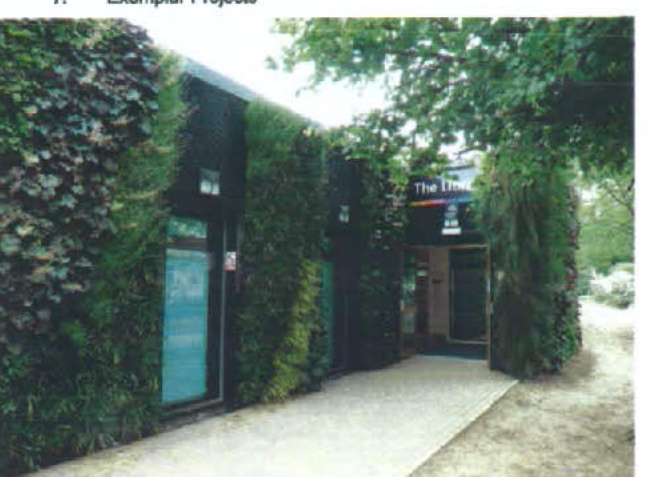
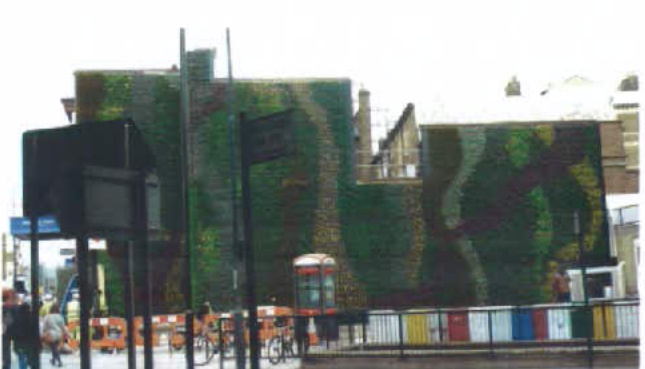
Grant Thorold Library, Grimsby Transport for London, Edgware Road
Copyright in submitted documents remains with their authors. Request removal
View as Markdown