Loading document...
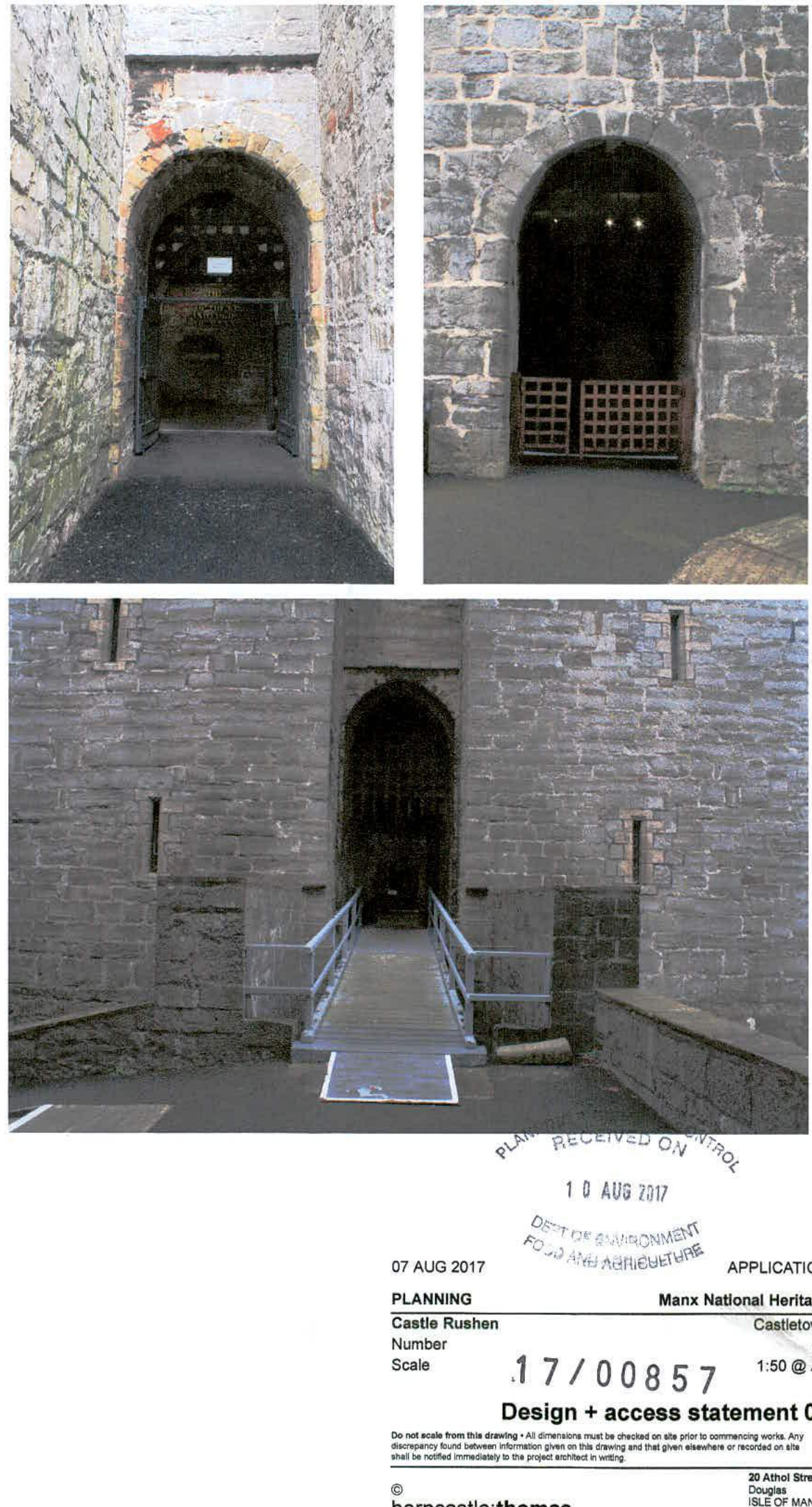
Castle Rushen • Registered Building 24 Castletown Conservation Area
Application for Full Planning Approval • Registered Building Consent Application for Scheduled Monument Consent
Manx National Heritage • Applicant Horncastle Thomas Ltd • Agent
This application seeks consent to make a number of modest additions to the Castle to improve access for all and to improve the visitor experience. Developing and enhancing the visitor experience, and making certain areas of the Castle more accessible, are important parts of the fire Conservation Management Plans for this significant and internationally important ancient monument.
The proposal has been considered in three parts:
Two of the rooms accessed from the Keep house are Castle's main introductory exhibition and video presentation. Currently, access from the Keep to the ground floor Castle rooms is via a large threshold step. The new ramp would significantly improve access to these rooms for wheelchair users and for antiquated disabled visitors.
From the conservation viewpoint, all of the proposals are intended to be reversible with a minimal effect on the existing historic structure. Flange, where required, will only be into joints within the existing stone work and will not cause any damage to the stonework of the castle walls or floors.
The amount of development is limited to the elements and areas described above; there is no new development per se, though it includes the reuse and enclosure of one existing covered area (the existing outer guest house). The enclosed floor area created is 27.1sqm.
A New shop + ticket area: The proposal to relocate the ticket desk and shop will allow Manx National Heritage to cater better for their visitors' needs and will enable them to better accommodate larger groups of visitors, such as school groups or visiting coach parties. The shop and ticket desk are currently located in a room that is not directly on the visitor route through the Castle; this is accessed via a narrow door and by negotiating a series of single step thresholds. This proposal is to provide a new retail and ticket area in the outer guesthouse. The space, although under cover, is currently open to the elements and is accessed from the street entrance via the open backdoor.
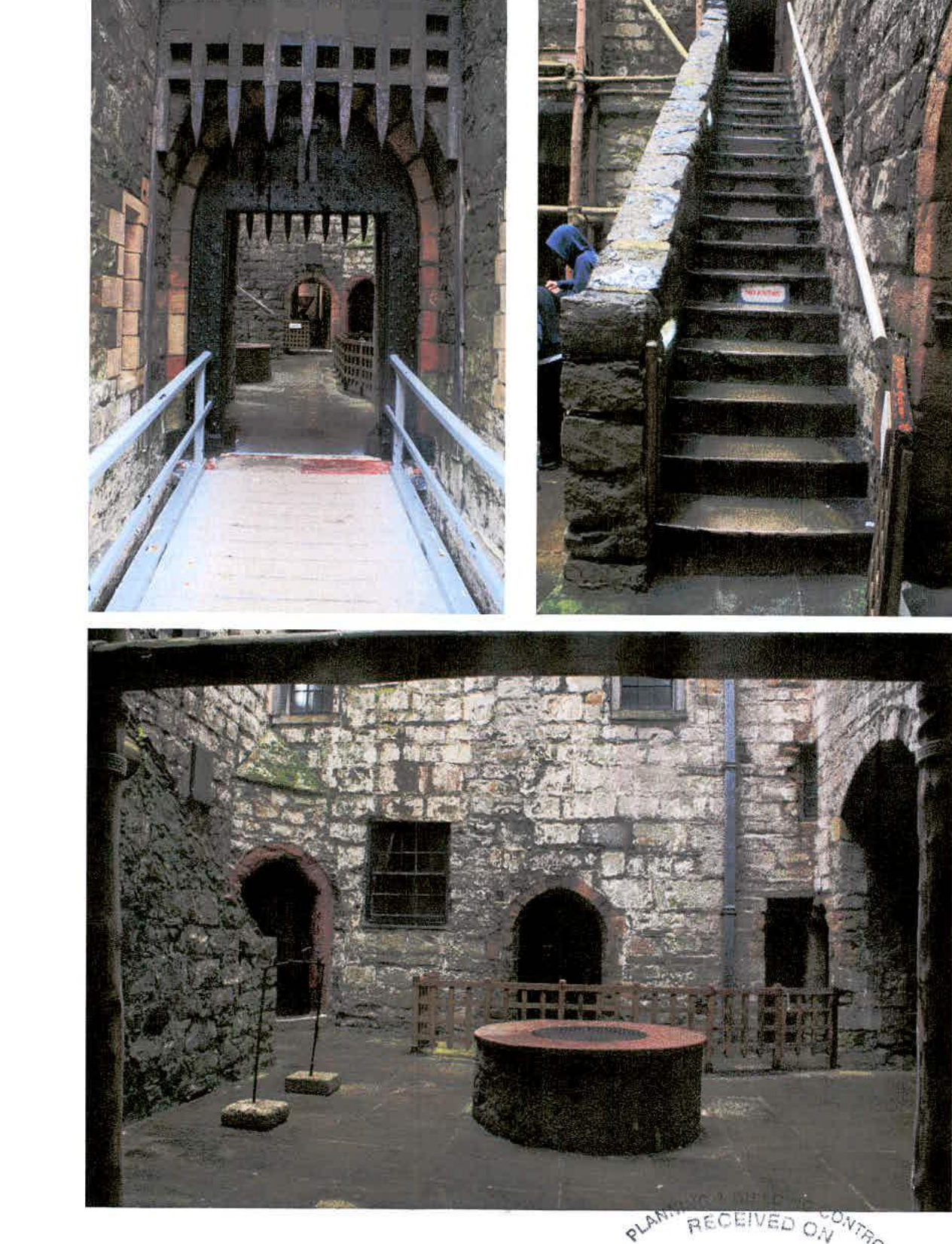
B New bridge in the drawbridge location: The layout and position of the new bridge will generally replicate the existing bridge. The decking for the new bridge will, however, offer an indication of how the original drawbridge functioned; an area of full-width decking will be installed at the castle and of the bridge where, originally, a permanent fixed full-width platform sat over the moving section of the drawbridge. Although the new bridge will not move and will necessarily have balustrades where the Castle drawbridge would not, the difference between the two sections will be legible to the modern visitor.
C New access ramp in the keep: The ramp and decked section, as proposed, will provide both a single ramp (wheelchair) and stepped (ambulant disabled) access along with the necessary handrails. The proposal to use the whole width of the rear section of the keep so that the deck and ramp appear as one simple object, thereby minimizing the visual impact, maintaining a balance between providing meaningful and useful access arrangements and preserving and protecting the essential character of the Keep.
The main principles adopted for each of the design elements are that they should be as 'light touch' as possible, that as little disturbance should be made to the historic fabric as possible and that the installation of the proposed elements could be removed without trace, if so required. In order to bring a sense of unity to the current proposals, a common palate of materials is adopted; timber decking appears in each section, handrails will be in a circular-section hardwood, balusters in galvanised steel rods.
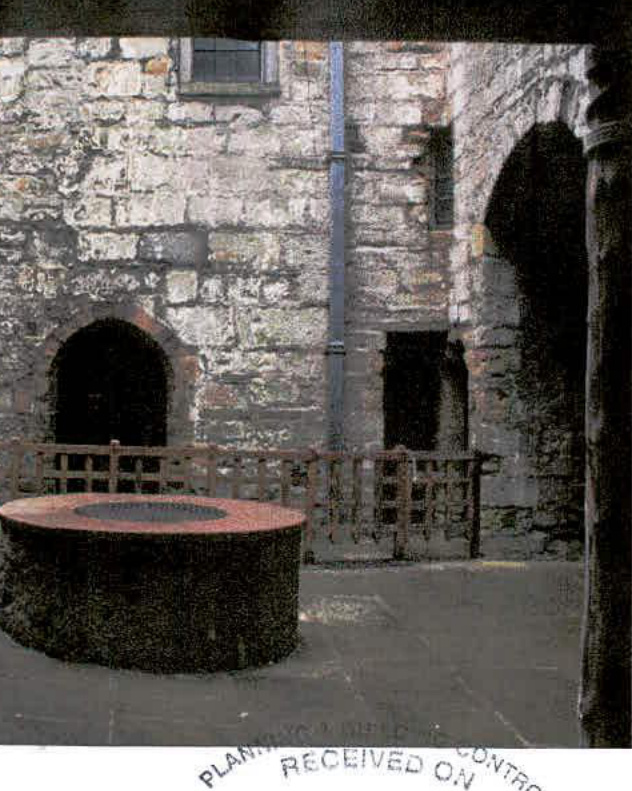
A New shop + ticket area: The new shop + ticket area will be enclosed at both existing openings using simple glazed screen doors with brushed stainless steel hinges + flange. A painted steel desk against the wall either side of the screen will form the weatherproofing; the use of a steel packer will enable this to be fixed into the joints of the stonework, leaving the stones themselves undamaged. A fixed glass panel will fit each worked opening above the parts of doors; the door handles will be full-height, in the same hardwood as the handrails on the new bridge section. The new floor will accommodate level access over the existing Castle thresholds and will accommodate a modest amount of thermal insulation, an electric underfloor heating mat and electrical services (via concealed floor boxes). A hole in the floor, currently covered by a metal grate, will be fitted in with a perspex layer; the grate being refurbished and placed on top. New retail lighting will be provided via an adjustable lighting track.
B New bridge in the drawbridge location: The existing bridge over the drawbridge pit, is thought to date if, and is a simple timber construction. The bridge has been well maintained cosmetically but the structure has outlived its use and the bridge has been propped from below using timber posts and braces. The proposed replacement has a non-slip finish timber deck supported on a main structure of corlen weathering steel. This material provides a low-maintenance solution (ie no painting required) in this location where access is difficult. The steel would be visible on the side and top faces of the stringers (the structural members each side of the bridge). The balustrade spindles will be set off the stringers and will appear to pass on the outside of them, being supported from a wider steel plate fixed to their bottom face. The purpose of this is to visually separate the balustrade from the bridge and to give an impression that the bridge is independent of the balustrades. Spindles would be in galvanised steel rods and the handrails would be hardwood. As noted in 02.3, when the threshold from bridge to platform has been crossed, the decking would run full-width and would be oriented across the visitor's path rather than along it.
C New access ramp in the keep: The materials for the ramp immediately recall those of the new bridge. Timber decking supported and edged by a corlen weathering steel structure. The balustrades and handrails would be the same materials, again being visually separate from the deck. The handrails would be supported by the deck though and would not be supported by the Castle walls.
The Castle is well placed to take account of pedestrian access via nearby parking areas and transport links. The same elements fall outside of the scope of the proposals; the purpose of the proposals is to improve access for mobility-impaired visitors within the Castle.
The general aim of the proposals is to improve access within the Castle for mobility-impaired visitors.
It is, first, proposed to remove the step, thereby creating a level access to the bridge at the entrance. There is a similar step at the Castle and but as this threshold forms a part of the historic fabric of the Castle, rather than a part of the bridge, it will not be possible to remove this. The consequence, which must be weighed against the benefit of removing the step and providing level access at the entrance end of the bridge, is a marginal increase in the gradient of the ramp, from 1:12 to 1:10.5. The length of the ramp would also be reduced marginally to 8.9m.
In relation to the historic context of the bridge, it is not considered possible to introduce any landings into the slope of the bridge and, whilst it is acknowledged that the gradient of the ramp could prove problematic for wheelchair users to navigate unaided, it is noted that, when open, the Castle is well staffed with attendants on site to assist wheelchair users if necessary. It is also acknowledged that the length and gradient of the ramp could prove difficult for ambulant disabled persons to use. Many National Heritage undertake to have a wheelchair available on site for the use of ambulant disabled persons, to be assisted by a member of Manx National Heritage staff whenever required.
It is noted that the handrails for the bridge will be set at a height of 1m above the deck of the bridge, complying with part K of the building regulations. Large flank walls are adjacent to the bridge, generally average approx 500mm from the outside of the handrail, to a maximum of 560mm. The height of the flank walls above the deck reduces from approximately 1.5m at the entrance end to approximately 1.2m at the castle end.
Manx National Heritage have noted that this bridge has been in use for c.100 years (with a lower handrail height of 900mm and a single, climbable, rail at mid height) without incident.
On the basis that it is vital that the form and appearance of the bridge does not harm the character of the Scheduled Ancient Monument, that a management plan can be implemented to reduce the impact of the length of the bridge on wheelchair or ambulant disabled visitors, the necessary relocations required from the Building Regulations will be sought for this part of the scheme at the time of application for Building Regulations Approval for the proposals.
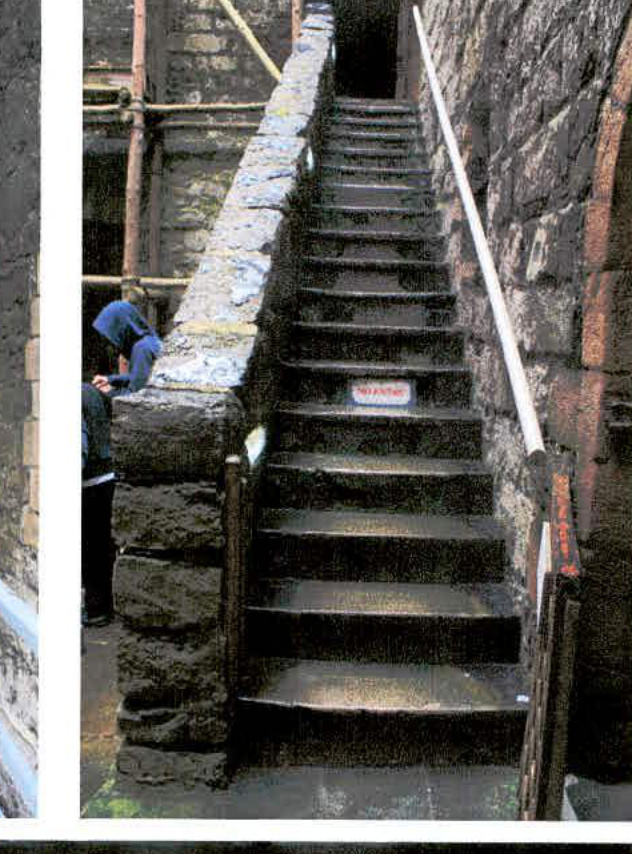
The ramp will comply with the requirements of part M, having a maximum length of 4.8m, its lower end being tapered to account for the slope in the keep's stone flag floor. The gradient is 1:15 (ie within the maximum length set out in part M for this gradient). The ramp has been designed to allow access to the three ground floor doorways that currently have a stepped access, all providing access to the Castle's primary exhibition spaces. The width of the ramp increases as it rises and the level area of decking then curves around the Castle's wall. Both sides of the ramp have a continuous handrail, extending 300mm beyond the start of the ramp, spaced at 1500mm at the bottom of the ramp, opening to 2.7m at the top. One of the handrails sits off the castle wall (75mm); this handrail does not continue 300mm beyond the top of the ramp as this could form a hazard to visitors passing the end of this wall. The curved section of handrail extends past the wall and down the two steps, finishing 300mm beyond the bottom step. There is a second handrail at the other side of the steps, also extending 300mm beyond the bottom step, this time returning at right angles towards the castle wall.
The level of the new deck, set to best serve the doorway threshold levels in the keep, does not, however, correspond to level of the bottom tread of the adjacent stone steps. The stone steps form the exit route from the last of the upper floor rooms during the castle visit. The risers are uneven and range from 252mm to 216mm, with the bottom step currently being 24mm; there is a gate at the bottom which is to stop visitors going up the stairs and going the wrong way around the castle. There are two options available to accommodate this condition, which will be evaluated once the deck has been installed:
Copyright in submitted documents remains with their authors. Request removal
View as Markdown