COPY OF EXPERIENCEPOOD AND ACHIEVING {{image:195256}}
Location (NGRE 226515 NGRN 467460)
Date (AD)
Development
c1200
The construction of great tower within a ditch, possible bailey to the north
1330s-40s
Tower raised to extant level; towers to south, west and east; north gatehouse
1360s-90s
Curtain wall with towers and firing platforms; outer gatehouse and barbican; new ditch beyond the curtain wall; a large room to inner gatehouse; adapting and raising the east keep tower for artillery
early 1400s
Adding buildings within the outer ward and the bailey
1536-40
Round Tower in the moat; the glacis; outer gateway to the barbican; stone batter around the keep
1550-75; 1580s
Modernisation of accommodation in the keep; Derby House; work to the outer gatehouse
1639-51
Adaptation of fortifications; enlarging domestic accommodation; extra storey and garret to Derby House; turrets and gateway to the barbican and raising its walls; the ‘New Worke’, gun platform on the shore
early 1690s/1700s
Refit of apartments and minor work in Derby House; barracks and stables in the outer ward and moat
by 1810
Outer gatehouse ground floor converted to prison
1814-52
Whole keep converted to prison with additions, Derby House remodelled as Rolls Office, Court modernised and Police Station built
1904-10
Restoration by Armitage Rigby, prison buildings removed
1970-72
Court and Derby House repaired and modernised
The Castle is on the western shore of Castletown Bay, near the mouth of the Silver Burn River. On three sides are now the buildings of Castletown, the harbour is outside the NE walls and the modern road cuts round the corner of the complex. The site of the Castle comprises the central keep, Derby House, the outer ward, the curtain wall, glacis and outer gatehouse, barbican entrance and moat (given over to gardens). Opposite the main entrance is a platform representing what remains of a defensive outworks associated with the Castle, now the site of Costa Coffee.
Statutory Designations
Castle Rushen is a Listed Monument, 'the preservation of which is of national importance', under s13 (1) of the Manx Museum and National Trust Act 1959. It is also Registered Building number 24. The complex is within the Castletown Conservation Area. The complex is owned by Manx National Heritage.
Building History
The origins of the Castle lie in the late AD 1100s when the Isle of Man was at the centre of the Norse Kingdom of Man and the Isles. It was built for one of the Kings of Man and the Isles on an easily defensible, yet still accessible, narrow spit of ground close to the limestone building material at Scarlett. Since then, it has undergone numerous structural interventions.
The following table, after that compiled by Drury McPherson Partnership in 2012, summarises the main building development phases;
Building Use
For most of its history, the Castle has served a defensive purpose. Guarding one of the main "gateways" into the Island, the two main periods of construction reflect the two main periods of threat to the Island - firstly the Anglo-Scottish wars of the 1300s and secondly the Civil War of the 1600s. Soldiers were garrisoned at the Castle during these times to repel attacks and to keep safe anyone inside.
During these periods, limited (and probably temporary) domestic accommodation was provided inside the keep for the Kings and Lords of Man and their staff. Derby House was constructed to provide longer term and more comfortable accommodation.
By the early 1800s, the defensive need for a Castle had subsided and the keep was converted to become the Islands prison for the next 100 years. The outer gatehouse and Derby House now served administrative purposes, with most Isle of Man Government business being handled here (despite the building being owned by the British Crown).
Victoria Road prison in Douglas was opened in 1891 following calls for better conditions for prisoners, and the Castle ceased this function. Many interventions made during the prison conversion were removed by renowned local architect, Armitage Rigby in the early 1900s and the Castle was used as a museum until the opening of the Manx Museum in Douglas in 1922. Ownership of the Castle was formally handed over to the Isle of Man Government in 1929 and it remained a site of visitor interest, with paid public admission. In 1988 Tynwald agreed to transfer ownership to Manx National Heritage and a phase of restoration and re-presentation of the keep was begun.
The Isle of Man Courts ceased to use the Courtroom in the outer gatehouse during 2013nd the whole of the site is now a visitor attraction with occasional use as the venue of the swearing-in ceremony for new Lieutenant Governors (with the exception of that held in 2016).
Building Condition
The condition of the limestone blockwork that makes up the complex is generally good. The Drury McPherson Partnership Conservation Plan of 2012 states that "There is no evidence for structural movement, historic or recent, suggesting that the foundations of the principal masonry structures were all taken down to hard clay .....or bedrock, and that bedrock is itself certainly stable."
The slated and leaded roof coverings have largely been renewed in recent years There are a number of structural parts that require regular attention;
Sandstone freestones throughout are vulnerable to weathering and wear and some have been replaced.
Water penetrates through the masonry itself (via the lime mortar rather than the stone) leading to moisture entering the fabric of the keep, tracking through walls and collecting to exit as water.
Building Layout
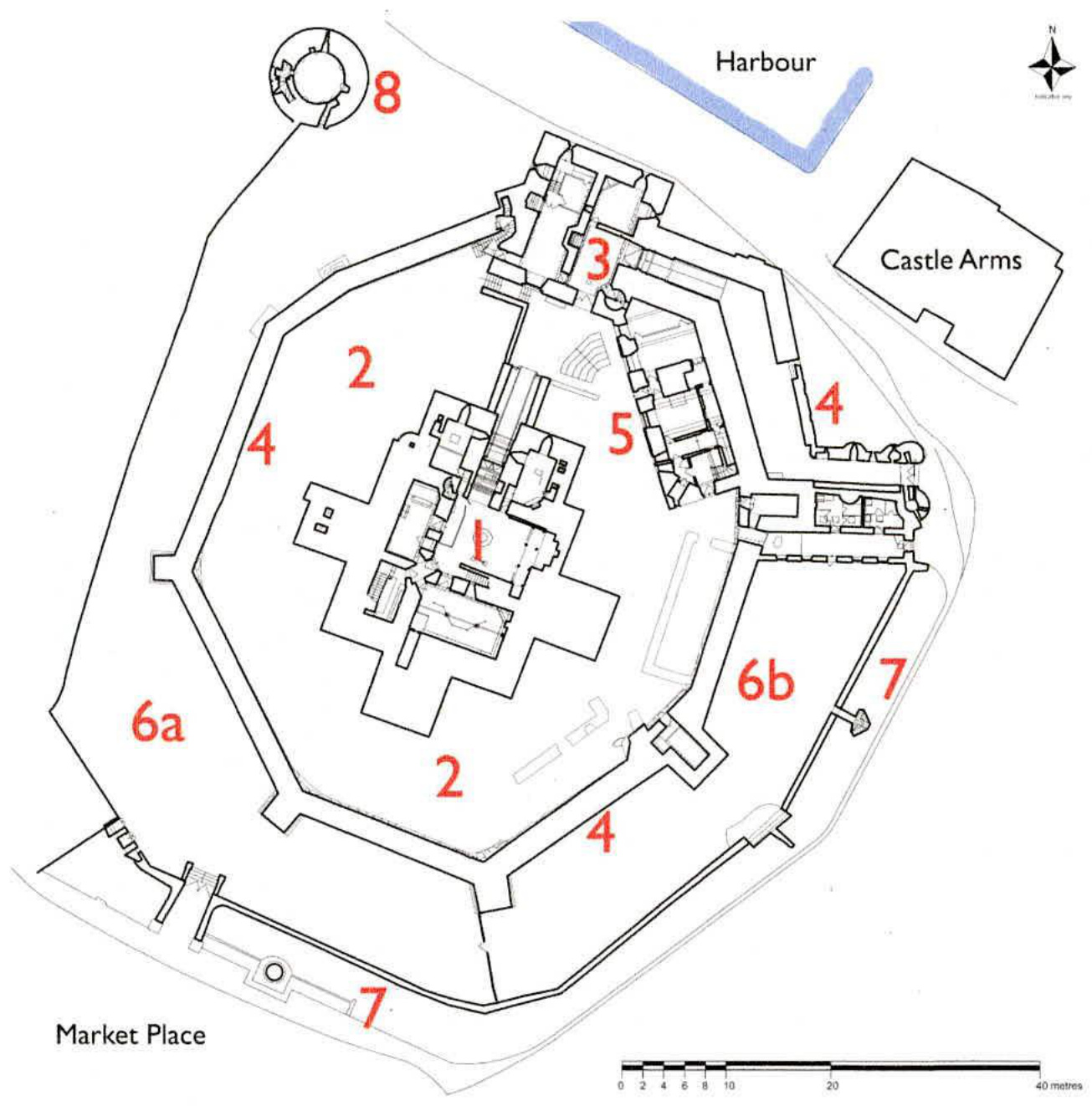
A site plan showing the layout of a historic castle complex with numbered zones, surrounding landmarks like the harbour, and a scale bar.
Plan of Castle Complex
(Drury McPherson 2012)
Keep and Inner Ward
Outer Ward
Outer Gatehouse (Courtroom on first floor)
Curtain Wall, Barbican entrance and Outer Gateway
Derby House
Moat (now a garden, part public 'The Speaker's Garden'
Glacis
Round Tower
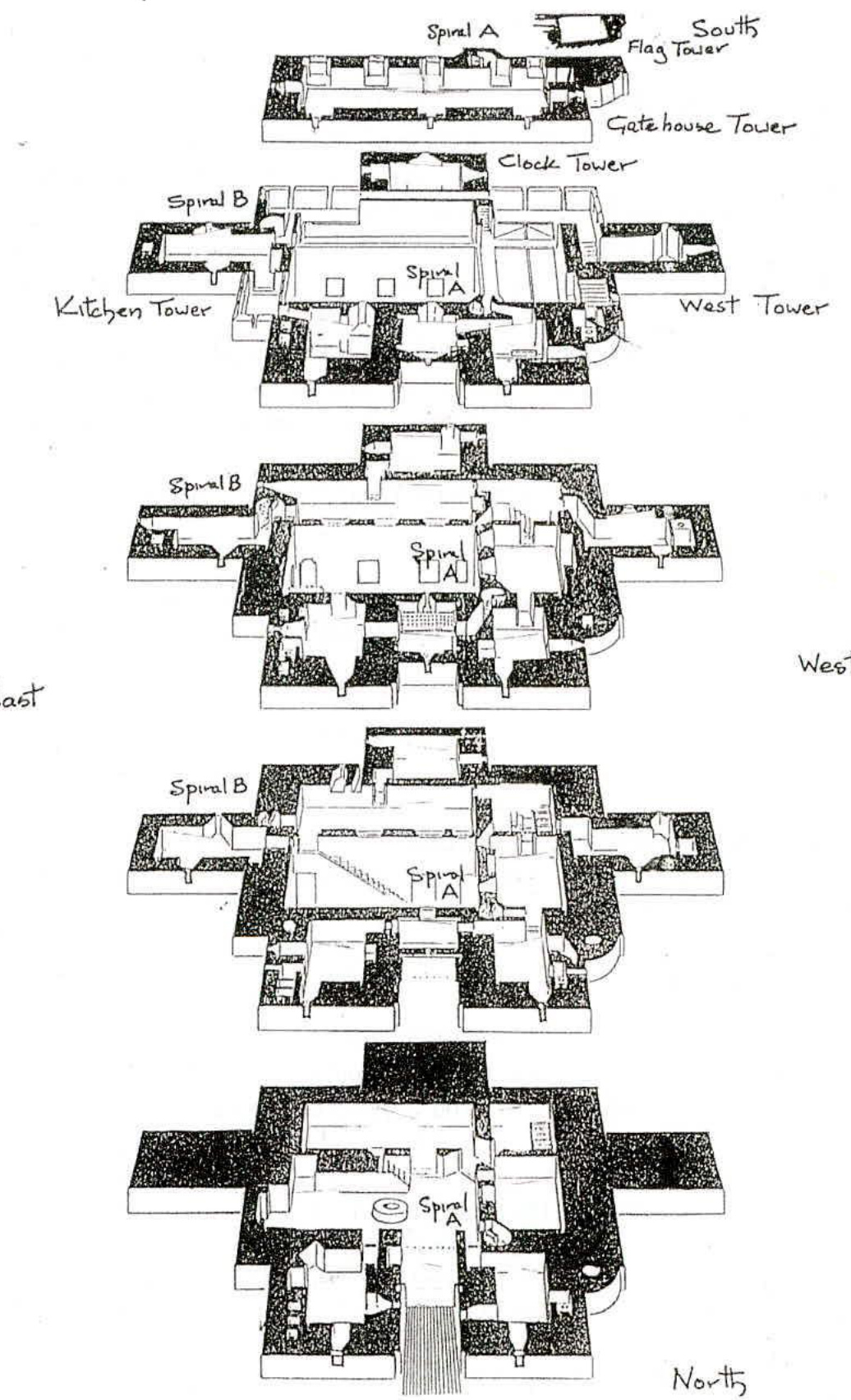
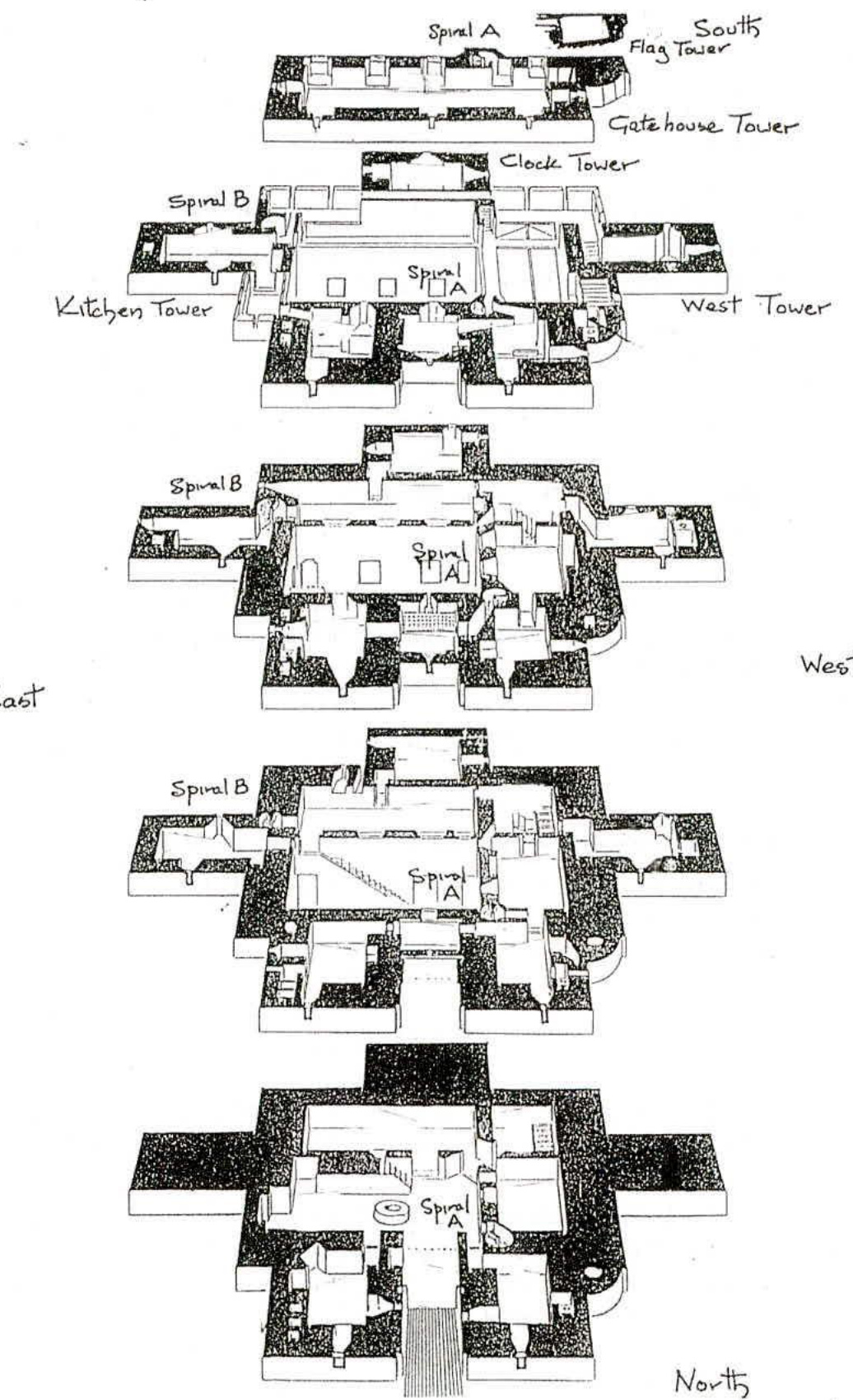
Cut-away section of the keep
This image displays a series of architectural floor plans or sections illustrating the internal layout of a historic castle keep, featuring labeled towers like the Gatehouse and Clock Tower.
Significances
(after Drury McPherson, 2012)
Evidential Value
Until the early 1400s, the Castle and the historic core of Castletown are the primary and almost the only documents for their own evolution. The earliest structural elements are the remains of a high status building on the site and could offer further details about the physical evolution of the place and dateable events and cultural affinities. This could shed real light on a little-understood period in the political history of the island. The known medieval structures on the castle site are of exceptional evidential value or potential.
The castle is an extraordinarily complete stone shell of a medieval fortress and palace in which the position and form of almost all the doors and windows, as well as the planning of the building, are easily discernible. Of the permanent structures only the spine wall of the gatehouse above first floor level, and the division wall(s) within the outer ward have been destroyed, and their plan is clear. The medieval elements of the castle are therefore of exceptional evidential value.
The potential of associated archaeological levels is unclear, but for the information that they may add to the clearly exceptional structure, they should provisionally also be regarded as exceptional and treated accordingly.
The glacis and round tower are rare survivals and are considered to be of exceptional evidential value.
The surviving contribution of later periods, notably the prison, is fragmentary. It requires documentary and visual sources to interpret and does not add to them, therefore it is mostly of little or neutral evidential value.
Historical Value
The Castle as it evolved is of exceptional illustrative historical value, as near perfect an illustration of a medium-sized medieval fortress and palace as can be found in Britain and rare in Europe. It is more important for being largely a coherent building, the result of several phases but completed over about a century, with a substantially consistent style.
The fortifications of the 1500s and 1600s involved no drastic alteration of the core and although the buildings in the Outer Ward do not survive, their presence can be discerned. The castle still dominates both town and surrounding landscape and seascape and large scale modern development has not intruded.
The work at the Castle in the 1600s illustrates a key event in its history, as a Royalist outpost in the Civil War. James Stanley, Earl of Derby, and Countess Charlotte made hasty additions to the defences and the Castle bears visible witness to this period.
Tension between the Earl and the people of the Island came to be focussed on William Christian, Illiam Dhone. The role of Castle Rushen and its associations with these people and events contribute to its exceptional historical significance.
Political activists and offenders of the establishment were held in the castle after during the 1800s. Many other criminals and debtors were also incarcerated within the Castle walls and their stories are of moderate significance.
Aesthetic Value
The medieval castle, especially the keep, is of exceptional architectural value, through both rarity (completeness) and the architectural expression of a complex plan and silhouette. The areas of the two Silver Burn bridge abutments give picturesque views in which the complex profile of the castle composes well and it has been popular with artists and subsequently photographers since the 1600s.
Views of and from the castle are important in appreciating its significance as a symbol of lordship and as a strategic site. At a local level, the Castle is the focus of Castletown and its conservation area.
The remains of the prison conversion work of 1816 in their fragmentary state are of moderate significance, despite being mostly intrusive in the context of the medieval building.
Communal Value
Castle Rushen is of exceptional significance to the national identity of Manx people. It has its origins in the Norse kingdom of Man and the Isles and while the physical remains of this early period are enigmatic, they are present and visible. They bring the association with Manx and regional history to life, and connections during this period are of exceptional significance in the Manx context, and central to the identity of Castletown as the early capital of Man.
After the end of the Anglo-Scottish wars, the island came to be ruled by a series of kings, later Lords. They had allegiance to the English crown, but also almost absolute internal jurisdiction and Castle Rushen provides a potent symbol of their lordship.
While no longer the seat of the principal court of the island (that of General Gaol Delivery), the courtroom is still formally equipped. It is the place in which Lieutenant Governors are usually invested, a ceremonial taking up of 'lordship' in the place that has been the formal seat of that power since the 1300s.
At a local and personal level, most Manx residents will have visited the castle if only on a school trip or whilst showing visitors around; it is part of a common image and shared experience. Whilst the Registry Office was in place, people registered births and deaths here. For those who have been married in the complex, it is part of a much more personal experience, but one shared by many from the local area.
Conclusions
The historic fabric and below ground archaeology of the Castle Rushen complex are of National (Isle of Man) significance with the potential to yield wider (UK) significance in the context of Civil War fortifications.
The surviving historic fabric of the outer gatehouse as part of the Castle Rushen complex is of exceptional significance and any proposed interventions should not materially harm the values of the place.
The surviving fabric of the drawbridge pit as part of the Castle Rushen complex is of exceptional significance and any proposed interventions should not materially harm the values of the place. The drawbridge currently spanning the pit is a comparatively modern ( 20th century) intervention which has been much repaired and replaced in the past and is therefore of no significance.
The keep courtyard as part of the Castle Rushen complex is of exceptional significance and any proposed interventions should not materially harm the values of the place.
Castle Rushen is of exceptional significance to the Isle of Man and the British Isles. Access to the building should be encouraged to enable as many people as possible to experience the building and its stories.
Manx National Heritage is keen make to reasonable adjustments to facilitate access and nonstepped access is possible at ground level in the outer gatehouse, drawbridge and keep courtyard without compromising the Castle structure.
Installing glazed doors to the ground floor of the outer gatehouse will make the area easier to control environmentally and provide a better space in which to welcome visitors, as well as offering a more comfortable space for them to prepare for their visit.
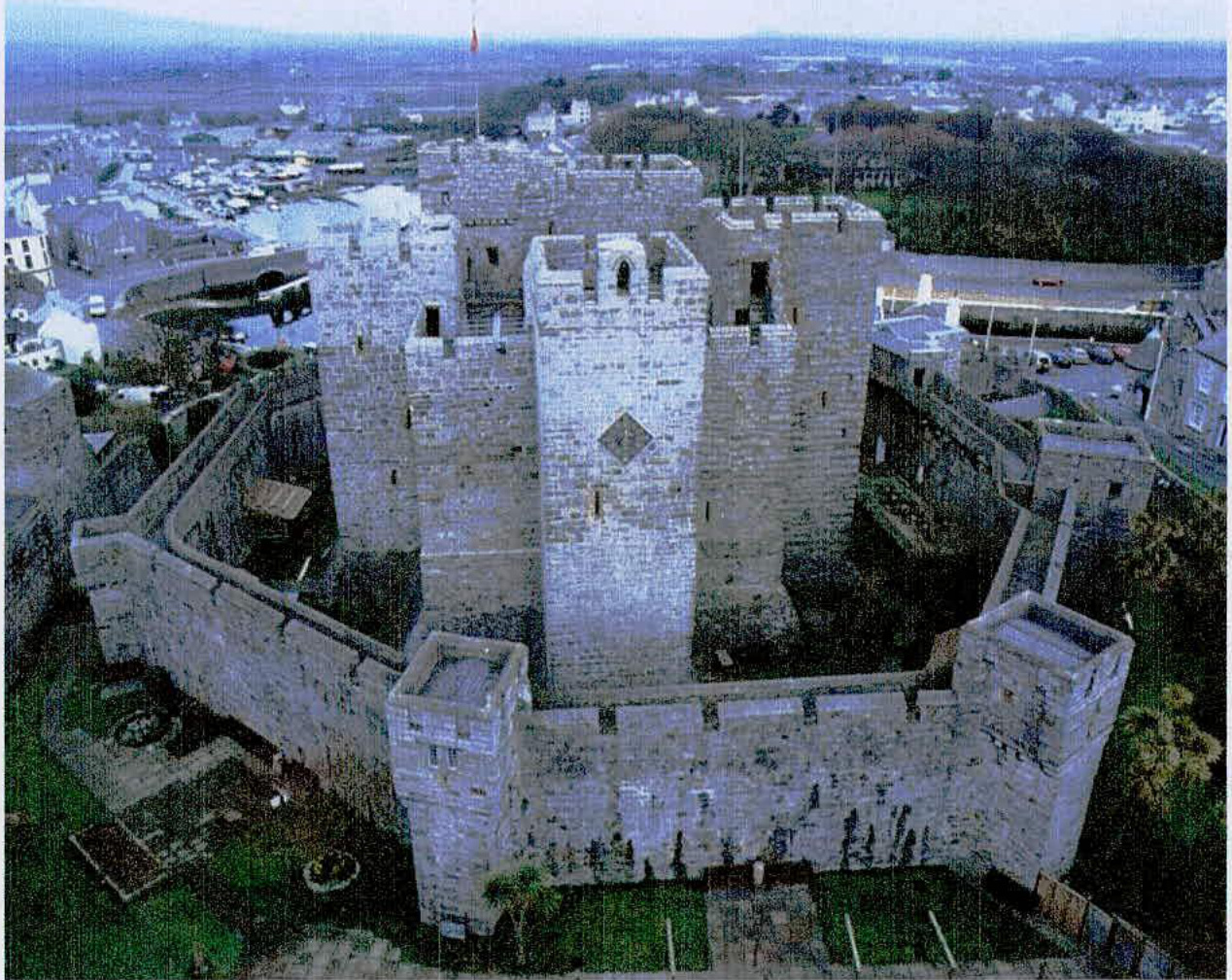
An aerial photograph showing a large medieval stone castle with a central keep and curtain walls, situated within a town environment.
Manx National Heritage
August 2017
Location (NGRE 226515 NGRN 467460)
Date (AD)
Development
c1200
The construction of great tower within a ditch, possible bailey to the north
1330s-40s
Tower raised to extant level; towers to south, west and east; north gatehouse
1360s-90s
Curtain wall with towers and firing platforms; outer gatehouse and barbican; new ditch beyond the curtain wall; a large room to inner gatehouse; adapting and raising the east keep tower for artillery
early 1400s
Adding buildings within the outer ward and the bailey
1536-40
Round Tower in the moat; the glacis; outer gateway to the barbican; stone batter around the keep
1550-75; 1580s
Modernisation of accommodation in the keep; Derby House; work to the outer gatehouse
1639-51
Adaptation of fortifications; enlarging domestic accommodation; extra storey and garret to Derby House; turrets and gateway to the barbican and raising its walls; the ‘New Worke’, gun platform on the shore
early 1690s/1700s
Refit of apartments and minor work in Derby House; barracks and stables in the outer ward and moat
by 1810
Outer gatehouse ground floor converted to prison
1814-52
Whole keep converted to prison with additions, Derby House remodelled as Rolls Office, Court modernised and Police Station built
1904-10
Restoration by Armitage Rigby, prison buildings removed
1970-72
Court and Derby House repaired and modernised
The Castle is on the western shore of Castletown Bay, near the mouth of the Silver Burn River. On three sides are now the buildings of Castletown, the harbour is outside the NE walls and the modern road cuts round the corner of the complex. The site of the Castle comprises the central keep, Derby House, the outer ward, the curtain wall, glacis and outer gatehouse, barbican entrance and moat (given over to gardens). Opposite the main entrance is a platform representing what remains of a defensive outworks associated with the Castle, now the site of Costa Coffee.
Statutory Designations
Castle Rushen is a Listed Monument, 'the preservation of which is of national importance', under s13 (1) of the Manx Museum and National Trust Act 1959. It is also Registered Building number 24. The complex is within the Castletown Conservation Area. The complex is owned by Manx National Heritage.
Building History
The origins of the Castle lie in the late AD 1100s when the Isle of Man was at the centre of the Norse Kingdom of Man and the Isles. It was built for one of the Kings of Man and the Isles on an easily defensible, yet still accessible, narrow spit of ground close to the limestone building material at Scarlett. Since then, it has undergone numerous structural interventions.
The following table, after that compiled by Drury McPherson Partnership in 2012, summarises the main building development phases;
Building Use
For most of its history, the Castle has served a defensive purpose. Guarding one of the main "gateways" into the Island, the two main periods of construction reflect the two main periods of threat to the Island - firstly the Anglo-Scottish wars of the 1300s and secondly the Civil War of the 1600s. Soldiers were garrisoned at the Castle during these times to repel attacks and to keep safe anyone inside.
During these periods, limited (and probably temporary) domestic accommodation was provided inside the keep for the Kings and Lords of Man and their staff. Derby House was constructed to provide longer term and more comfortable accommodation.
By the early 1800s, the defensive need for a Castle had subsided and the keep was converted to become the Islands prison for the next 100 years. The outer gatehouse and Derby House now served administrative purposes, with most Isle of Man Government business being handled here (despite the building being owned by the British Crown).
Victoria Road prison in Douglas was opened in 1891 following calls for better conditions for prisoners, and the Castle ceased this function. Many interventions made during the prison conversion were removed by renowned local architect, Armitage Rigby in the early 1900s and the Castle was used as a museum until the opening of the Manx Museum in Douglas in 1922. Ownership of the Castle was formally handed over to the Isle of Man Government in 1929 and it remained a site of visitor interest, with paid public admission. In 1988 Tynwald agreed to transfer ownership to Manx National Heritage and a phase of restoration and re-presentation of the keep was begun.
The Isle of Man Courts ceased to use the Courtroom in the outer gatehouse during 2013nd the whole of the site is now a visitor attraction with occasional use as the venue of the swearing-in ceremony for new Lieutenant Governors (with the exception of that held in 2016).
Building Condition
The condition of the limestone blockwork that makes up the complex is generally good. The Drury McPherson Partnership Conservation Plan of 2012 states that "There is no evidence for structural movement, historic or recent, suggesting that the foundations of the principal masonry structures were all taken down to hard clay .....or bedrock, and that bedrock is itself certainly stable."
The slated and leaded roof coverings have largely been renewed in recent years There are a number of structural parts that require regular attention;
Sandstone freestones throughout are vulnerable to weathering and wear and some have been replaced.
Water penetrates through the masonry itself (via the lime mortar rather than the stone) leading to moisture entering the fabric of the keep, tracking through walls and collecting to exit as water.
Building Layout
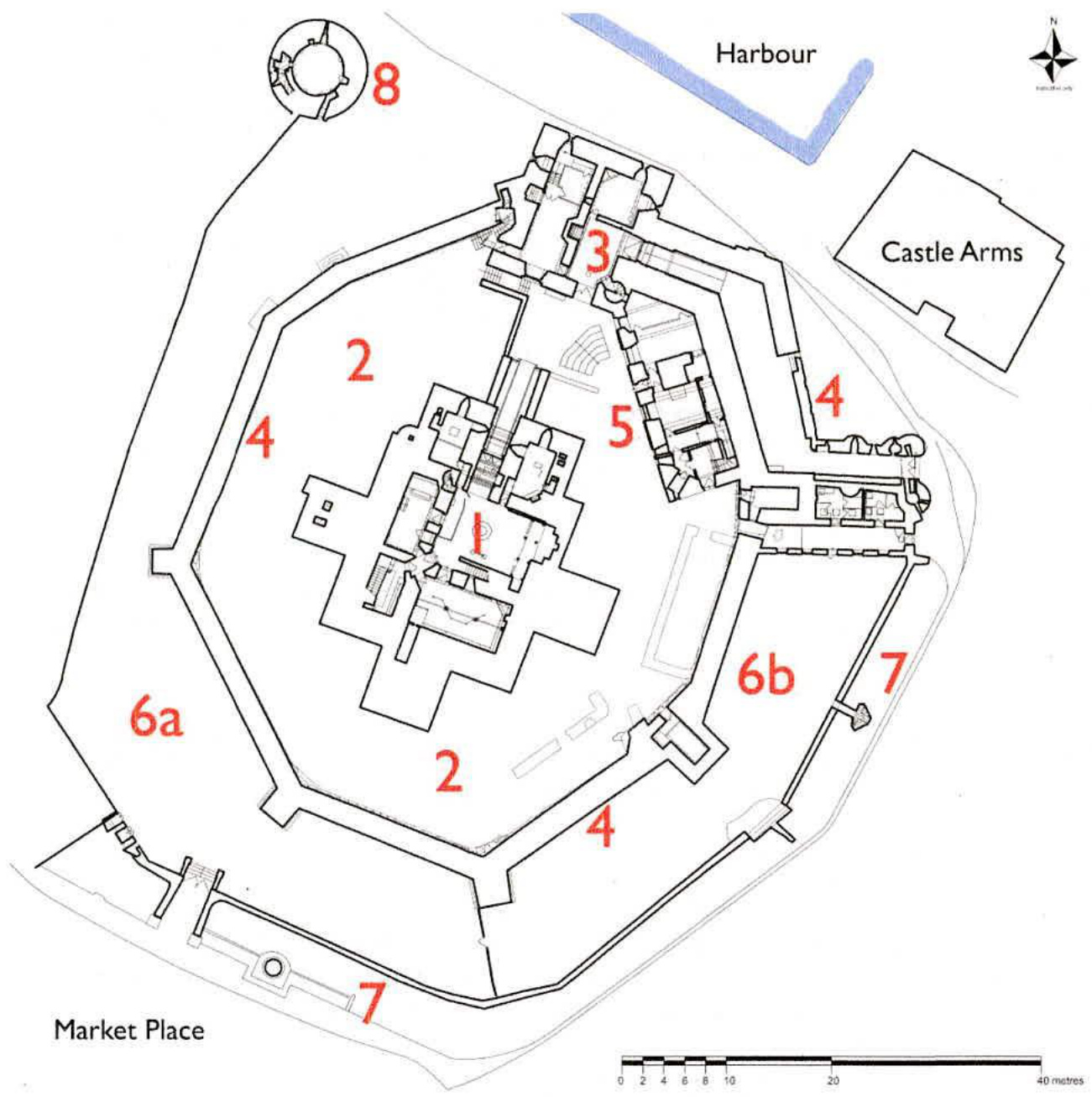
A site plan of Castletown Castle showing the keep, curtain walls, and surrounding features like the harbour and market place with numbered sections.
Plan of Castle Complex
(Drury McPherson 2012)
Keep and Inner Ward
Outer Ward
Outer Gatehouse (Courtroom on first floor)
Curtain Wall, Barbican entrance and Outer Gateway
Derby House
Moat (now a garden, part public 'The Speaker's Garden'
Glacis
Round Tower
Cut-away section of the keep
Architectural floor plans and sections of a historic keep showing tower layouts, spiral staircases, and internal room arrangements.
Significances
(after Drury McPherson, 2012)
Evidential Value
Until the early 1400s, the Castle and the historic core of Castletown are the primary and almost the only documents for their own evolution. The earliest structural elements are the remains of a high status building on the site and could offer further details about the physical evolution of the place and dateable events and cultural affinities. This could shed real light on a little-understood period in the political history of the island. The known medieval structures on the castle site are of exceptional evidential value or potential.
The castle is an extraordinarily complete stone shell of a medieval fortress and palace in which the position and form of almost all the doors and windows, as well as the planning of the building, are easily discernible. Of the permanent structures only the spine wall of the gatehouse above first floor level, and the division wall(s) within the outer ward have been destroyed, and their plan is clear. The medieval elements of the castle are therefore of exceptional evidential value.
The potential of associated archaeological levels is unclear, but for the information that they may add to the clearly exceptional structure, they should provisionally also be regarded as exceptional and treated accordingly.
The glacis and round tower are rare survivals and are considered to be of exceptional evidential value.
The surviving contribution of later periods, notably the prison, is fragmentary. It requires documentary and visual sources to interpret and does not add to them, therefore it is mostly of little or neutral evidential value.
Historical Value
The Castle as it evolved is of exceptional illustrative historical value, as near perfect an illustration of a medium-sized medieval fortress and palace as can be found in Britain and rare in Europe. It is more important for being largely a coherent building, the result of several phases but completed over about a century, with a substantially consistent style.
The fortifications of the 1500s and 1600s involved no drastic alteration of the core and although the buildings in the Outer Ward do not survive, their presence can be discerned. The castle still dominates both town and surrounding landscape and seascape and large scale modern development has not intruded.
The work at the Castle in the 1600s illustrates a key event in its history, as a Royalist outpost in the Civil War. James Stanley, Earl of Derby, and Countess Charlotte made hasty additions to the defences and the Castle bears visible witness to this period.
Tension between the Earl and the people of the Island came to be focussed on William Christian, Illiam Dhone. The role of Castle Rushen and its associations with these people and events contribute to its exceptional historical significance.
Political activists and offenders of the establishment were held in the castle after during the 1800s. Many other criminals and debtors were also incarcerated within the Castle walls and their stories are of moderate significance.
Aesthetic Value
The medieval castle, especially the keep, is of exceptional architectural value, through both rarity (completeness) and the architectural expression of a complex plan and silhouette. The areas of the two Silver Burn bridge abutments give picturesque views in which the complex profile of the castle composes well and it has been popular with artists and subsequently photographers since the 1600 s.
Views of and from the castle are important in appreciating its significance as a symbol of lordship and as a strategic site. At a local level, the Castle is the focus of Castletown and its conservation area.
The remains of the prison conversion work of 1816 in their fragmentary state are of moderate significance, despite being mostly intrusive in the context of the medieval building.
Communal Value
Castle Rushen is of exceptional significance to the national identity of Manx people. It has its origins in the Norse kingdom of Man and the Isles and while the physical remains of this early period are enigmatic, they are present and visible. They bring the association with Manx and regional history to life, and connections during this period are of exceptional significance in the Manx context, and central to the identity of Castletown as the early capital of Man.
After the end of the Anglo-Scottish wars, the island came to be ruled by a series of kings, later Lords. They had allegiance to the English crown, but also almost absolute internal jurisdiction and Castle Rushen provides a potent symbol of their lordship.
While no longer the seat of the principal court of the island (that of General Gaol Delivery), the courtroom is still formally equipped. It is the place in which Lieutenant Governors are usually invested, a ceremonial taking up of 'lordship' in the place that has been the formal seat of that power since the 1300 s.
At a local and personal level, most Manx residents will have visited the castle if only on a school trip or whilst showing visitors around; it is part of a common image and shared experience. Whilst the Registry Office was in place, people registered births and deaths here. For those who have been married in the complex, it is part of a much more personal experience, but one shared by many from the local area.
Conclusions
The historic fabric and below ground archaeology of the Castle Rushen complex are of National (Isle of Man) significance with the potential to yield wider (UK) significance in the context of Civil War fortifications.
The surviving historic fabric of the outer gatehouse as part of the Castle Rushen complex is of exceptional significance and any proposed interventions should not materially harm the values of the place.
The surviving fabric of the drawbridge pit as part of the Castle Rushen complex is of exceptional significance and any proposed interventions should not materially harm the values of the place. The drawbridge currently spanning the pit is a comparatively modern ( 20th century) intervention which has been much repaired and replaced in the past and is therefore of no significance.
The keep courtyard as part of the Castle Rushen complex is of exceptional significance and any proposed interventions should not materially harm the values of the place.
Castle Rushen is of exceptional significance to the Isle of Man and the British Isles. Access to the building should be encouraged to enable as many people as possible to experience the building and its stories.
Manx National Heritage is keen make to reasonable adjustments to facilitate access and nonstepped access is possible at ground level in the outer gatehouse, drawbridge and keep courtyard without compromising the Castle structure.
Installing glazed doors to the ground floor of the outer gatehouse will make the area easier to control environmentally and provide a better space in which to welcome visitors, as well as offering a more comfortable space for them to prepare for their visit.