Loading document...
PROJECT No.2 Parking for up to 232 cars & 3 coaches
PROJECT No.3 Multi Purpose Building
PROJECT No.4 Internal alterations Mansion House
PROJECT No.5 Refurbishment of the Labourers cottages
PROJECT No.6 Refurbishment of the fountain
PROJECT No.3 Maintenance refurbishment of Gatelodge
PROJECT No.1 Extension & refurbishment of Gatelodge
PROJECT No.5 Refurbishment of the fountain
PROJECT No.3 Extension & refurbishment of Gatelodge
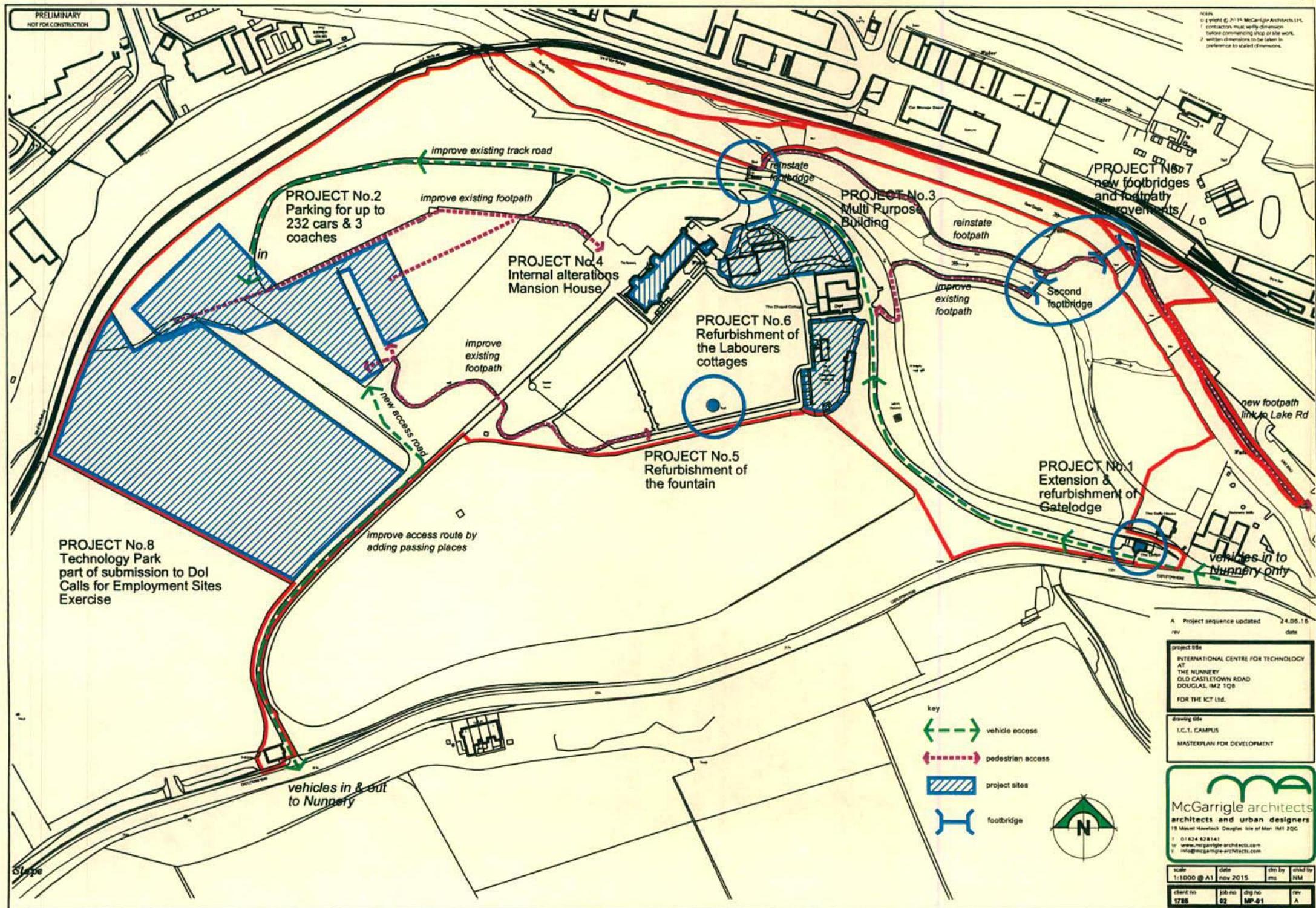
Copyright © 2016 McGarrigle Architects Ltd. connectors must verify dimension before commencing shop or site work written/dimensions to be taken in preference to scaled dimensions This drawing has been prepared for Standard Planning Application purposes only and is not to be interpreted as a full working construction drawing.
KEY
Historic walls
Former Grots
Important Views
Existing Trees
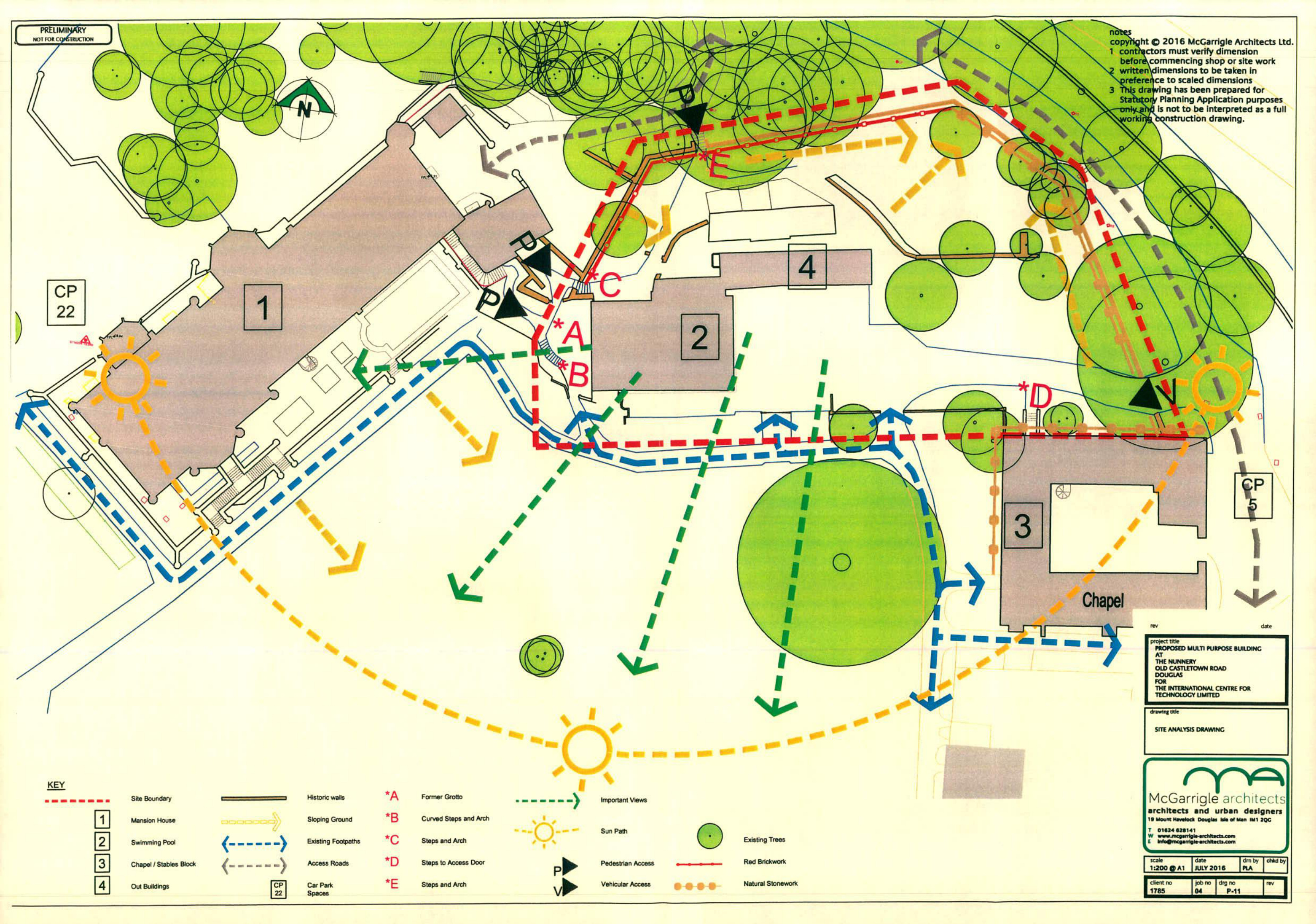
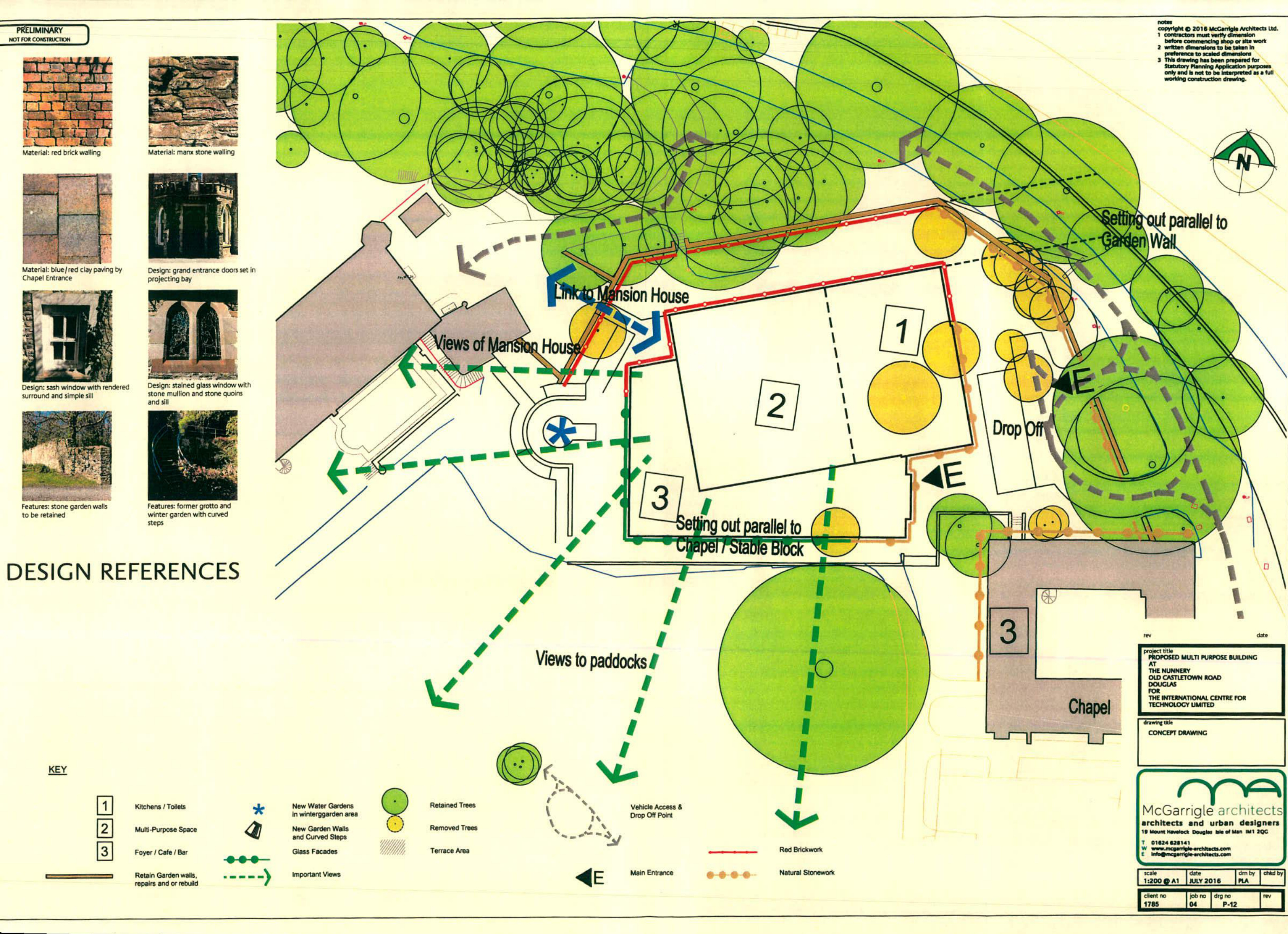
KEY
Date: Tuesday 17th November 2015 @ 2.30pm Job: The Nunnery, Old Castletown Road, Douglas Job No: 1785.02
Niall McGarrigle McGarrigle Architects Ltd Karen Galtress DEFA, Fisheries Directorate Robert Moore DEFA, Fisheries Directorate Richard Selman DEFA, Forestry, Amenity \& Lands Directorate Andrew Igoea DEFA, Forestry, Amenity \& Lands Directorate Andrew Johnson MNH, Field Archaeology Kate Hawkins MNH, Natural History
1.1 No objection to new footbridge but design will have to cope with river in flood 1.2 Timing of construction important, preferred to be in July to September 1.3 Care needed to avoid contamination and disturbance of river and wildlife; construction to have nio impact on the river and surrounding area 1.4 Method Statements will be required to be agreed with Manx Utilities and Fisheries, DEFA prior to works commencing 1.5 Karen recommended contacting Malcom Cowin at Manx Utilities. Consent for the bridge works will be required from Manx Utilities under the Flood Risk Management Act 2013. As this is a Designated River such consent is also required for constructing or planting anything within 9 m either side of it. 1.6 Flood Risk will need to be considered in design 1.7 Richard recommended carrying out a survey for invasive and protected plants; Japanese Knotweed had been recorded in the area and upstream at Middle River Estate; and tubular water-dropwort may be in the area. The survey should be across the estate not just in the river area. 1.8 Rob suggested the footpath along to Lake Road may not be as simple as thought as it has many roots and undulations and perhaps an opening in the Tesco car park might be better.
2.1 Andrew J. said that some of this area had previously been formal gardens 2.2 Niall showed the proposed Cell-Web brochure and discussed having an impermeable main vehicle route through the car park perhaps in bitmac or similar and permeable crushed stone parking bays where the car park would be drained. Therefore there would be no underground drainage required. 2.3 The car park would be kept away from trees and their roots where possible 2.4 Excavation to 200 mm would be too much and damage to roots would be likely as roots are likely to be in the top 400 mm 2.5 The larger trees could have a RPA of 15 m 2.6 Andrew I. would look for the appointment of an arboriculturalist or landscape architect, who would prepare a tree survey, an impact assessment, a tree protection plan and mitigation plan with a Method Statement; and then oversee the works as the car park is built. 2.7 Richard recommended a desktop wildlife survey, bats have been recorded in the area. Manx Wildlife Trust may have survey information on the area. He also asked for a statement on scheduled species in the area. 2.8 Bat species may be sensitive to any car park lighting, Pipistrelle may not be so sensitive but Big-eared Bats would be very sensitive. Lighting design will require careful thought and should be shown on planning drawings. 2.9 Andrew I. and Richard would prefer the new two-way access road to be outside the woodland area, in the adjacent field. 2.10 Andrew I. said the woodland track access route 'covering' would need to be a 'no dig' solution, as he was concerned about trees very close to the track.
3.0 Business Incubator Units in part-Sangsters Field 3.1 Andrew I. said the landscaping, proposed trees and water feature would need proper landscape design. The, trees should all be native species such as sorbus, beech etc 4.0 Multi-Purpose Building on the former Swimming Pool Site 4.01 Andrew I. did not have too much concern for loss of the few trees in this area as indicated on the plan 4.02 Richard did not see much concern for ecology on this site, but bats had been recorded in the area of the Chapel but no roosts evident. 4.03 Andrew J said the area behind the swimming pool gable had previously been a religious grotto. 4.04 Andrew J added that trial excavations had previously been carried out but not much had been found. 4.05 Andrew J recommended an archaeologist be appointed to prepare an archaeological statement to go with the planning application. The archaeologist should be involved in early discussions on the design of the foundations and excavations and then should oversee the initial works on site. 4.06 Andrew J suggested Dr Peter Davey or Dr Phillipa Tomlinson of the Centre for Manx Studies may be suitable, or alternatively Oxford Archaeology North might be consulted. 5.0 Labourers Cottages 5.1 Andrew J said this is the most sensitive of the sites; this is the likely location of the original priory. The rear wall to the access road was believed to be based on the Russian fortifications at the Crimea. Andrew J said that anything that involved digging or excavations would require careful thought and execution. Andrew J said that any works would require an archaeological assessment and statement
Signed: man WLangle Dated: 30th November 2015
I was asked by Mr P Vermeulen to undertake a bat survey of the swimming pool during the formulation of plans to re-redevelop part of the Nunnery estate. By the time I attended a few days later, on 1st April 2016, to carry out this survey, the brief had been extended to include inspection of the trees identified for felling in order to create a car park west of the main house.
Inspection of the swimming pool amounted to a visual check inside the pool. Access to the attic was not possible but it was possible to see a large portion of it owing to the 8 skylights in the roof and translucent panels in the pool ceiling immediately below them. Some of these were missing or distorted permitting a view into the attic above. From the outside it could be seen that the roof is in very good repair and from the inside it could be seen that it was held up by girders rather than timber beams and joists. This, together with the high level of illumination would militate against bat occupancy and no droppings were seen on the translucent panels.
The main pool area itself was also brightly illuminated through the ceiling panels and there were no cracks or crevices for bats to crawl into.
From the outside, the swimming pool is oriented almost E-W but the south wall is almost all taken up by glazed doors now boarded up. There are no gaps into the soffits below the roof and, as has been mentioned, the roof is in good condition. The west and east walls are of breeze block construction with no gaps and again, the soffits are a good fit. Running east from the north east corner of the pool house is a high wall with some cracks and crevices but close inspection with a torch found no bats present. This wall supports the roof for a series of outbuildings running up the rear of the swimming pool, including a cellar. There were no signs of bats seen inside the buildings and the presence of cobwebs suggests that that they are not used by bats.
Close inspection of the many cracks and crevices in the outbuildings walls and the adjoining grotto showed no sign of bats either.
This survey confirms earlier ones undertaken by the Manx Bat Group, in 1998 and 2004 which also found no indication that the swimming pool was used by bats.
After examining the swimming pool, I surveyed the trees estimated to be removed for the new car park and marked on a plan sent to me by Mr N McGarrigle. These are on the highest part of the estate in the area known to me as the Rose Garden. The trees concerned are principally two lines of young beech trees crossing the garden on a roughly north-south access and appear to have been inexpertly pollarded in the past. There were only a few holes, none suitable for bat use. Some other trees on the western boundary and around the entrance/exit are marked for removal but are quite small and have no holes or cracks for bats to use. A single Scots pine is shown for removal in a small car park to the northwest but has no potential for bat use.
Although these trees do not provide bats with any roosting spaces they might provide feeding habitat for bats and feeding bats were noted in this area during the 2004 survey. Since the hedges would provide shelter for insects under certain wind conditions, their importance for bats should be assessed during the summer season when bats and insects are flying. N. Pinder
Chairman \& Recorder Manx Bat Group 2nd April 2016
Copyright in submitted documents remains with their authors. Request removal
View as Markdown