Loading document...
Registered Building 248
RECEIVED ON 14 MAR 2014 DEPARTMENT OF INFRASTRUCTURE
(a) Registered Building Consent form RPAB2(i) (b) Certificate of Ownership form O3(i) (c) Site Plan showing location of the church within Kirk Michael and curtilage (d) A4 plan showing Areas of church and heating pipes affected by proposals (e) Overview of proposals. (f) Kitchen design plan - S Vestry (kitchen) (g) North Vestry design plan – N Vestry (to become admin, safe storage, robing, etc) (h) Set of four pages of photographs of Areas affected with notes (i) Additional two pages of photographs dealing with specific questions raised by the Conservation Officer. (j) Details of proposed drain (3 pages) (k) Building Control approval for proposed foul drain. Job Ref 13/07485/OTH. (l) 1:50 Scale Drawing dated Sept 2011 Rev.14.2.13 of Proposed Reordering (m) 1: 20 Scale Drawing no 32.1.13 dated Sep 13 of Proposed Entrance Screen (n) 1:50 Scale Drawing no 32.2.13 dated Nov 13 of Proposed Foul Drain
Registered Building 248
1400314
The church is well described in the notes that accompanied the Registered Building no. 248 registration in 2009. It would be fair to say that it is a typical John Welch church, often described a ‘shoebox with a couple of side wings.’ The design created a large unsupported space for pews, many never used, and an equally large volume of air that is expensive to heat.
It is almost certain that the two vestries were added at a later stage as they used materials not available when the church was built in 1835. They are utilitarian with no features of historic or artistic interest.
The pews are simple, without any carving, best described as ‘cheap and cheerful’ and covered in very dark stain. They have no special historic value. The area of church with ecclesiastical value is primarily the chancel along with pulpit, font, Bishop’s chair and prayer desks. Nothing in this area at the front of the church will be changed.
The aim is to make the church more flexible for use by not only its own members but for community events. There are a number of benefits from the proposals. The following description commences at the main (southern) entrance door and moves into the building. The numbering on the A4 plan and Application for Registered Building Consent form RBAP2(i) is clockwise from this point. The points listed in form RBAP2(i) are detailed more fully below.
No changes will be made to the exterior of the building, other than forming a 40mm drainage pipe from the kitchen sink through the outside wall (fair face rendered over stone) and dropping down to the ground outside. The drain will run under the tarmac path that surrounds the church to an inspection pit with cast iron cover in the grass – a straight run of about seven metres from the church building. Any external pipework will be painted to match the material behind.
The existing inner entrance porch door would be retained but modified to half glazed to provide a more welcoming visual access. It would also improve the safety aspect by being able to see if anyone is standing immediately behind the door.
The entrance / proposed meeting room area would involve removal of four rarely used pews. The seat of the most southerly pew to remain against the wall. The pews, like all others in the building, are of simple design and of no architectural merit.
The floor either side of the central tiled aisle comprises wooden planks that we would wish to cover with, say, a warm mid-bronze fleck high-duty contract quality carpet.
The proposed half-glazed oak screen would enable this area to still feel part of the church and yet retain light coming into the church via the stained glass windows. The oak would be complimentary to the lighter wood used in the pulpit and reading desks. The half-glazed double doors it would provide a wider and more welcoming entrance path into the church. This area would be furnished with chairs and tables and could also be used as a meeting room. The southern wall to have noticeboards with wooden frames to match the screen.
Page 1 of 4
When finished, the area could be used for a crèche or meetings of up to probably 20-25 people and could be separately heated to avoid running the main boiler. It would also be a welcoming approach into the main church rather than people be restricted by a narrow aisle.
It is very difficult at present to safely carry hot drinks, etc on trays along the narrow aisles. The removal of the pews in the south nave would enable the area to be used for refreshments, displays, etc. Some of the better pews could be swung 90° and put with their backs against the wall. The pews are of simple design and of no architectural merit.
The floor level is the same throughout accessed off a tiled aisle. It is a ventilated, joisted wooden floor and the intention is to have it the surface sanded and sealed.
The church has been full on only one occasion in the last decade – a funeral, and chairs in this area could easily be turned to face the front of the church should the need arise again. If necessary the seating can be augmented by either wooden or stacking chairs from the church hall across the road.
This is currently a traditional 'Vicar's Vestry' with a mishmash of furniture items, books, etc. It also stores Registers, communion items, etc in a safe. The Vestry was a later addition of timber frame and fibreboard construction. The fibreboard would be covered with plasterboard to provide 30 minute fire protection. The existing door is flat faced on both sides and appears to be of modern hollow construction. It has no architectural or historical merit and would be changed to provide 30 minute fire protection.
The finish of walls, flooring, etc to be as agreed with the Environmental Health Officer - Food Safety Unit, to meet current food regulations.
To be able to better provide hot beverages and other refreshments the proposal would be to transfer the contents of this South side Vestry into the North side Vestry. From the proposed kitchen would be a serving hatch to the South Nave (Area 2).
Kitchen designers have looked at the area and the most efficient proposals accepted. A flat-back water heater is proposed with a cold water feed from the toilet area. The sink would involve a drain for the washing up water to be made through the exterior wall. Builders have been to site and can see no difficulty of connecting to an existing foul water sewer that runs from the existing toilet area at the foot of the tower. There is an inspection cover 7m from the SW corner of the building. For further details please see the separate three page report. Building Control permission has been approved for the route of the proposed foul drain on 23 December 2013 – Job Ref 13/07485/OTH.
This was originally used as a 'Choir Vestry' but is now a storage area containing filing cabinets, cleaning materials, etc. The present arrangement for beverage preparation is also in this area but is less than satisfactory.
The current entrance is limited by the location of an old galvanised F&E tank for the central heating boiler. The proposal is to remove the tank and extend the Vestry westwards to the rear wall, making it the same size as the South Vestry. A new F&E tank would be fitted above the ceiling of the extended area. Like the South Vestry it was a later addition to the 1835 building and is of timber frame and fibreboard construction.
Page 2 of 4
The fibreboard would be covered with plasterboard and a new doorway created in the southern face of the extension. The existing door appears to be of modern panel construction with plywood infill to the top panel that is normally glazed. It has no architectural or historical merit and would be changed to provide 30 minute fire protection.
The North Vestry will be used very much as the present South (Vicar's) Vestry is – admin, safe storage of registers, communion vessels, church records, Burial Authority records, robes, etc.
Removal of the first three pews back level with the western wall of the north transept. The present fourth pew seat would remain and provide easy access for undertakers at funerals and carers accompanying anyone in a wheelchair. Wheelchair users would have a much better view of the front of the church from this point and feel more inclusive. Like all pews, they are of simple design, utilitarian in construction and with no architectural merit.
Removal of these first three pews will open up access to and improve viewing of the Manx Heritage Stones. These are claimed to be the best collection of Norse standing stones on the Island, along with some from the earlier Celtic period. Dr Andrew Foxton and colleagues from MNH have held a meeting on site and had no objection to the proposals. They have kindly offered to relocate one small stone supported by a pew to an alternative position within the current viewing area.
Existing cast iron flow and return pipework would need modification in Areas 2 and 5. In both areas the pipes serve a radiator at the eastern end of the run of pews, and both radiators will become redundant and need removal. Pipework will also be removed so not seen, cut back to a point level with the western walls on both the South and North Transepts. The redundant pipework is shown on the A4 plan of Areas Affected by proposals.
The Entrance Area / Meeting Room formed in the South Transept would benefit by the addition of a radiator tapped into the existing pipework on the western side wall. This to be dark brown to match the existing match boarding behind.
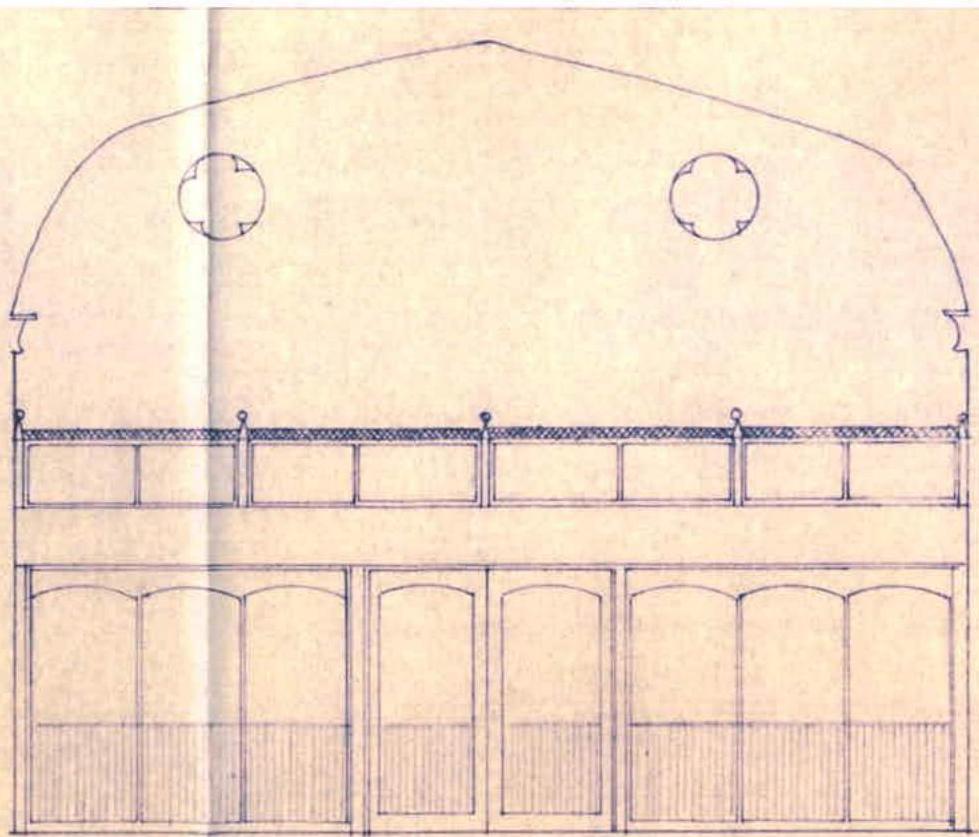
The following diagram shows the architect's initial sketch of the proposed oak screen as viewed from the body of the church. The top 40% or so shows not the proposed screen but the south transept internal wall (behind) with two circular windows at high level. The next 10% or so is a low balcony probably with frosted glass panels concealing a storage area for flat items behind, so they cannot be seen from the body of the church.
The ceiling height will be 8ft to line up with the fixed door transom at the base of the fanlight in the inner entrance door. The void between the ceiling of the meeting room and the mezzanine floor above will be insulated with 150mm fibreglass. This will be accessed from a trapdoor in the right hand side (west) ceiling with a commercial quality pull down loft ladder.
For full final specification please see 1:20 scale Drawing no: 24:1:13 Job no 339 dated September 2013. Drawn by Guy J Thompson, Diocesan Surveyor. As agreed with the Conservation Officer, the finals are oak apple design to match the organ enclosure, as are oak fretwork items at the top of each glazed area in the screen.
Page 3 of 4
ELEVATION SKETCH 1
Guy J Thompson DipBlgCon, MCIOB, MBEng, MRICS The Old Paint Shop, Athol Street, Port St Mary, IOM. Diocesan Surveyor
Minister: Revd Canon Malcolm Convery 878855 Churchwarden: Stephen W Hamer 462210 / 877814 50 Faaie ny Cabbal, Kirk Michael 15 Faaie ny Cabbal, Kirk Michael
(a) Registered Building Consent form RPAB2(i) (b) Certificate of Ownership form O3(i) (c) Site Plan showing location of the church within Kirk Michael and curtilage (d) A4 plan showing Areas of church and heating pipes affected by proposals (e) Kitchen design plan - S Vestry (kitchen) (f) North Vestry design plan – N Vestry (to become admin, safe storage, robing, etc) (g) Set of four pages of photographs of Areas affected with notes (h) Additional two pages of photographs dealing with specific questions raised by the Conservation Officer. (i) Details of proposed drain (3 pages) (j) Building Control approval for proposed foul drain. Job Ref 13/07485/OTH. (k) 1:50 Scale Drawing dated Sept 2011 Rev.14.2.13 of Proposed Reordering (l) 1: 20 Scale Drawing no 32.1.13 dated Sep 13 of Proposed Entrance Screen (m) 1:50 Scale Drawing no 32.2.13 dated Nov 13 of Proposed Foul Drain
Copyright in submitted documents remains with their authors. Request removal
View as Markdown