Loading document...
Planning Statement on behalf of: Mr A Ranscombe The Red House, Victoria Road, Douglas IM2 6AQ
By Ashley Pettit RIBA IHBC
The previous application was approved at appeal. The Registered Building Consent (11/01608/CON) listed eleven conditions regarding details and materials. These are addressed in this application.
In addition to adjusting the plans and elevations to include the above details, the following changes have occurred:
The overall size of the extension, roof heights and elevations are unaltered from the previous application, with the exception of the few changes scheduled above.
The size and arrangement of some windows have been modified, but to suit the construction details now submitted with the application. enclosed: Architect’s Statement Coloured Elevation (White painted timber except to gables, as originally intended – not as at time of registration).
Ashley Pettit Architects James Place Victoria Road Douglas IM2 4HD
Since the house was constructed major changes have occurred in the way domestic buildings are managed.
In general, we no longer have servants, the cooking is done by the house owners and dining/kitchen arrangement is more common.
Currently, houses have more bathrooms and, with central heating, a more open plan arrangement. It is also more common for the houses to have a more casual link to the garden.
Baillie Scott was an innovative architect, keen to adapt the Victorian houses he was brought up with into a more informal style.
The Red House was designed and built by Baillie Scott to showcase his ideas of how the modern house should react to the greater freedom of the emerging middle classes. In Marion Barter’s appraisal dated May 2011 and submitted as part of the original application, on page 20, when discussing the interior, she refers to the use of hinged pine an oak screens between rooms that were ‘an innovative device to enable the flexible use of space, first tried at the Red House and highly significant’ but equally she draw attention to the design details in the staircase that were over scaled but later used in larger houses and the arcade screen and glazed first floor landing replicated in Ivydene and later houses. This house explored the potential of his new order.
We see that Baillie Scott was looking to establish new ideas and these ideas were constantly evolving. In his article titled ‘A Cottage in the Country’ published in The Studio magazine in 1904, he describes how the house illustrated in the article contrasts with the modern tradition of house building, ‘which ends by making a room or a passage a rectangular box lined with smooth plastered surfaces, and which then proceeds to decorate these surfaces with superficial materials covered with patterns’, whereas in his design ‘is here set aside for the realities of the structure itself.’
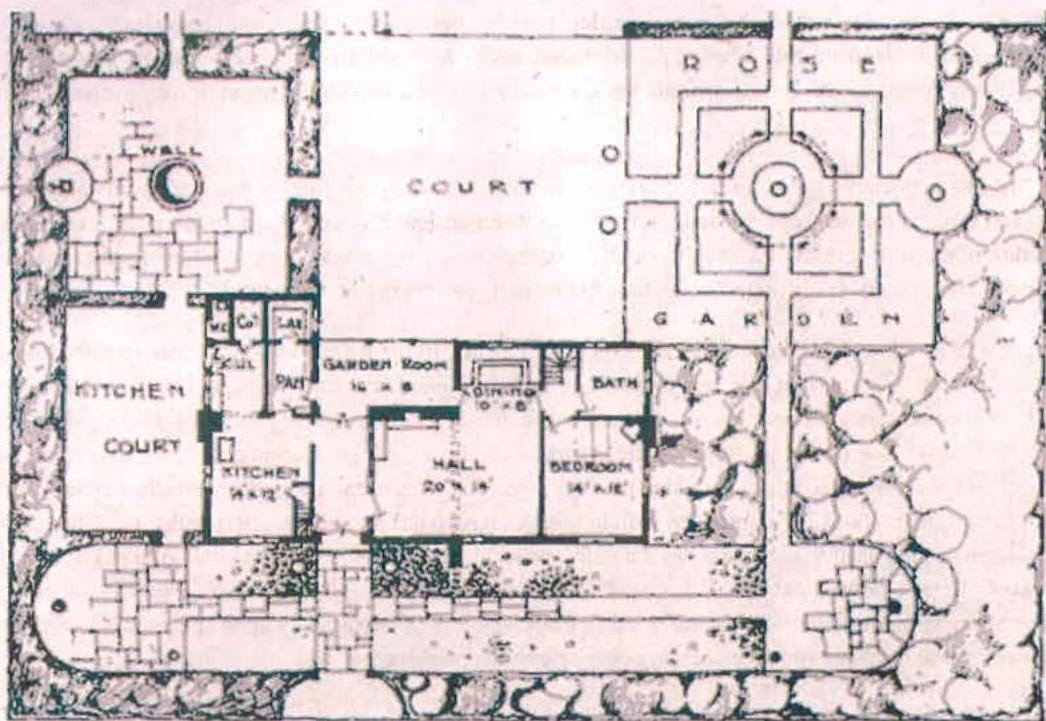
He also goes at some lengths to describe how the spaces are combined and how the dining area is set up off the hall (the main room) and linked to the pantry via the garden room. He states ‘In winter time this garden room would be enclosed with glazed shutters and forms a miniature winter garden, but in summer time it is the garden room itself which would be chiefly used for meals, and for this purpose the service is especially arranged.’ he goes on to add, ‘The garden room in these days, when the advantages of a life spent, as far as possible, in the open air are increasingly realised, becomes an essential feature in a country house, especially in one designed mainly for summer use. On summer mornings it is here the family would meet for breakfast, and while enjoying the advantages of the open air they would be sheltered from a sudden shower.
The illustrations show this garden room to be a tiled roof simply supported on large posts with bracing. There is no detail of the glazed shutters nor is there any record of this house being built. He does however also go on to describe the importance of the garden ‘for in a summer dwelling the garden is perhaps even
more important than the house itself, and it's apartments and leafy corridors are but an outdoor extension of the house plan, so that house and garden are each a part of a whole comprehensive scheme.'
So whilst Baillie Scott was developing ideas about how the house would link better with the garden, he has not considered the advantages of a dining kitchen. We have to wait a further 60 years for this idea to establish itself. His book House and Garden published in 1906 does acknowledge that careful consideration need be given to the kitchen 'But the growing scarcity of servants, as well as the growth of democratic ideas, have led in recent years to a more careful consideration of the workings of a house.'
He does however illustrate a design for Cooperative Housing which again repeats the exposed timber posts used in his garden room, to form a ground floor cloister. The Cottage in the Country is also illustrated as Springcot in the chapter on holiday homes.
The driving force of the new extension is to provide new accommodation away from the original house. The servants have gone and the new rooms offer alternative accommodation more suitable for current concerns for energy conservation and home comforts, ensuite and open plan.
Baillie Scott did go on to design rustic bays on later houses.
The new extension incorporates an oak frame (by Oakwrights). We have used this manufacturer recently in a project in St Johns. There they had a method of glazing between the structural timbers using an oak cover mould (Drawing 209). This was very successful and expresses the timber structure rather than appear as a window.
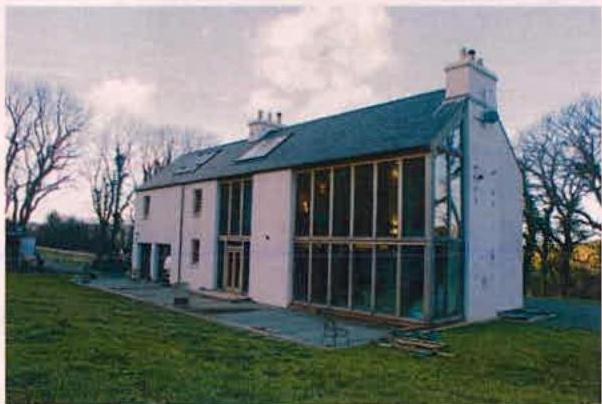
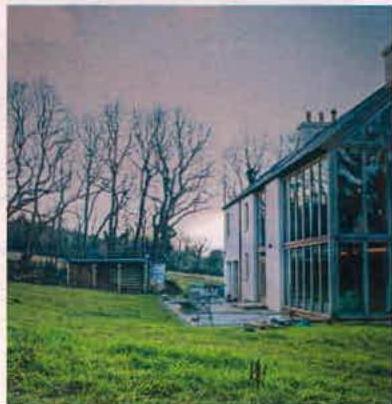
We consider that the new bay links the interior of the new dining/kitchen to the garden. The glazing proportions have been carefully considered and adjusted to be balanced with the building (and the golden section).
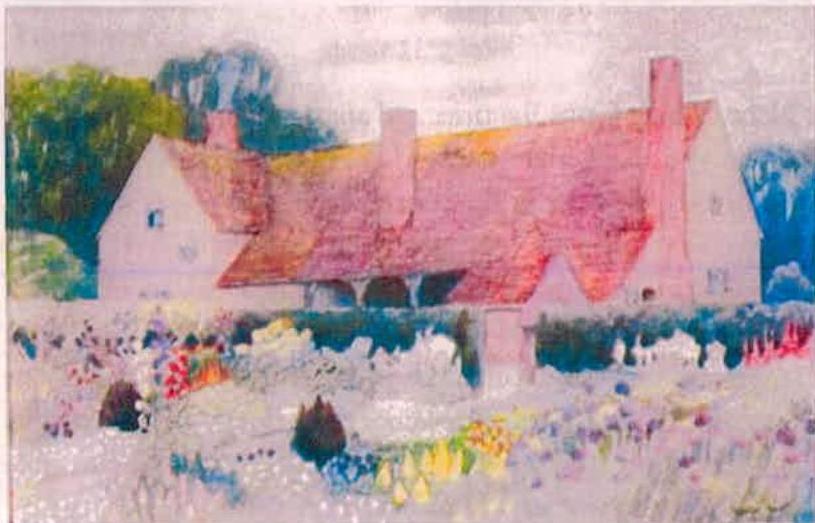
Baillie Scott used a similar device on Springcot and wrote at some lengths in his article in the studio of how the structure should be expressed and how the building should link to the garden.
This elevation is all new and is not read with the original building and is an opportunity to experiment with new forms sympathetic to Baillie Scott’s original ideas. It allows the interior of the new room to link with the immediate garden which is designed as an extension to the house.
Plan : Springcot
Elevation : Springcot
Copyright in submitted documents remains with their authors. Request removal
View as Markdown