Loading document...
| Reasons for choice of design: |
| A thorough search of the Peel area was undertaken in order to find a suitable location for the installation of telecommunications equipment to meet the demand for improved 3G coverage in the central area of Peel. St Germans Cathedral was considered to be the best option available in terms of the level of coverage provided and minimising impact on the character and appearance of the area. Given that St Germans Cathedral is a Registered Building within the Peel Conservation Area it is accepted that telecommunications equipment will need to be designed in a way which is sensitive to the character and visual amenity of the building and surrounding area. The proposal, which is subject of this application, involves the installation of antennas and ancillary equipment internally within the bell tower of St Germans Cathedral. The proposed antennas will be shielded from view by Glass |
RECEIVED ON 17 SEP 2012
Airport Director Consultation (only required for an application for prior approval) {{table:309668}} Developer's Notice {{table:309669}}
| Copy of Developer's Notice enclosed? | Yes | No |
| Date served: n/a |
| The proposed site: |
| The proposed site is St German's Cathedral which is a Registered Building located in the Peel Conservation Area. The Cathedral was designed by architects Messrs Thomas Berry & Sons of Liverpool and constructed of local red sandstone and Welsh slate. The cruciform shaped cathedral was completed in 1883 however the tower was rebuilt in 1906 following issues of instability. The walls within the tower are plain brickwork with new floors and ceilings recently fitted. Galvanised steel bell frames have also been installed within the tower. The Cathedral is located at a fairly high point in central Peel which makes it an ideal location to meet the demand for improved in-building 3G coverage in the surrounding area. |
| Type of Structure: |
| Description: |
| The proposal involves the installation of 4No antennas on supporting steelwork within the bell tower of St German's Cathedral. The existing louvers (at the locations where the antennas are to be installed) will be removed and replaced with GRP louvers which are coloured and textured to match the existing louvers. The proposal also involves the installation of 4No wall mounted Radio Units within the bell tower. The scheme has been designed so that there will be no change to the exterior appearance of the building. |
¹ Macro or Micro
Reinforced Plastic (GRP) louvers which will be designed specifically to match the colour and texture of the existing louvers which they will replace. GRP louvers are required in order to ensure that the signal from the proposed antennas can reach the surrounding area. The proposal will not result in any change to the exterior appearance of the Cathedral. The works within the bell tower are considered to be fairly minor and will have no adverse impact on the character or architectural importance of the listed building.
| ICNIRP Declaration attached | Yes | No |
| ICNIRP public compliance is determined by mathematical calculation and implemented by careful location of antennas, access restrictions and/or barriers and signage as necessary. Members of the public cannot unknowingly enter areas close to the antennas where exposure may exceed the relevant guidelines. When determining compliance the emissions from all mobile phone network operators on the site are taken into account. |
| Frequency: | 3G (TX) - 2110.3-2120.3Mhz |
| Modulation characteristics² | 3G: QPSK + 16 QAM |
| Power output (expressed in EIRP in dBW per carrier) | 29.5 |
| Height to underside of antennas (metres above ground level) | 17.4 metres |
² The modulation method employed in GSM is GMSK (Gaussian Minimum Shift Keying) which is a form of Phase modulation The modulation method employed in UMTS is QPSK (Quad Phase Shift Keying) which is another form of Phase Modulation
| Reason(s) why site required e.g. coverage, upgrade, capacity (map attached if required): |
| In order to improve the level of service that Manx Telecom provides for their customers, they are constantly developing their network, as well as refining and modernising their equipment. The dynamic nature of technological advances in the telecommunications industry, coupled with the demands from subscribers to provide new and better quality services, dictates a continual reinvestment programme in the infrastructure behind the use of mobile devices. Manx Telecom are currently involved in developing new sites to provide coverage to areas which have not benefited from access to the full services they offer and to areas of their existing network where increased capacity or improved service quality is required to meet demand. |
| Many more people now use mobile devices for personal and business purposes and to a large proportion of the population, the use of a mobile phone is now considered an essential part of everyday life, both at work and in their leisure time. These customers legitimately demand and expect to have adequate signal coverage and capacity for their mobile devices throughout the island. |
| However it remains the case in some areas and at particular times of the day, capacity on the Manx Telecom network may not keep up with demand, creating network congestion, poor download speeds and service disconnections. Combating these technical deficiencies is at the forefront of the origins of a new cell instruction. |
| Although the main functionality of mobile phones to support voice calls and messaging remains at its core, in recent years the emergence of smart phones and high-spec wireless devices has put added pressures on Manx Telecom's network as customers demand reliable data streaming and coverage capacity. The increasing ownership of smart phones is driving significant increases in the number of people accessing the internet on mobile phone networks, creating the emergence and growth of the 'pocket internet'. |
| In this respect many consumers have commented that typical mobile speeds are insufficient for the use of data-hungry mobile devices seeking to download music, video content and applications. Internet-based communications services such as social networking sites and instant messaging has put added pressure on |
mobile phone networks as the growth in the average time spent online can be attributed to the use of the internet becoming more mainstream and accessible via mobile devices. Improved in-building coverage and capacity is a key objective of Manx Telecom's 3G network rollout.
It is emphasised that the only reason Manx Telecom seeks to place a base station anywhere is to improve the service to its customers and planning authorities should not question the need for a proposed telecommunications development. Indeed it would not be financially viable for Manx Telecom to develop their existing networks further and invest time and monies into any particular case, if there was no demand for the mobile phone service it seeks to provide. Any new telecommunications base station should be seen as an important economic driver which is a material planning consideration.
The proposed site at St Germans Cathedral is required in order to provide high quality 3G coverage to the streets and buildings in the central Peel area. The enclosed coverage plot entitled 'Peel Current 3G Coverage' shows that while the central Peel area benefits from an outdoor level of 3G coverage (illustrated by the yellow shading), there is a deficiency in the level of in-building coverage (illustrated by blue shading). This coverage deficiency means that customers may have difficulties gaining access to the full services available through the Manx Telecom 3G network when they are indoors. The coverage plot entitled 'Peel Composite 3G Coverage' illustrates the level of 3G coverage which would result from the existing Manx Telecom sites in Peel, in addition to the proposed site at St Germans Cathedral. This clearly illustrates that the proposed installation at St Germans Cathedral will ensure that the majority of the built up area of Peel will benefit from an 'in-building' level of 3G Manx Telecom coverage.
The specific coverage requirement in this area of central Peel means that the search area where a site would be operationally viable is very limited. There are two existing Manx Telecom base stations in the Peel area (one on Peel Hill to the west and one on the eastern edge of the town. The coverage from these two sites is not sufficient to provide high quality in-building 3G coverage in central Peel. On that basis, a new site is required in the central area of Peel to provide a continuous level of in-building 3G coverage to Manx Telecom customers in the area.
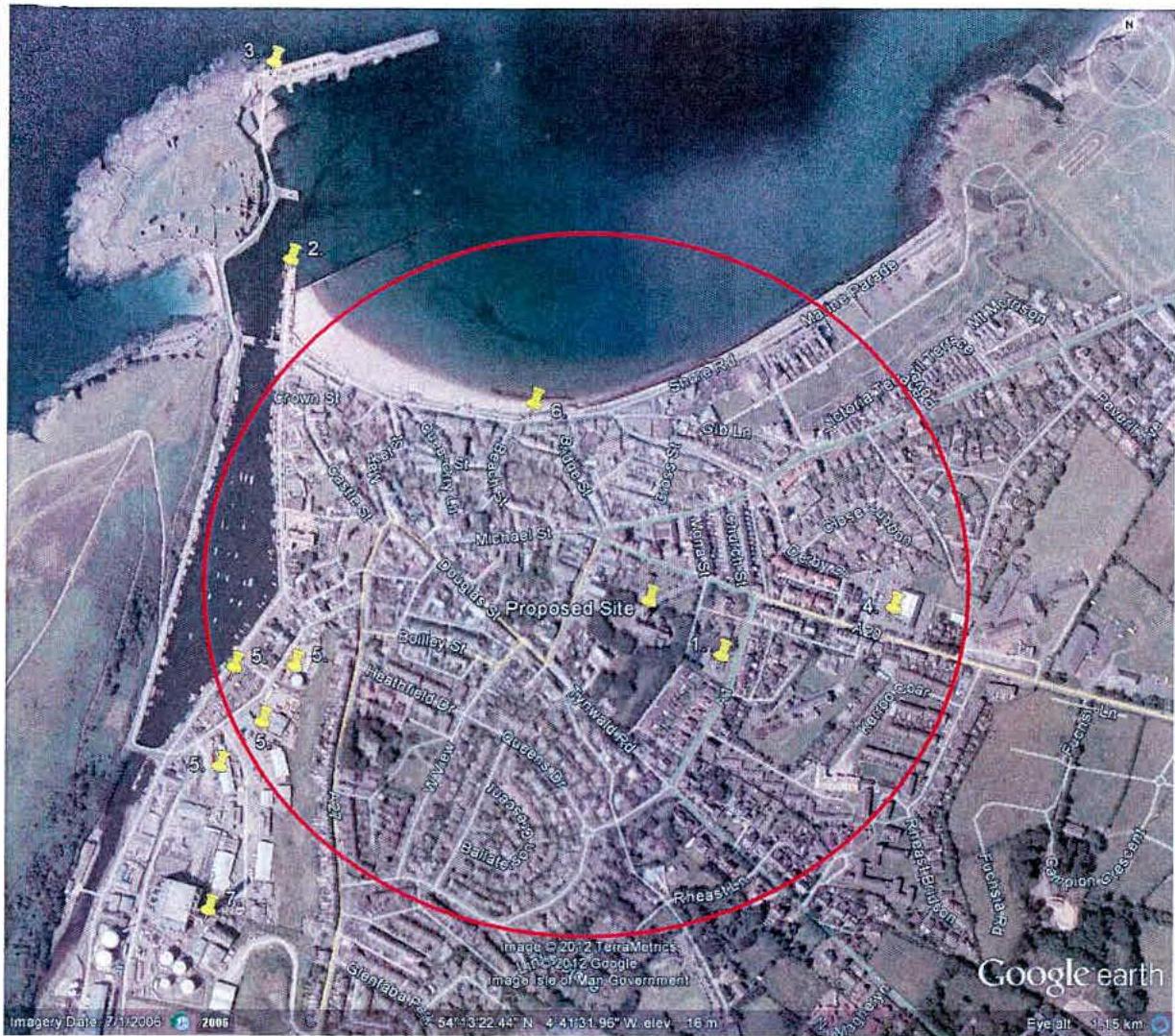
The following table provides details of alternative sites that were considered and discounted prior to progressing with the site which is subject of this application (the locations are plotted on the aerial photo below):
| Map Ref: | Site Location | Reasons for discounting in terms of planning, acquisition and coverage |
|---|---|---|
| 1 | Peel Telephone Exchange | The Peel Telephone Exchange is a single storey building located adjacent to St Germans Cathedral. The possibility of installing rooftop equipment was discounted as it would not be sufficiently high enough to gain height over the surrounding building and tree clutter and would not therefore provide the required coverage to the target area. A ground based installation within the grounds of the telephone exchange was also considered. A ground based structure at this location would need to exceed the height of surrounding buildings and trees in order to meet the coverage demand in the surrounding area and it was therefore considered that the proposed installation within the bell tower at St Germans would have less impact on the character and appearance of the surrounding area. The telephone exchange site was therefore discounted as it was considered that the proposal at St Germans Cathedral would be more appropriate in terms of minimising impact on the surrounding area. |
| 2 | East Quay Building | This building was considered for the installation of telecommunications equipment; however, due to the low height of the land at this location in relation to the majority of Peel, it would not provide the required quality of 'in-building' 3G coverage to the target area. This option was therefore discounted as it would not meet the coverage requirement in central Peel. |
| 3 | Existing Cable & Wireless Site, Peel Breakwater | The possibility of sharing with the existing Cable & Wireless site on Peel Breakwater was considered but discounted due to the low height of the land at this location in relation to the majority of Peel. A site at this location would not meet the requirement for in-building 3G coverage in the central Peel area. This option was therefore discounted as it would not meet the coverage requirement in central Peel. |
| 4 | Shopping Centre Derby Road | The possibility of installing rooftop equipment was discounted as the building would not be sufficiently high enough for the antennas to gain height over the surrounding building and tree clutter and would not therefore provide the required coverage to the target area. A ground based installation within the grounds of the shopping centre was also considered. A ground based structure at this location would need to exceed the height of surrounding buildings and trees in order to meet the coverage demand in the surrounding area and it was therefore considered that the proposed installation within the bell tower at St Germans would have less impact on the character and appearance of the surrounding area. The shopping centre site was therefore discounted as it was considered that the proposal at St Germans Cathedral would be more appropriate in terms of minimising impact on the surrounding area. |
| 5 | Locations adjacent to Station Road & East Quay | There are various commercial properties located in the vicinity of Station Road and East Quay, however the land at this location is significantly lower than the majority of the target area and a site at this location would not meet the requirement for in-building 3G coverage in central Peel. This option was therefore discounted as it would not meet the coverage requirement in central Peel. |
| 6 | Shore Road | The possibility of installing a streetworks style installation adjacent to Shore Road was considered and discounted because the land is significantly lower than the majority of the target area and a site at this location would not meet the requirement for in-building 3G coverage in central Peel. This option was therefore discounted as it would not meet the coverage requirement in central Peel. |
| 7 | Existing Chimney Station Road | The possibility of installing telecommunications equipment onto the large chimney located to the south west of Peel was considered. This option was discounted because the antennas would need to be located at a high level on the chimney which would result in a duplication of existing coverage provided by the existing Manx Telecom site on Peel Hill. A site at this location would not be close enough to the central Peel area to provide the level of in-building 3G coverage that is required. |
The following aerial photo shows the location of the alternative sites that have been discounted in relation to the search area which is shown as a red circle:
Additional relevant information:
It is recognised by many that telecommunication networks are a core infrastructure asset for any modern economy and the Isle of Man Government need to plan positively for their installation and long term use.
Infrastructure Policy 3 of the Isle of Man Strategic Plan (Adopted 2007) deals specifically with communications systems and states:
'A balance must be struck between the need for new, evolving communications systems to satisfy residential and business demand and the impact that the necessary infrastructure will have upon the environment. Measures which may help to achieve a satisfactory balance will include a presumption against visually intrusive masts in sensitive landscapes, the encouragement of mast sharing by different operators, and the removal of redundant infrastructure. Exceptions to this policy would need to demonstrate a strategic national need, which cannot be otherwise secured by mast sharing or alternative locations.'
In accordance with Infrastructure Policy 3, an additional base station is required in central Peel in order to satisfy the residential and business demand for high quality in-building 3G coverage. A thorough search of the Peel area has shown that there are no existing telecommunications sites within the search area which would meet the coverage demand in the central Peel area. The proposal which is subject of this application involves the installation of telecommunications equipment within the bell tower of St Germans Cathedral, thereby negating the
need for a ground based mast. While the proposal which is subject of this application is only for Manx Telecom, there would be sufficient space within the bell tower at St Germans to install equipment for an additional operator if the relevant louvers were replaced by GRP. It is considered that the sensitive design which is proposed at St Germans Cathedral, along with the importance of providing improved mobile communications coverage to the surrounding area, ensures that a good balance is struck between the need for evolving communications systems and minimising impact on the environment. In accordance with Infrastructure Policy 3, we can confirm that Manx Telecom would remove any equipment that becomes redundant in the future.
Environment Policy 32 from the Isle of Man Strategic Plan relates to development affecting Registered Buildings and states that:
"Extensions or alterations to a Registered Building which would affect detrimentally its character as a building or special architectural or historic interest will not be permitted."
Environment Policy 35 of the Isle of Man Strategic Plan deals with development within Conservation Areas and states:
"Within Conservation Areas, the Department will permit only development which would preserve or enhance the character or appearance of the Area, and will ensure that the special features contributing to the character and quality are protected against inappropriate development."
The proposed installation of telecommunications equipment within St Germans Cathedral complies with Environment Policies 32 and 35 of the Strategic Plan as it will not result in any detrimental impact on the character of the building, or on the architectural or historic interest of the building. While there will be some minor works inside the bell tower, none of these works will be visible from the exterior of the building. The proposal will have no impact on the character and appearance of the surrounding area as it has been sensitively designed and concealed within the existing church tower. The replacement GRP louvers would be made specifically for the site and will be coloured and textured to match the louvers which are being replaced. The existing louvers (which would be removed) will be retained at a safe location within the Cathedral so that they can be re-installed if the telecommunications equipment is no longer required at this location.
Overall, it is considered that the proposal complies with relevant policies in the Isle of Man Strategic Plan.
Special attention has been paid to the desirability of preserving the Registered Building, its setting and any features of special architectural or historic interest which it possesses. Particular regard has been had to the historic and special architectural importance of the building and particular physical features of the building that justify its designation as a listed building.
The Introduction of the Policy and Guidance Notes states:
"Above all Conservation means ensuring that, to the fullest possible extent, our built heritage remains in active use as an integral part of the living and working community, as a material asset that makes a positive contribution to economic prosperity and the overall quality of life which we enjoy on the Island."
In accordance with the above aim, the proposed installation within the bell tower at St Germans Cathedral will meet the demands of modern day communications requirements in the area which in turn makes a positive contribution to economic prosperity and quality of life.
Policy RB/5 related to Alterations to Registered Buildings and states:
"In considering whether to grant planning approval for development which affects a registered building or its setting and in considering whether to grant registered building consent for any works, the Department shall have special regard to the desirability of preserving the building or its setting or any features of special architectural or historic interest which is possesses."
It is considered that the proposal which is subject of this application would have a neutral impact on the setting and appearance of the Registered Building due to the sensitive siting and design of the proposed equipment within the bell tower. The proposal involves the installation of equipment within the bell tower and does not involve the permanent removal or alteration of any features of special architectural or historic interest. The proposal ensures that the heritage asset of the Registered Building is preserved while also providing the wider benefit of meeting the
demand for high quality 3G coverage in the surrounding area.
As detailed in the Code of Best Practice, the options available to operators can be affected by site conditions, technical constraints, landscape features and capacity requirements. The main options available are mast/site sharing, installations on existing buildings and structures, camouflaging equipment, using small scale equipment and erecting new ground based masts.
As there were no suitable telecommunications sites in the search area, the search moved onto investigating the suitability of existing buildings and other structures in the search area. This search highlighted St Germans Cathedral as an option which would be suitable in terms of the coverage that would be provided to the target area and where a sensitive scheme could be designed in order to camouflage the proposed equipment.
Paragraph 141-143 of the Code of Best Practice highlights that antennas can be effectively concealed behind GRP louvers within church towers in order to minimise any impact on the surrounding area. Paragraph 143 confirms that the installation of equipment within church tower has the advantage of using existing features and avoiding the need to create new and unnecessary forms of development.
The issue of health and safety concerns regarding telecommunications apparatus has been the subject of recent media coverage within the UK. As you may be aware, an Independent Expert Group on Mobile Phones (IEGMP) undertook thorough and in-going research with regard to the health effects of phones and base stations. The research found that: -
‘...the balance of the evidence does not suggest that mobile phone technologies put the health of the general population at risk.’
Court cases and appeals in the UK have established that health concerns are not a sufficient basis alone for withholding planning permission, notwithstanding any view the Authority may have adopted about current research in this field, providing it has been demonstrated that the proposed installation will comply with the ICNIRP guidelines.
The proposal, which is the subject of this application, is designed to be ICNIRP compliant as demonstrated by the ICNIRP certificate included with this application.
| Name: (Agent) | Mono Consultants Limited | Telephone: | 0141 270 2733 |
| Operator: | Manx Telecom Limited | Fax no: | 0141 566 6661 |
| Address: | Mono Consultants Limited 48 St Vincent St Glasgow G2 5TS | Email: | [email protected] |
| Signed: | Mono Consultants Limited | Date: | 13 September 2012 |
Copyright in submitted documents remains with their authors. Request removal
View as Markdown