Loading document...
HIGHWAY SERVICES DIVISION
Temporary Processing of Asphalt Waste Containing Coal Tar (AWCCT) at Old Turkeyland Quarry
| Name | Signature | Title | Date of Issue | Version |
|---|---|---|---|---|
| Gary Saunders | Highway Services Director | 17/12/2025 | 1 |
Author: Scott Duncan Status: ISSUE
This document requires the following approvals;
| Version | Date | Author | Checked | Description |
|---|---|---|---|---|
| 001 | 24/10/25 | S Duncan | G Saunders | Initial Version |
| 001 | 17/12/25 | S Duncan | G Saunders | Final Version |
Department of Infrastructure December 2025 Temporary Processing of AWCCT at Turkeyland Quarry Planning Statement of Case
CONTENTS
Chapter 3 - Planning and Regulatory Oversight
Chapter 4 –Site Assessment and Pollution Prevention
Chapter 5 –Compound and Temporary Plant
Chapter 6 –Transport Statement
Chapter 7 –Conclusion
Appendices Included in this document: Appendix A Planning Drawings
Department of Infrastructure December 2025 Temporary Processing of AWCCT at Turkeyland Quarry Planning Statement of Case
Chapter 1 –Introduction
The application seeks temporary planning consent for the controlled processing of hazardous asphalt waste, in accordance with the Isle of Man Government’s strategic planning and environmental policies, including Waste Policy 1 and Environment Policy 24 of the Strategic Plan. The proposed operation will be undertaken under a Waste Direction issued by the Department of Environment, Food and Agriculture (DEFA) and will be subject to regulatory oversight by the Environmental Protection Unit (EPU) to ensure full compliance with statutory environmental safeguards.
The temporary processing activity will be strictly time‑limited to align with the construction period of the Balthane Junction Improvement Scheme, currently estimated at 6–8 months. Although AWCCT processing will occur during two discrete operational phases, the temporary permission sought covers the full construction period to allow for safe site establishment, secure containment, controlled storage, and appropriate reinstatement upon completion.
The EPU will regulate the activity under the Water Pollution Act 1993 and the Public Health Act 1990, ensuring that stringent environmental controls are in place. These will include: impermeable hardstanding, sealed drainage and water‑management systems, emissions and odour monitoring, and full hazardous‑waste tracking and documentation.
Enabling local processing avoids the environmental risks and financial costs associated with exporting hazardous material off‑Island, removes reliance on landfill disposal, and supports the principles of a circular economy. Cold recycling ensures that the material is safely reused in road construction,
Department of Infrastructure December 2025 Temporary Processing of AWCCT at Turkeyland Quarry Planning Statement of Case
maximising the value of existing resources and supporting the Island’s sustainability objectives, including reduced waste to landfill and improved environmental resilience.
In parallel with this temporary proposal, the Department of Infrastructure is progressing a long‑term strategy aimed at establishing a licensed facility at Turkeyland Quarry for the permanent storage and processing of AWCCT. This future initiative is separate from, and not dependent upon, the temporary planning application. The temporary activity does not prejudice any future planning consideration but provides an immediate and proportionate solution to current infrastructure needs.
This approach is consistent with the Isle of Man’s Waste Regulation framework under the Public Health Act 1990, the Collection & Disposal of Waste Regulations 2000, and the Import & Export of Waste Regulations 2001, which promote waste recovery and environmentally sound management of hazardous materials. It also reflects best practices outlined in the UK’s Regulatory Position Statement RPS 157, which permits the storage, treatment, and reuse of asphalt waste containing coal tar (AWCCT) under controlled conditions, provided environmental and human health risks are mitigated.
Importantly, the hazardous material is encapsulated within a cold recycled bound pavement layer, significantly reducing the risk of leaching and exposure. This method aligns with the SEPA Position Statement WAS-PS-06, which recognises cold recycling as a sustainable treatment option that reduces environmental impact and supports the reuse of hazardous road materials in construction.
Chapter 3 –Planning and Regulatory Oversight
Department of Infrastructure December 2025 Temporary Processing of AWCCT at Turkeyland Quarry Planning Statement of Case
temporary planning approval is required for the use of Turkeyland Quarry as a licensed landfill site for the temporary processing of AWCCT.
The permission sought is limited in scope and duration and is required to support the Balthane Junction Improvement Scheme. Conditions attached to any approval will ensure environmental protection, containment, and operational safety, consistent with the Island’s statutory planning framework under the Town and Country Planning Act 1999.
The Environmental Protection Unit (EPU), part of the Department of Environment, Food and Agriculture (DEFA), will oversee the temporary processing activities under an approved Direction issued to the Department of Infrastructure. The EPU regulates waste and water pollution under the Water Pollution Act 1993 and the Public Health Act 1990.
For this project, EPU oversight will ensure the site operates on impermeable hardstanding with sealed drainage, maintains appropriate containment systems, adheres to hazardous waste tracking requirements, and complies with all environmental protection measures. These safeguards ensure the temporary activity can be carried out safely and within the Island’s regulatory framework.
3.1 Policy Context The proposed temporary processing of Asphalt Waste Containing Coal Tar (AWCCT) at Old Turkeyland Quarry fully accords with the principles and requirements set out within Waste Policy 1, which establishes the strategic framework for sustainable waste management on the Isle of Man. A clause‑by‑clause assessment is provided below:
The proposal directly supports the waste hierarchy by enabling reuse of AWCCT as part of the Balthane Junction Improvement Scheme. Without this temporary processing activity, the only remaining option would be off‑island disposal or long‑term storage, both of which are environmentally inferior. The project therefore maximises resource recovery and minimises reliance on disposal.
There is currently no licensed hazardous asphalt processing facility on the Island. This proposal provides essential interim capacity to safely treat AWCCT and prevents this hazardous material from entering landfill. It supports the development of longer‑term, on‑island hazardous waste solutions and aligns with the Department’s intent to expand future licensed capabilities at Turkeyland Quarry.
Department of Infrastructure December 2025 Temporary Processing of AWCCT at Turkeyland Quarry Planning Statement of Case
The proposal incorporates sealed drainage, impermeable hardstanding, secondary and tertiary containment, dust and noise controls, and full oversight by the Environmental Protection Unit (EPU). The activity is confined to a licensed landfill site away from residential receptors. These measures ensure no significant adverse impacts on public health, amenity, land, air or controlled waters.
Processing AWCCT locally avoids the extensive environmental burden of shipping hazardous road material off‑island for treatment. Transport is limited to short internal haulage between sites, significantly reducing vehicle miles and associated emissions.
Turkeyland Quarry already operates under a waste processing licence, benefits from a controlled access environment, has robust infrastructure, and is remote from sensitive receptors. The site is therefore an appropriate and policy‑compliant location for the temporary processing of hazardous asphalt waste.
The scheme includes: a concrete maturation pad with sealed joints a 89,000‑litre sealed drainage channel with penstock control bunded storage and processing systems an inspection and maintenance regime aligned with CIRIA C736
These measures ensure full compliance with this clause.
The proposal is strictly time‑limited, linked solely to delivery of the Balthane Junction Improvement Scheme. It represents the minimum level of development required to safely manage the identified waste stream and prevent environmental harm. It is therefore proportionate, necessary and fully consistent with clause (g).
3.2 Environmental Impact Assessment (EIA) Requirements This planning statement supports the position that a full Environmental Impact Assessment (EIA) is not required for the proposed temporary waste processing activity.
Department of Infrastructure December 2025 Temporary Processing of AWCCT at Turkeyland Quarry Planning Statement of Case
The development will occur entirely within the confines of an existing licensed waste management facility, using established hardstanding, drainage, and containment infrastructure. No new land take, excavation, or emissions sources beyond those already associated with the licensed landfill site are proposed. The activity is limited in scale, temporary in duration, and subject to stringent environmental controls.
In accordance with Environment Policy 24(ii), the application is accompanied by appropriate and proportionate environmental information, demonstrating how potential impacts—including dust, noise, drainage, emissions to controlled waters, and hazardous materials management—will be mitigated. These measures ensure compliance with the Strategic Plan’s environmental protection objectives.
Although the proposal meets the technical threshold for EIA screening due to the classification of the material, the screening assessment confirms that no likely significant environmental effects will arise, given:
the location within a licensed landfill site the limited and temporary nature of the activity the robust containment and control measures ongoing regulation by the Environmental Protection Unit (EPU)
Accordingly, a full EIA would not provide any material additional environmental assurance beyond the detailed information already submitted. The environmental information included with the planning application is therefore sufficient to support a robust and informed planning determination without the need for further assessment.
Chapter 4 –Site Assessment and Pollution Prevention
4.0 Site Assessment Two potential sites were identified and assessed for their suitability to accommodate the recycling of Asphalt Waste Containing Coal Tar (AWCCT), based on spatial capacity, operational feasibility, proximity to the Balthane Junction, and environmental constraints.
Site 1 - Site Compound: Located adjacent to the Balthane Roundabout, Site 1 occupies land previously occupied by the demolished properties at Railway Terrace (see Figure 4.1 below).
Department of Infrastructure December 2025 Temporary Processing of AWCCT at Turkeyland Quarry Planning Statement of Case
The compound has insufficient space to support aggregate processing and batching operations. Its proximity to existing buildings introduces several risks, including health and safety concerns, challenges in maintaining environmental controls, and difficulty achieving regulatory compliance for hazardous waste processing. These factors make the location unsuitable for AWCCT treatment.
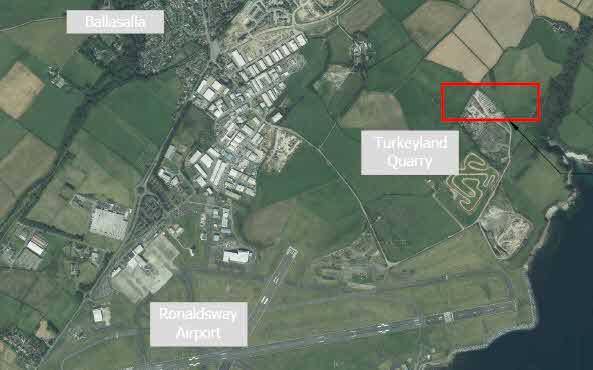
Site 2 - Old Turkeyland Quarry: Turkeyland Quarry is a larger facility currently operating under a waste processing licence (see Figure 4.2 below). It Is located approximately 1.6 miles from the Balthane Junction, offering convenient access while maintaining a safe distance from residential and commercial areas.
Department of Infrastructure December 2025 Temporary Processing of AWCCT at Turkeyland Quarry Planning Statement of Case
Turkeyland Quarry presents a significantly more suitable option for the temporary processing of AWCCT due to the following advantages:
Size and Infrastructure: The site offers a large operational footprint with a robust concrete hardstanding, capable of supporting aggregate processing and cold recycling activities.
Environmental Controls: It includes a substantial surface water drainage channel with a penstock-controlled outlet, enabling effective containment and controlled removal of leachate.
Licensing and Operational Experience: Although not currently licensed for hazardous waste, the site operates under an existing waste processing licence and has experienced staff familiar with waste handling protocols.
Security and Safety: The site benefits from a secure perimeter, controlled access, and natural buffer zones, reducing risks associated with noise, dust, and odour.
Strategic Fit: Its location and existing infrastructure align with the Department of Infrastructure’s long-term strategy to establish a licensed facility for AWCCT processing, supporting the Island’s sustainability and waste management goals.
Location: Its location is away from residential areas
These combined factors make Old Turkeyland Quarry the preferred location for the proposed temporary processing operation.
4.1 Pollution Prevention Best practice for waste processing compounds is set out in CIRIA C736 – Containment Systems for the Prevention of Pollution (2014), which outlines requirements for impermeable surfaces, sealed drainage systems, secondary/tertiary containment, together with inspection and maintenance expectations. Table 4.1 summarises the relevant principles and how they translate at a general level into project-specific implications that remain within CIRIA’s scope.
Table 4.1: Overview of CIRIA (2014) best practice guidance
Feature CIRIA (2014) Guidance Project-specific implications
| Feature | CIRIA (2014) Guidance | Project Specific Implications |
|---|---|---|
| Secondary containment | Design to contain loss of contents with allowance for rainfall and potential fire-water; use materials compatible with stored substances; provide controlled drainage to a contained point; avoid uncontrolled overflow routes; minimise wall/floor penetrations and protect structural integrity; incorporate safe access for inspection and clean-out. | Provide bunded storage/handling areas for relevant liquids associated with asphalt processing. Determine containment capacity, freeboard and construction details in accordance with CIRIA C736. Include controlled drainage to contained points and clearly identifiable isolation. Maintain safe access for inspection and removal of accumulated liquids |
| Impermeable surfaces | Use low-permeability, chemically resistant surfaces; construct with sealed joints; fall surfaces to | Locate storage and processing only on impermeable pads. Provide falls to contained collection points |
Department of Infrastructure December 2025 Temporary Processing of AWCCT at Turkeyland Quarry Planning Statement of Case
| contained collection points; protect against impact/abrasion; manage joints as serviceable components subject to periodic maintenance; prevent infiltration to ground | consistent with CIRIA. Keep joints sealed and serviceable; register and rectify damage or spalling. Where heavy plant operates, provide protection measures compatible with CIRIA’s durability principles. | |
|---|---|---|
| Sealed drainage systems | Provide a sealed drainage systemsegregated from surfacewater networks; capture spills and wash-down within containment; incorporate means of isolation and controlled removal; design out pathways that could permit escape to ground or water; document the drainage arrangement for operation and maintenance. | Route all relevant run-off to contained collection points within a sealed system that is separate from surface-water drainage, with isolation and controlled removal consistent with CIRIA. Keep definitive drawings showing the sealed network, isolation locations and normal operating positions. Any open conveyance features used must form part of the sealed/contained system as defined by CIRIA. |
| Tertiary Containment | Provide site-wide measures (e.g. perimeter bunds, cut-off drains, level management) to contain major incidents and protect sensitive receptors; ensure continuity and adequate capacity; design overland flow paths to remain within the site; consider extreme rainfall/flood pathways. | Confirm continuity and capacity of perimeter/tertiary measures against CIRIA criteria. Arrange levels and overland flow paths so that surface flows are directed to contained areas and remain within the site envelope under credible events. Record the basis of capacity and continuity checks. |
|---|---|---|
| Inspections & Maintenance | Inspection & maintenance Implement a planned inspection and maintenance regime covering bunds, impermeable surfaces, joints, drains, isolation devices and alarms; keep documented records; repair defects promptly; carry out periodic integrity checks where appropriate; retain documentation for audit. | Prepare and operate an inspection/maintenance plan in line with CIRIA: define frequencies, responsibilities and record-keeping for containment, surfaces/joints, drains and isolation devices. Undertake periodic integrity checks where CIRIA indicates. Retain records for the period required by licence/permit conditions. |
4.2 Secondary Containment Processing of Asphalt Waste Containing Coal Tar (AWCCT) will be undertaken on the maturation pad at Turkeyland Quarry. The maturation pad serves as a secondary containment system, required to prevent pollution from leachate or runoff during the treatment and storage of AWCCT. The pad is constructed of concrete with a perimeter upstand to intercept runoff, ensuring that any contaminants are effectively managed. A site-specific risk assessment, aligned with CIRIA C736’s three-tier methodology, has confirmed that the containment measures are appropriate for the nature and volume of AWCCT being processed.
Figure 4.3: Turkeyland Quarry: Maturation Pad
Department of Infrastructure December 2025 Temporary Processing of AWCCT at Turkeyland Quarry Planning Statement of Case
Department of Infrastructure December 2025 Temporary Processing of AWCCT at Turkeyland Quarry Planning Statement of Case
Figure 4.5: Turkeyland Quarry: Main Drainage Channel
Runoff will be retained within the channel and controlled via a penstock valve, which prevents discharge to the existing sea outfall. The contaminated runoff will be removed by tanker and transported to the Meary Veg sewage treatment plant for appropriate disposal in accordance with environmental regulations and best practice. There will be no discharge of leachate to sea.
This system ensures that surface water is effectively managed and that pollutants are contained and treated responsibly, supporting compliance with CIRIA C736 guidance on pollution prevention.
4.5 Tertiary Containment A tertiary containment measure is in place at Turkeyland Quarry in the form of a perimeter upstand surrounding the maturation pad, as illustrated in Figure 4.6. The upstand is intended to contain surface water runoff and prevent uncontrolled discharge beyond the operational area.
Figure 4.6: Turkeyland Quarry: Upstand to Hardstanding Edge
Department of Infrastructure December 2025 Temporary Processing of AWCCT at Turkeyland Quarry Planning Statement of Case
The upstand acts as a physical barrier, ensuring that any residual or accidental runoff is retained within the site boundary. This measure complements the primary and secondary containment systems and aligns with the principles of CIRIA C736, which advocates for multi-tiered containment strategies to mitigate pollution risk.
In the event of a containment breach or extreme weather event, the upstand provides a final safeguard, allowing for controlled management and disposal of contaminated water, thereby supporting compliance with environmental regulations and best practice.
Emissions to air (dust and particulates) Odour, noise, and vibration Emissions to land and surface/ground waters (including runoff and leachate) Mud and debris management Litter control Site security and access control Traffic management
All controls will be proportionate to the assessed risk and aligned with best practice guidance, including that referenced in Section 5.4 of CIRIA C736. Full details will be provided in the Department’s Waste Direction submission, including a Working Plan and compound layout prepared by the appointed Contractor.
Hardstanding Integrity: Inspection of surface condition and joint integrity to prevent infiltration and ensure structural integrity. Perimeter Upstand: verification of continuity and containment capacity to prevent uncontrolled discharge. Drainage Channel: Assessment of storage capacity and management protocols to handle expected volumes. Penstock Control and Tanker Export: Evaluation of operational readiness and compliance with discharge and export procedures
Audit outcomes will inform updates to the working plan.
Chapter 5 –Compound and Temporary Plant
5.0 Compound Regulatory Requirements The temporary compound will operate under a Waste Direction issued by the Department of Environment, Food and Agriculture (DEFA), with the
Department of Infrastructure December 2025 Temporary Processing of AWCCT at Turkeyland Quarry Planning Statement of Case
Environmental Protection Unit acting as the regulatory assessor. The compound will be managed in accordance with UK best practice, including the guidance set out in Regulatory Position Statement (RPS) 157.
The key regulatory requirements include: Storage Requirements:
Waste must be stored in secure containers. Storage volumes are subject to defined limits. No waste shall be stored for longer than 12 months. Different waste types must be stored separately. Where waste is stored in containers, the total quantity at any one time must not exceed 20 containers. The person storing the waste must either own the containers or have the owner’s consent.
Environmental Protection Measures:
Waste storage facilities must be secure and incorporate safeguards against pollution and unauthorized access. Discharge of pollutants into controlled waters without consent is prohibited.
Hazardous liquids (including leachates) must be stored within secondary containment systems on impermeable surfaces with sealed drainage.
5.1 Source of Asphalt Waste Containing Coal Tar (AWCCT) Asphalt Waste Containing Coal Tar (AWCCT) is classified as hazardous waste due to the presence of polycyclic aromatic hydrocarbons (PAHs). A total of approximately 1,375 tonnes of AWCCT will be managed at the compound, comprising:
375 tonnes to be transported from the Balthane Roundabout site. 1,000 tonnes currently stored in skips at various locations across the island.
To ensure compliance with regulatory thresholds and best practice (including RPS 157), the AWCCT will be processed in controlled phases. This approach ensures that the total volume of AWCCT stored onsite at any one time remains within the permitted limits of:
500 m³ if stored uncovered, or 1,000 m³ if stored under cover.
The temporary nature of the operation ensures that no material will be stored for longer than 12 months. Storage volumes and durations will be actively monitored and managed to maintain full compliance throughout the project.
For indicative planning purposes, a notional processing rate of approximately 60 tonnes per hour is considered achievable, subject to plant availability and logistical constraints. Final output rates and processing durations will be confirmed following the appointment of a specialist contractor.
Department of Infrastructure December 2025 Temporary Processing of AWCCT at Turkeyland Quarry Planning Statement of Case
Monday to Saturday: 07:00 –19:00
The duration of each processing phase will be defined in the detailed construction programme, which will be developed in collaboration with the appointed specialist contractor. While the overall project is anticipated to be completed within 6–8 months, the specific processing methodology, production rates, and phase durations will be determined based on the contractor’s proposed approach and operational logistics.
Crushing and screening of AWCCT material. Stockpiling of processed materials. Batching and transportation to the work site. Additional aggregate bins or stockpiles, particularly for imported primary fine aggregate, which is expected to be required.
Primary crushing will reduce larger material to a manageable size for further processing (see Figure 5.1: Primary Crushing Operation).
Figure 5.1: Primary Crushing
Secondary crushing and screening will then refine the material into the required coarse aggregate size fractions. A mobile crushing and screening
Department of Infrastructure December 2025 Temporary Processing of AWCCT at Turkeyland Quarry Planning Statement of Case plant, such as that shown in Figure 5.2: Mobile Secondary Crushing and Screening, is likely to be deployed. Figure 5.2: Secondary Crushing and Screening
In addition to size separation, this equipment can remove deleterious physical materials. Excavators will be used to feed the crushers and manage stockpiles.
5.5 Mobile Batching Plant The mobile batching plant comprises silos for cement and water, along with a batching unit, typically based on a modified crusher with a conveyor for loading trucks. This specialist plant folds into an HGV trailer-sized unit for transportation.
For safe and efficient operation, an overall working area in the order of 2,000 to 2,500 m² is typically required for mobile batching, exclusive of wider quarry operations (see Figure 5.3: Mobile Batching Plant).
Figure 5.3: Mobile Batching Plant
Department of Infrastructure December 2025 Temporary Processing of AWCCT at Turkeyland Quarry Planning Statement of Case
The decommissioning process will be undertaken in a timely and controlled manner to minimise any residual environmental impact and ensure the site is left in a safe and stable condition.
Chapter 6 –Transport Statement
On the approach to the Old Turkeyland Quarry, Balthane Road narrows, with formal passing places available to facilitate two‑way HGV movements. Although the road geometry requires occasional use of these passing places, opposing HGV encounters occur infrequently in practice due to existing traffic patterns and the relatively low volume of HGVs travelling to this specific location. The road’s current layout and operational characteristics are
Department of Infrastructure December 2025 Temporary Processing of AWCCT at Turkeyland Quarry Planning Statement of Case
therefore considered suitable for accommodating the anticipated temporary increase in HGV traffic associated with the proposal.
HGV Load Assumptions: A standard rigid HGV typically carries 18–20 tonnes of asphalt‐type material. A conservative 20‐tonne load assumption has been adopted to ensure movements are not understated. This reflects the typical vehicle configuration routinely accessing the industrial estate and Old Turkeyland Quarry.
HGV Movements:
Tanker Movements: The site’s sealed drainage and containment system will require periodic removal of collected runoff. One tanker collection per week is anticipated, resulting in approximately 12 tanker movements across the full programme.
Department of Infrastructure December 2025 Temporary Processing of AWCCT at Turkeyland Quarry Planning Statement of Case
Chapter 7 –Conclusion
7.0 Summary The temporary processing of Asphalt Waste Containing Coal Tar (AWCCT) at Old Turkeyland Quarry represents a necessary, proportionate, and environmentally robust approach to enabling the delivery of the Balthane Junction Improvement Scheme. In the absence of any licensed on‑island facility capable of treating AWCCT, the proposed activity provides a safe and controlled solution that accords with the Isle of Man Government’s Waste Strategy, Waste Policy 1 (a–g), and Environment Policy 24. The proposal also aligns with the principles of the waste hierarchy by facilitating reuse over disposal and by minimising the need for off‑island transport of hazardous material.
Turkeyland Quarry is demonstrably suitable for this temporary activity, offering impermeable hardstanding, sealed drainage, established containment measures, and regulatory oversight by the Environmental Protection Unit (EPU). The proposal is time‑limited, environmentally safeguarded, and designed to prevent any long‑term impacts, with full decommissioning and reinstatement to occur upon completion of the works.
The supporting Transport Statement confirms that Balthane Road is an established HGV route serving over 200 commercial units within the Balthane Industrial Estate and is fully capable of accommodating the temporary increase in vehicle movements associated with AWCCT processing. The Transport Statement also demonstrates that the two processing phases, each lasting approximately two weeks, will generate only 5–6 HGV movements per day, together with minimal ancillary tanker movements. These traffic levels are negligible within the context of baseline industrial‑estate traffic and will not give rise to any material highway safety or capacity concerns.
Overall, the proposal is environmentally sound, operationally feasible, and supported by a clear evidence base demonstrating that all environmental, regulatory, and transport considerations have been appropriately addressed. The development presents no significant adverse impacts and provides an essential, policy‑compliant mechanism for enabling wider infrastructure improvements at Balthane Junction. Approval of this application will allow the Department of Infrastructure to progress the scheme efficiently while maintaining strong environmental protection, sustainable practice, and responsible management of hazardous material.
Department of Infrastructure December 2025
Temporary Processing of AWCCT at Turkeyland Quarry _________________________________________________________________________________________________________________________ ______ Planning Statement of Case
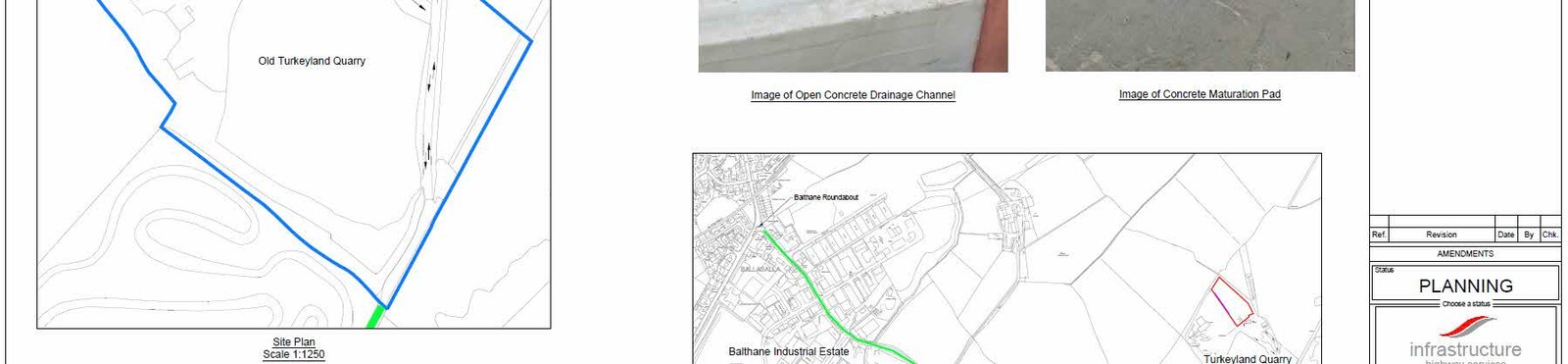
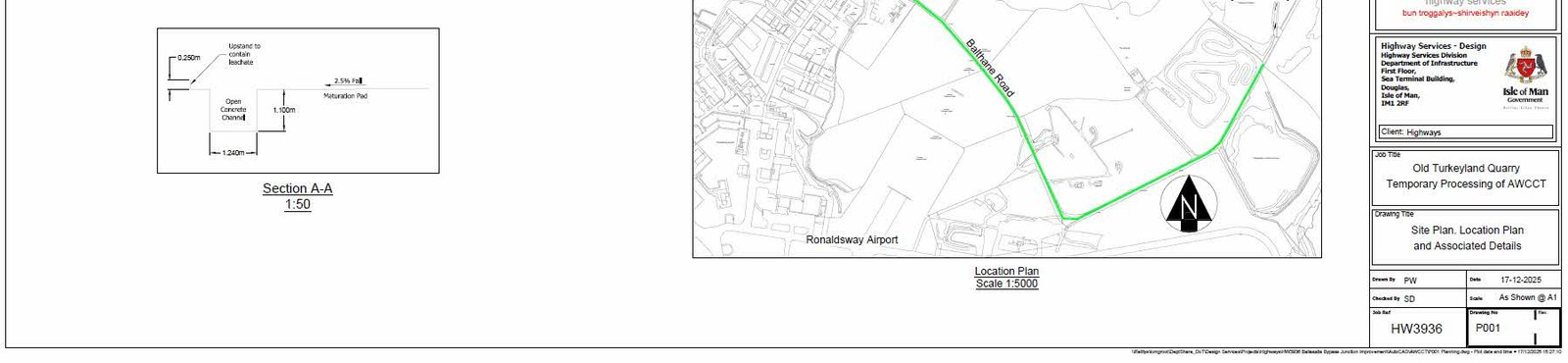
APPENDIX A –PLANNING DRAWING
Not to Scale
Copyright in submitted documents remains with their authors. Request removal
View as Markdown