Planning Statement In Respect Of The West Quay, Ramsey, Flood Defence And Highway Refurbishment Scheme
1.0 INTRODUCTION
1.1 This proposal concerns a section of Ramsey which abuts the southern side of Ramsey Harbour from Bowring Road through to East Quay and incorporating all of the public highway within this area. Much of West Quay currently has angled parking along its northern side with a metal chain fence separating it from the quayside working area. On the southern side there are some parking spaces - several are parallel with the footway and others angled in the vicinity of the Mitre Hotel. The road widens considerably towards its eastern end where there is angled parking on both sides.
1.2 The application proposes to install a flood wall alongside the harbour, floodgates around openings within the flood wall and new paving and surface treatment throughout the application site.
1.3 The incidence of flooding in Ramsey, as throughout the Island, is increasing and the awareness and predictability of flood events, what causes them and how this will change in the future is also the subject of a great deal of work within Government.
1.4 A series of schemes for the increased protection of parts of our Island where significant amounts of assets are at highest risk are being devised; a scheme for flood walling in Douglas has been approved and is currently being implemented. Similar schemes in Castletown and Peel have also been permitted and some implemented. All of the above are wholly or partly within adopted Conservation Areas.
1.5 The need for increased protection against future flood risks is becoming heightened, particularly with awareness of climate change and the impacts of that with the need for existing property to become more flood resilient and the assessment of flood risk not only to a proposed development but also potential risks from it becoming a key element in the consideration of development proposals.
1.6 The application site abuts part of the main commercial part of Ramsey with the harbourside properties accommodating residential, office, retail and industrial accommodation all of which contributes to the interest and vitality of the town. The harbourside also accommodates on street car parking which is currently restricted by disc display within certain times of the day and week.
1.7 The harbourside has no formal footway although the rear of the parking spaces is marked by a metal chain fence which is set back from the harbourside and this space can accommodate pedestrians as well as those working from boats moored within the harbour itself.
1.8 Ramsey Swing Bridge sits almost half way along the application site, providing pedestrian and vehicular (one way only to the north) access to and from the Mooragh Promenade. The bridge is manually controlled to swing across to enable access for boats into and out of the inner harbour.
1.9 Across the harbour from the application site is Ramsey Shipyard which accommodates a boat yard and a number of industrial units. To the north of this are a number of residential properties between the shipyard and North Shore Road including a relatively new residential development of Traie Twoaie.
1.10 The most recent iteration of flood maps shows the town affected by flooding as follows with the green shading indicating high likelihood of tidal flooding:
1.11 The quayside accommodates a variety of buildings of differing heights, styles, functionsand ages. Part of the site lies within the town’s Conservation Area and there are RegisteredBuildings abutting the site (see Planning Context below).
2.0 THE PROPOSAL
2.1 Proposed is a scheme to introduce enhanced protection against flooding of the southern side of the harbour. This scheme incorporates the building of a wall along the southern edge of the harbour from Bowring Road to Neptune Street incorporating pedestrian and vehicular flood gates; the resurfacing of the footway and carriageway throughout the application site retaining the existing semi circular ginnel name paving relating to Old Post Office Lane, Collins Lane etc.
2.2 The proposed flood wall will be 1.3m above footway level and constructed in concrete with inset imprinted pattern depicting a wavelike texture to make reference to the maritime location of the proposal. In addition, artwork panels will be introduced at strategic points along the wall. Artwork will be subject to selection by competition in conjunction with the IOM Arts Council.
2.3 The wall will start at the junction of Bowring Road and the harbour wall and continue along the northern side of Derby Road, West and East Quays to wrap around the Old Custom House and terminating on East Quay just north east of Neptune Street.
2.4 The wall will be positioned at the outer edge of the existing harbour wall from Bowring Road to the Registered Tree opposite the car showroom on Derby Road from where the wall will sit set inland from the harbour wall by a distance of approximately 1.8m minimum - a wider area than at present - replacing the current post and chain fencing.
2.5 The section between the existing harbour wall and the proposed new flood wall will be finished in blue coloured surfacing. Appropriate wailing and mooring posts will be either retained or introduced as shown in the accompanying drawings along with new power pedestals and access ladders.
2.6 This blue surfacing will continue until the Swing Bridge where new granite paving will be introduced alongside a new raised junction surface incorporating new street lights, tactile paving, granite carriageway setts and new steel lighting columns.
2.7 From East Street and the Swing Bridge eastward the road widens and new granite composite footway surfacing will be introduced alongside the flood wall incorporating new tree planting in the wider sections of the footway. Opposite Old Post Office Lane there will be a continuation the blue surfaced footway with different coloured surfacing on the harbour
side of the blue surfacing. At this point the harbour wall will run adjacent to the carriageway with the pedestrian footway solely on the harbour side of the wall.
2.8 On the southern side of the road, there will be new granite paving introduced on sections of the currently concrete footway:
2.9 As mentioned above, the existing ginnel names will be retained.
2.10 Between East Street and East Quay the southern side of the road will see a continuous granite finished footway with different coloured setts denoting the parallel spaces available in front of a number of properties in this area where the road is wider. A new, wider footway will be introduced in granite in front of the Mitre Hotel with a new pedestrian crossing leading to the other side of the road.
2.11 The granite footway will continue across the north eastern end of the Market Place across onto East Quay terminating just before the Old Custom House.
2.12 The carriageway along Derby Road, West and East Quays will be a simple asphalt surface with appropriate line marking where necessary.
2.13 The scheme will rearrange and reorientate the existing on street car parking and will result in the loss of 52 existing on street car parking spaces. The currently angled parking on the harbourside will be replaced with parallel spaces with two areas of motorcycle parking between Collins Lane and the Swing Bridge and a loading bay and two customer parking spaces including one suitable for disabled users, alongside the Farmers’ Combine. Otherwise there will be no on street parking on the southern side of Derby Road and West Quay up to the Swing Bridge.
3.0 PLANNING POLICY CONTEXT AND MATERIAL CONSIDERATIONS
3.1 There are a number of planning policies and proposals which are relevant to the determination of this application as well as other material considerations including statements of national policy and strategy, planning policy statement and other legislation.
3.2 Ramsey Local Plan 1998
3.2.1 The starting point for most developments is the land use designation on the adopted development plan. In this case, the only adopted land use plan is the Ramsey Local Plan which was adopted in 1998. Cabinet Office prepared a replacement for this, - the draft Area Plan for the North and West (APNW) incorporating not only Ramsey but the whole of the north and the west of the Island, commencing in 2019 and cumulating in the adoption of a final draft plan which was put to Tynwald. However, the plan this plan did not attract the required majority of votes in Tynwald on 18.11.25 and was not adopted. The draft APNW therefore has no material weight in the planning process.
3.2.2 There is, however, information which supports the plan, some of which is factually based and may have relevance to the current application, despite the plan itself having failed to be adopted and this will be cited later in this document. It should be noted that the prevailing adopted land use plan and proposals date back to a time when flood risk was much less of a concern than it is now and there is considerable amounts of data which has been compiled and policy adopted since then which does not appear in the Ramsey Local Plan but none the less is material to the consideration of development proposals today.
3.2.3 The site is designated on the Ramsey Local Plan along with all of the land between Bowring Road, South Promenade and Albert Road, as Mixed Use. There is a secondary reference within this Mixed Use area, of Town Centre which includes all of this area as well
as land on the southern side of Albert Road which currently accommodate car parks on cleared sites.
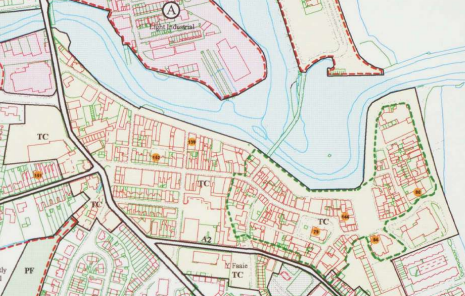
3.2.4 The site identifies a number of Registered Buildings within the Town Centre Mixed Use area, including 26, West Quay which abuts the application site. Since the adoption of the local plan, the Swing Bridge and Stone Bridge have both been Registered (RBs 338 and 347 respectively). Part of the site lies within the town’s Conservation Area (shown in green dashed lines below).
Excerpt from Ramsey Local Plan 1998
3.2.5 The Ramsey Local Plan Written Statement contains a number of proposals and statements which are considered relevant to the current proposal. The Sulby River is recognised as one of the quality open space areas in the town. It states that the harbour and beaches and bay should be protected from pollution (paragraph 7.3).
3.2.6 The Statement refers to the need for archaeological excavations should there be any redevelopment proposals in the area of East Quay (paragraph 7.5).
3.2.7 The Plan recommends the protection of the saltmarsh on the Sulby River and the Mooragh Promenade dunes, neither of which is within the application site.
3.2.8 There is a Policy referring to the protection of Ramsey Beaches including no development or engineering operations which would increase the amount of sand/silt moving towards South Pier or into the harbour (R/E/P2).
This image displays a planning site location map showing a coastal or riverside area with a network of roads, building footprints, and a significant water body.
3.2.9 There is a policy requiring consultation with Manx National Heritage on any development in the East Quay/South Promenade area (R/E/P4).
3.2.10 There are policies within the Written Statement on Conservation Areas and Registered Buildings which have been overtaken by more up to date policies and statements which will be referred to later in this document.
3.2.11 North Shore/Shipyard area is identified as an area for environmental improvement including planting of wildlife beneficial planting (R/E/P7).
3.2.12 The section on Ramsey Town Centre emphasises the need for the continuation of the town centre as the focus of commercial activity, noting the importance of the workshops, warehouses and retention of the harbour trade which “helps maintain the vitality and interest of the town centre”. It also recognises the importance of residential units in the town centre area (paragraph 9.7).
3.2.13 Car parking is discussed but in respect of potential pedestrianisation proposals (paragraph 9.10).
3.2.14 West Quay is specifically referred to at R/TC/P6 in presuming in favour of rehabilitation and conversion of the warehouse buildings rather than their replacement.
3.3 Isle of Man Strategic Plan (2016)
3.3.1 The Strategic Plan provides generally non geographic policy and guidance on development throughout the Island and this sits alongside any land use development plan in guiding development. If there is any conflict between adopted policies, whichever was adopted later would prevail, in this case, the Strategic Plan.
3.3.2 Ramsey is identified in the Strategic Plan as a Service Centre where development will be concentrated to provide regeneration and choice of location for housing, employment and services (Spatial Policy 2).
3.3.3 Development is generally directed to existing settlements (Strategic Policies 1, 2 and 10, Spatial Policy 5, Housing Policy 4 and Transport Policy 1).
3.3.4 In terms of flooding and coastal defence works the following policies are relevant: Environment Policy 10 - requires the submission of a flood risk report with applications for development on sites at risk of flooding. Environment Policy 11 - indicates that they will only be permitted where they do not increase or transfer the risk of flooding, prejudice the capacity of the coast to form a natural sea defence or increase the need for additional coast protection works except where necessary to protect existing investment or development.
3.3.5 Supporting paragraph 7.11.1 requires potential environmental effects of new coastal defence work to be taken into account and that such development does not increase or transfer the risk of flooding elsewhere.
3.3.6 Environment Policy 12 requires that that new coastal defence works must not have an unacceptable impact on the character, appearance, ecology, archaeology or natural processes of the coastal environment.
3.3.7 There are a number of policies in the Strategic Plan which are relevant to enhancement of the environment with particular regard to sites within Conservation Areas and concerning or close to Registered Buildings: Strategic Policies 4, 5 and 6, Environment Policies 35, 36 and 42.
3.3.8 Environment Policy 35, supported by CA/2 of Planning Policy Statement 1/01 Conservation of the Historic Environment of the Isle of Man require that within Conservation Areas development must preserve or enhance the character and ensure that the special features contributing to the character and quality are protected against inappropriate development.
3.3.9 General Policy 2 provides a list of criteria with which development should accord requiring that development respects the site and surroundings in terms of scale, form and design (b) and should not adversely affect the character of the surrounding townscape (c and g) or public views of the sea (e). It also requires that development provides appropriate safe and convenient access for all highway users, together with adequate parking, servicing and manoeuvring space and does not have an unacceptable effect on road safety or traffic flows on the local highways (h and i). It also requires that development does not prejudice the use or development of adjoining land in accordance with the appropriate land use plan.
3.3.10 Recreation Policy 2 seeks to prevent a net loss of open space.
3.3.11 Environment Policy 22 states that Development will not be permitted where it would unacceptably harm the environment and/or the amenity of nearby properties in terms of: i) pollution of sea, surface water or groundwater; ii) emissions of airborne pollutants; and iii) vibration, odour, noise or light pollution. Environment Policy 24, together with appendix 5, sets out the need for Environmental Impact Assessment for development which would have a “significant effect on the environment”. Appendix 5 sets out further information and instances where an Environmental Impact Assessment will be required in all cases, including “coastal work to combat erosion and maritime works capable of altering the coast through the construction of for example dykes, moles, jetties and other sea defence works, excluding the maintenance and reconstruction of such works”.
3.3.12 Environment Policies 4 and 7 protect ecology providing a planning context for the provisions of the Wildlife Act 1990. In this respect the existence of the Marine Nature Reserve is relevant:
3.3.13 The Strategic Plan identifies Ramsey Harbour as one of the principal gateways to the Island with an emphasis on building and agricultural imports and exports (paragraph 5.15). Transport Policies 13 and 14 state:
Transport Policy 13: Development in or around harbours should neither compromise the ability of the harbour to accommodate other commercial or recreational users in a viable manner, nor be detrimental to the character of those harbours of historic interest.
Transport Policy 14: Any proposed schemes likely to impact upon the ecology and/or archaeology of a harbour or the nearby coastline should be accompanied by an Environmental Impact Assessment.
3.4 Draft Area Plan for the North and West
3.4.1 Whilst not approved by Tynwald, it is considered relevant that this document includes information and guidance on flood risk. It states that The Island Plan is clear about devising a roadmap which addresses climate change including developing a Plan for climate change adaptation including flood management and mitigation stating that the draft Area Plan plays a part in responding to the climate crisis.
3.4.2 It refers at 4.1.3 to “The issues faced by specific assets identified in the First Monitoring Audit (2018)11 of the NIS are the same as those identified in the original Strategy, namely:....Flooding and wave overtopping in the harbour environments of Ramsey and Peel”.
3.4.3 It also states: “4.1.4 The Audit made it clear that there remain are a number of local infrastructure issues. These are addressed throughout the plan, namely... ii. Coastal defence schemes in Peel and Ramsey”.
3.4.4 It refers to the Government Harbours Strategy as follows:
4.2.2 The Harbours Strategy notes that Ramsey Harbour accommodates commercial freight operations, fishing vessels, recreational boating and ship repair. Constraints include limited vessel berthing and loading/unloading operations and a narrow and exposed harbour entrance. The opportunities at Ramsey include: existing boat lifting and storage ashore, and an existing marine engineering sector, including specialist
marine workshops. There are opportunities for yacht refit, landside support services for industries such as renewables and potential for a town quay wharf with improved facilities highlighting the area’s maritime heritage.
4.2.3 Key details of the Harbours Strategy for Ramsey relate to:
i. The Department of Infrastructure taking over responsibility for the shipyard premises -
a. A third of which is to be used for Government maritime vessels and storage;
b. The remainder of the shipyard is to be promoted for engineering and vessel maintenance.
3.4.5 Managing and dealing with flood risk is identified as a key issue for Ramsey as well as protecting the Marine Nature Reserve (Natural Environment Proposal 6) which supports the Wildlife Act 1990 and Environment Policies 4 and 7 of the Strategic Plan.
3.4.6 The Plan went as far as stating that flood alleviation measures will be supported in principle for the Ramsey harbour area, requiring that “schemes must demonstrate the known flood risk and assess nature conservation (including designated sites), biosecurity (invasive non-native species), heritage and landscape and visual impacts. There must be clear demonstration that the final design and finishes have been prepared with the findings in mind with clear mitigation proposals where necessary to minimise those impacts” as well as requiring that regard is had to silt build up, echoing concerns in the Ramsey Local Plan, noted above.
3.5 Other material considerations Legislation Equality Act 2017
3.5.1 Whilst not planning legislation, the Equality Act particularly Section 143 states that public bodies in the exercise of their functions, must promote equality, eliminate discrimination, advance equality of opportunity and foster good relations and states that “The steps involved in meeting the needs of disabled persons that are different from the needs of persons who are not disabled include, in particular, steps to take account of disabled persons’ disabilities.”
Town and Country Planning Act 1999
3.5.2 Section 16(3) of the Town and Country Planning Act (1999) states, "In considering (a) whether to grant planning approval for development which affects a registered building or its setting, or (b) whether to grant registered building consent for any works, the relevant Department shall have special regard to the desirability of preserving the building or its setting or any features of special architectural or historic interest which it possesses".
3.5.3 Section 18(4) of the Town and Country Planning Act (1999) states, "(4) Where any area is for the time being a conservation area, special attention shall be paid to the desirability of preserving or enhancing its character or appearance in the exercise, with respect to any buildings or other land in the area, of any powers under this Act”. The site adjoins two Registered Buildings (26, West Quay and the Swing Bridge) and is close to the Stone Bridge which is also an RB
National Strategy on Sea Defences, Flooding and Coastal Erosion
3.5.4 GD No. 2016/0044 - National Strategy on Sea Defences, Flooding and Coastal Erosion was received and approved and the associated Evidence Report noted as an essential source of information and guidance in respect to ensuring the ongoing resilience of our communities and economy to weather and climate related damage. The Department intends to have the renewed Strategy covering 2026 -2036 laid before Tynwald in January 2026.
3.5.5 The Strategy establishes objectives to raise community awareness and adaption to flood and coastal erosion risks, manage and reduce their impacts and prioritise investment to balance the urgency and impact of the risks involved. Department for Infrastructure responsibilities under the National Strategy include highway drainage, and critical infrastructure.
3.5.6 The planning officer’s report on the recently approved application for the Douglas Promenade Sea Wall, 24/00743/B states in respect to the National Strategy on Sea Defences etc:
“No Action Plan has been published setting out how the various infrastructure projects identified within the Strategy will be delivered. Until then, it is current
Government policy to continue to invest in sea defences and in reducing flooding risk for areas at high risk.”
3.5.7 The Strategy identifies seven areas of Ramsey two of which are in the highest risk class. These includes the application site. It also states that Ramsey, inter alia has been affected by flooding following torrential rain events. Ramsey also has the greatest number of critical assets within one grid square (23 assets). This grid square includes the application site. This grid square also has the highest combined risk for all receptors - property, environment, road and rail infrastructure and critical assets. The report recommends to “Review schemes already planned by DoI and Manx Utilities and consider potential to bring forward schemes to address high level of risk e.g. Manx Utilities Litney Stream and DoI Ramsey Harbour.”
3.5.8 It goes on:
Tidal flood mapping suggests that a large portion of Ramsey would be vulnerable to flooding should a 1 in 200-year tidal flood (plus climate change allowing) occur. To the north of the river, properties on or close to the promenade between the sea and Mooragh Marina are most at risk. However there is a greater flood risk to those areas to the south of the river. Any water overtopping the defence to the south of the Harbour is routed in north-westerly direction across low lying land on the south bank of the river. As this area is heavily populated a significant number of properties and residents would be at risk. Ramsey Harbour is at risk of still water level flooding during the 1 in 2-year event in present day conditions showing a very high risk of still water level flooding, highlighting the need for imminent defence improvements which are planned. Flood risk also from surface water flooding and fluvial flooding - Litney Stream and Sulby River towards the coast with a number of historic events including December 2015. Flood defences already in place helped protect some communities in Ramsey.
This area is highly sensitive to climate change for coastal flooding so level of risk is likely to substantially increase over next 50 years and climate change projections need to be taken into account in scheme design.
3.5.9 The down stream impact of any works upstream on the Sulby River should also be considered.
3.5.10 The 2014 Flooding and Wave Overtopping Study Concept Design Report is a further background document which refers to Ramsey and the potential for a raised flood wall, set back wall and/or tidal gate recommending the set back wall as the preferred option.
3.6 Brownfield development
3.6.1 The promotion and realisation of the development of brownfield sites within settlements has been a key element of Government strategy in recent times with schemes now brought forward to support the Strategic Plan policies which promote sustainable development within settlements.
3.6.2 The Unoccupied Urban Sites strategy identified key sites which it was hoped could be brought forward. In Ramsey, there were a total of 15 sites, five of which front onto West Quay with a further three within close proximity and reference to the proximity of these sites to the potential flood zone is noted.
3.6.3 If a site is identified as an UUS it can be eligible for funding under the Island Infrastructure Scheme. Funding under this Scheme is made available “to bridge the financial gap to enable development on these key urban sites, turning unviable development plans to viable opportunities with the minimal amount of support needed.”
3.6.4 Finally, there is a Registered Tree adjacent to the proposed wall to the south east of Harbourside Apartments. This is an elm, Registered in 2019.
4.0 PLANNING HISTORY
4.1 There have been a number of applications for the renovation and replacement of buildings along West Quay but none for the application site itself other than an application for the construction of a flood wall and highway drainage system which was submitted in October 2021 but withdrawn in January 2022.
4.2 There are a number of vacant sites along the landward side of West Quay, some of which have extant planning approvals for redevelopment including 21/00585/B on the former Barry Curran and Farmers’ Combine site, 23/00446/B for 21-22, West Quay, 22/00649/B for 6, West Quay and buildings to the rear. None has currently commenced.
4.3 Elsewhere on the Island, flood defence schemes have been permitted in Castletown (16/00635/B) (implemented), Peel (20/01320/B) and Douglas (19/00755/B, 22/01264/B and 24/00743/B) (part implemented).
5.0 PLANNING ASSESSMENT
5.1 The proposal is considered to have potential impacts on the following receptors:
• Highway safety (General Policy 2h and i and Transport Policy 4)
• Car parking (General Policy 2h and Transport Policy 7)
• Visual impact (Strategic Policies 3, 4 and 5, Environment Policy 42 and General Policy 2 b, c and g)
• Impact on heritage assets (Strategic Policy 4, Environment Policies 35 and 36 and Planning Policy Statement 1/01 - Conservation of the Historic Environment of the Isle of Man
• Use of the harbour and harbourside by those in boats and the public using the quayside (General Policy 2k)
• Impact on flood risk (General Policy 2l and Environment Policies 10 and 13)
• Impact on the Registered Tree (Environment Policy 3)
5.2 It is also relevant to consider whether any adverse impacts identified in respect of the above are outweighed by any benefits of the scheme and whether there could be any reasonable alternatives to the proposed application.
5.3 Highway safety (General Policy 2h and i and Transport Policy 4)
5.3.1 The scheme has been designed to maintain highway safety for all users of the application site - pedestrians, vehicle users, property owners and those engaged in activities within the harbour itself and who use the harbourside.
5.3.2 The scheme incorporates a continuous 1.8m walkway on the harbourside of the new wall. This improves the space available for users of this area and particularly would enable those with mobility aids to safely use all of the harbourside walkway. This will also provide a wider area for boat owners and those needing to use the harbourside for marine related activity. The scheme also provides a new footway on the landward side of the new wall which is fundamental to meeting accessibility and highway standards which provides pedestrians with a safe route to parked vehicles without stepping onto the carriageway and providing a dedicated pedestrian route which will not be impeded by those working on craft within the harbour. DfT Inclusive Mobility guidance recommends a minimum 1.5 m clear width for pedestrian routes, ideally 2 m, to ensure accessibility for all users. This landward footway would ensure that this is available at all times.
5.3.3 Whilst not generally a planning consideration, the scheme, if approved would take between 18 and 24 months to complete and a Traffic Management Plan would be prepared and agreed within Department for Infrastructure prior to the start of any works. This will involve measures to ensure all properties owners have access to their properties when needed and with advance warning notification to avoid local events and minimise disruption to harbour operations wherever possible.
5.3.4 Whilst buses do not currently use Derby Road, West or East Quays, the scheme has been designed to accommodate them together with appropriate bus stop facilities should this be proposed in the future.
5.3.5 The scheme has also been designed to accommodate all users with new tactile paving
at crossing points to assist visually impaired users, enhanced pedestrian connectivity through the application area with widened footways, improved lighting, continuous links along the harbourside and with Parliament Street.
5.3.6 It is concluded that the proposal will not result in any adverse highway safety impact.
5.4 Car parking (General Policy 2h and Transport Policy 7)
5.4.1 The scheme will result in the loss of 52 on street car parking spaces. This is unfortunately unavoidable if the wall is to be introduced and whilst maintaining an appropriate harbourside working area with pedestrian footway and an appropriate carriageway width.
5.4.2 The scheme has retained space in front of the Farmer’s Combine, the operation which perhaps involves the largest delivery vehicles to properties on the southern side of the harbour, to enable the delivery of items along with two parking spaces directly alongside. Unfortunately due to the alignment and width of the road at this point, it is not practicable to incorporate additional on street parking spaces here...
5.4.3 The application is accompanied by various studies into car parking in the town all of which are considered relevant and comments have been made in respect any changes in circumstance since that works undertaken. The information suggests that there is not a shortage of available car parking within the town which would result in the proposal being considered to have a detrimental impact on car parking sufficient to justify a refusal of the application.
5.4.4 The supporting information includes reference to the available spaces within convenient walking distance of the town and Ramsey’s wider network offers sufficient capacity to absorb this change in the number of spaces available on the Quays. Any disadvantage from the loss of parking we would suggest is outweighed by the benefit in enhanced flood protection resulting from the proposal.
5.5 Visual impact (Strategic Policies 3, 4 and 5, Environment Policy 42 and General Policy 2 b, c and g)
5.5.1 As with the proposals for Castletown, Peel and Douglas, the introduction of a new wall feature alongside the harbour/sea will change the appearance of the area. In these other cases this change was considered acceptable.
5.5.2 In the case of Ramsey, like Castletown and Peel, the harbour is a working area which is shared by marine craft as well as vehicles and pedestrians. Like these other two, Peel in particular, the area of the flood wall is well used by local people and visitors using the harbourside facilities which include restaurants, public houses, shops, cafes and outside seating. The proposed flood wall is, in the main, introduced such that there is still public access on the harbour side of the wall, maintaining this currently well used space. This scheme enhances this space by widening the area and also maintains a pedestrian footway on the other side of the wall and thus provides an opportunity for a distinct separation of the marine workings and operations and pedestrian movement.
5.5.3 A dedicated operational zone will be introduced to the east of the Swing Bridge where marine related operations may be undertaken without pedestrian access running through the area. When this is not required it would be available to the public.
5.5.4 It is essential to the success of the scheme, both functionally and visually, that this mix of public and marine use is maintained and we would submit that this proposal achieves both.
5.5.5 The introduction of the wall will obscure some of the boat related activity from view from the southern side of the road although masts and rigging will still be visible. At present, there are currently often vehicles parked alongside the metal chain fence which prevent a clear view of the harbour so in practice, this view will not materially change. This will continue for the most part albeit in front of a new flood wall.
5.5.6 The character of the harbour and West and East Quays is more focused on the buildings which abut them and the harbourside activity rather than the harbourside itself per se. We would submit that this interaction of buildings and quayside will remain but with a more formal demarcation of harbour with the town but with public access to both. As noted in the Environmental Impact Assessment the current carriageway and footways within the Conservation Area and within the application area are in poor repair and with little or no original materials. What is proposed would introduce more attractive materials which are more user friendly and complement the highway improvements which have already been undertaken within the town and will provide a consistent treatment throughout the application site.
5.5.7 The view of the area, and the Conservation Area more specifically is largely from close up, by users of the Quays themselves. There are some more distant views, such as from the shipyard and from the southern end of Mooragh Promenade but from where the size and scale of the existing buildings will still dominate the view and streetscene with the new wall being no higher than the parked vehicles which currently appear along the quayside and some of which will remain in the new arrangement for on street parking.
5.5.8 Currently there is a variety of harbourside boundaries including solid walling along Derby Road and chain fencing otherwise along the rest of the application site up to East Quay where there is a low masonry wall. What is proposed will provide a consistent treatment all the way along the quay which in our view will be a visual improvement.
5.5.9 The wall has been designed differently to the walling approved in Peel, Castletown and Douglas and reflects the preponderance of plain, rendered buildings and the functional nature of the working harbour with detailed elements to add interest and opportunities for Ramsey specific artwork to be incorporated. From a distance, the wall will be little different to the sides of the existing harbour wall but projecting slightly above the white moorings.
5.5.10 We would submit that the impact on the streetscene, taking the above into account, will be acceptable.
5.6 Impact on heritage assets (Strategic Policy 4, Environment Policies 35 and 36 andPlanning Policy Statement 1/01 - Conservation of the Historic Environment of the Isleof Man
5.6.1 There are a number of Registered Buildings abutting the application site and proposed works and also a range of other, non designated heritage assets which are listed in the Environmental Impact Assessment. These include plaques and buildings which are not Registered but none the less are of heritage value and the impact on them must also be considered both in terms of the proposed flood wall and the street works.
5.6.2 Two of the Registered Buildings abut the site - the Swing Bridge and 26, West Quay. The proposed flood wall will directly affect the setting of the bridge as it will run up to it and the proposed street works in the vicinity will also have an impact. The context of the bridge is directly associated with the harbour both visually and functionally. This will remain with the harbourside remaining usable by the marine craft alongside it. As the bridge is significantly higher than the proposed wall, it will remain visible above it, as it currently is, over the parked vehicles in the on street spaces on each side.
5.6.3 The surface of the carriageway and footway within the bridge will not change although the surfaces beside it on the West Quay will change from a concrete road and footway to a granite finished footway and coloured asphalt table top junction. This change in colour of carriageway and footway will distinguish the bridge from the rest of West Quay, drawing more attention to this iconic feature of Ramsey’s harbour. The introduction of the concrete wall in lieu of the existing railings will not detract from the importance of the swing bridge, its form and finish compatible with the sides of the harbour channel wall which is seen at lower tides in the background to the east of the bridge.
5.6.4 This junction of the bridge, East Street and West Quay is a busy one for both pedestrian and motorists with pedestrians coming from all four directions and wishing to cross either the bridge, West Quay, East Street or in some cases, all three. It is therefore ver important to ensure that any highway improvements make provision for all road users, particularly pedestrians at this point. The existing pedestrian crossing will move to the western side of the junction to facilitate the servicing of the pet shop which is currently located at 12, West Quay and to ensure that vehicles can safely access this property without obstructing pedestrian movement.
5.6.5 The proposed flood wall will be on the other side of the road from 26, West Quay and indeed all of the buildings which face onto the harbour, some of which are in the Conservation Area. We would submit that this distance, across a modern surfaced carriageway which is currently concrete but which will be mostly simple asphalt - reduces
any impact on the character or appearance of both the individual buildings and the area more generally. As stated above, when viewed from across the harbour, the highway works will not be perceivable and whilst the flood wall will be seen, its scale in relation to the buildings fronting the Quays will reduce its impact significantly to become a minor element in the streetscene and where the buildings and bridge remain the dominant features.
5.6.6 The highway works in the vicinity of 26, West Quay effectively replace existing broken concrete slabs with a more attractive granite finish which we would submit are more attractive and have a positive rather than negative impact on the character and importance of this Registered Building. The blister tactile paving around the dropped kerbs will be buff in colour and therefore not striking or out of place but will assist those with impaired vision to negotiate the junction.
5.6.7 The objective of the application is to increase the resilience of Ramsey to the prospect of flooding and if successful, one outcome would be to make more attractive the occupation and development of the Quays and indeed Parliament Street. It will also prolong the life of the adjacent buildings. All of this will support the long term retention and maintenance of the town’s historic fabric.
5.6.8 The wall will continue to close to the Stone Bridge on Bowring Road which has recently been Registered. The wall will sit to the rear of existing structures - buildings and walls - and infrastructure which will mostly screen any view of it from the highway alongside.
5.6.8 As such, it is our position that the proposal will not have any adverse impact on the heritage assets of the town, its Registered Buildings and Conservation Area and is in full accordance with all of the relevant policies concerning this aspect of impact.
5.7 Use of the harbour and harbourside by those in boats and the public using the quayside (General Policy 2k)
5.7.1 As explained above, the harbour area is well used by a range of people for a variety of purposes: the harbour itself is used by pleasure and fishing craft and for freight. The harbourside is used in association with these activities as well as being a pleasant place to walk and sit.
5.7.2 The proposal takes full account of the needs of all of these users, making the footway and harbourside working area wider and with more distinct separation between harbour
related activities and pedestrian traffic. The proposed arrangement will provide a more convenient and safer access arrangement to vehicles parked on the harbour side of West Quay and Derby Road and permanent pedestrian footway access along the application site.
5.7.3 The proposed flood wall will not affect the use of the harbourside area and will provide more space for those who use it. The highway works will retain car parking alongside the quay but with greater protection behind the wall for those using the harbourside area.
5.7.4 During times of potential flood, the proposed wall will afford more protection for those using West Quay.
5.7.5 As such we would submit that the proposal will protect and promote the use of the harbour and harbourside in full accordance with these policies.
5.8 Impact on flood risk (General Policy 2l and Environment Policies 10 and 13)
5.8.1 The Flood Risk Assessment which accompanies the application explains in detail the nature of the flood risk to the town from both tidal and fluvial events, the fluvial coming from the Litney Stream. The report explains how the proposed flood wall will provide significant protection which does not presently exists, to a considerable number of properties well into the future. The introduction of the wall significantly reduces tidal flood risk for up to 542 residential properties under future climate scenarios and 478 under present-day extreme events.
5.8.2 It is clear that the proposed flood wall, in providing additional retention capacity could increase flood risk slightly at Shipyard Road and in Parliament Square although most events show no additional properties affected. There could also be additional impact on drainage of the Litney Stream when the flood wall gates are closed, for example in Market Hill and Albert Street. The properties which are at increased fluvial risk - sited mainly along West Quay and Tower Street would significantly benefit from the proposals however, during period of tidal events, In all, there are significantly more properties which would benefit from the proposed flood wall than would be more at risk as a result of it.
5.8.3 We believe that the proposal overall would not introduce an unacceptable flood risk and would significantly benefit many existing and future properties from unacceptable flood risk.
5.9 Impact on the Registered Tree (Environment Policy 3)
5.9.1 There is a Registered Tree on the northern side of Derby Road. RT0802 is an elm and was entered onto the register in 2019. This sits alongside an existing solid wall that the proposed wall will site beyond.
5.9.2 Any works in the vicinity of this tree will be
undertaken
in accordance with BS 5837: 2012 - Trees in Relation to Design, Demolition and Construction. We believe that the context of this tree in a heavily paved, urban setting with
restricted its growth and spread but nevertheless, appropriate care will need to be taken to ensure that the tree is not damaged during or after the proposed works.
5.10 Impact on ecology (Environment Policies 4 and 7 and General Policy 2d)
5.10.1 A Preliminary Ecological Appraisal has been prepared by Ecology Vannin, dated November 2025. This incorporates a previous Inter-Tidal Ecological Appraisal which was undertaken by the Manx Wildlife Trust in 2020.
5.10.2 The report identifies the Ramsey Bay Marine Nature Reserve and the need for the undertaking of the works to avoid the release of hazardous substances into the bay. It considers a number of other ecologically sensitive receptors although concludes that most are sufficiently distant from the site for the proposal to cause any likely impact.
5.10.3 It discusses the Ramsey Salt Marsh and suggests that there might be impact on this from the proposed works although does not clarify how. The report concludes that a pollution plan should be provided to ensure that nothing is allowed to enter the water which could have a pollutive effect and care should be taken not to disturb the invasive barnacle which is found adjacent to the site.
6.0 Conclusion
6.1 The rising incidence and severity of flooding of the town necessitates some steps to be taken to protect the various properties and land which is currently affected and likely to be affected more and more significantly in the future due to Climate Change.
6.2 The option of doing nothing is therefore not an acceptable position for Isle of Man Government and like Peel, Douglas and Castletown it is considered appropriate to introduce flood protection for Ramsey.
6.3 The applicants considered raising the height of the existing harbour wall but this was discounted due to it being considered more intrusive and posing greater environmental and social risks. This would also have prevented the provision of harbour side working space for fishing and leisure craft and a harbourside walkway for the public as presently exists.
6.4 The option of a tidal gate was found to be unsuitable due to the lack of storage capacity within the harbour and the significant risk associated with the thing of the closure of the gate during a storm surge or large rainfall event.
6.5 As such, the option of introducing a new wall set back from the harbour side was considered the most appropriate course of action here. The information provided with the application demonstrates that the wall will have no adverse impact on the streetscene, landscape, heritage assets, use and function of the harbour, highway safety or any other critical receptor.
6.6 The scheme will result in the loss of 52 parking spaces however, the information provided with the application demonstrates that this loss may be accommodated within the town’s available parking spaces and that there are within convenient and safe walking distance, sufficient car parking spaces so as to mitigate this loss in car parking.
6.7 The proposal will result in a significant benefit to a large number of properties and land.
6.8 Whilst the scheme will result in a change to the appearance of the area, a loss of parking spaces and a potential slight increase in flood risk to some areas, we do not believe that these implications justify refusal of the application and that if there are perceived to be any adverse impacts from the proposal, that the benefits from enhanced flood protection to considerable parts of the town, outweighs any possible negative impacts.
6.9 We believe that the proposal satisfies all of the relevant planning policies and will bring long term benefit to the town.
Sarah Corlett 12.12.25
Copyright in submitted documents remains with their authors. Request removal