Loading document...
Consultancy Services
PLANNING & BUILDING CONTROL RECEIVED ON 8 8 FEB 1993 DEPT OF ENVIRONMENT PODAY ANALYSIS
Fields 324673, 321756 and 324674 adjacent to A26 Braaid, Isle of Man
Common Lizard (Zootoca vivipara) and Birds (Aves)
February 2026
 | |
| Job number: | 26_06 |
| Title: | Precautionary Working Method Statement – Common Lizard and Birds |
| Client: | Mr I Kelly |
| Prepared by: | Adam Denard BSc (Hons) MCIEEM – Senior Ecologist |
| Verified by: | Mike Haigh - Ecologist |
| Date of Issue: | February 2026 |
| Version: | 1 |
| Revisions: | 1 |
| Status: | FINAL |
|
This report is prepared by Ecology Vannin Consultancy Services for the sole and exclusive use of Mr I Kelly and their contractors in response to their particular instructions. No liability is accepted for any costs, claims or losses arising from the use of this report or any part thereof for any purpose other than that for which it was specifically prepared or by any party other than Mr I Kelly. Any biological records for wildlife found in survey will eventually be submitted to Manx Biological Recording Partnership. This report does not prevent MWT pursuing its charitable objectives in relation to planning. This report has been prepared by an environmental specialist and does not purport to provide legal advice. You may wish to take separate legal advice. The information which we have prepared and provided is true and has been prepared and provided in accordance with the BS42020 2013 and Chartered Institute of Ecology and Environmental Management’s Code of Professional Conduct and guidelines for preliminary ecological appraisals (CIEEM 2017). We confirm that the opinions expressed are our true and professional bona fide opinions. | |
|
Signed (Author) Electronic Signature  Signed (QA) Electronic Signature  |
Adam Denard BSc (Hons) MCIEEM is Senior Ecologist with Ecology Vannin and has been a professional ecologist for over 10 years, with particular emphasis on recording and assessing habitats in England and the Isle of Man for their potential to support protected species. After graduation with First Class honours in Conservation and Land Management, Adam worked on professional bat surveys for Oxford University before going onto work for ecological consultancies in England 2004 – 2009. During this time key skills were surveying for higher plants (site assessment, NVC and aquatic macrophytes), Great Crested Newt, Bats, Birds (Breeding and wintering), Reptiles and Riparian mammals. Adam worked as conservation officer for Manx BirdLife in 2010 (including producing a preliminary Isle of Man Birds of Conservation Concern) and after a career break has been providing consultancy services for Manx Wildlife Trust since 2017. Adam regularly produces professional ecological reports within the Isle of Man planning system including Preliminary Ecological Appraisal Reports (PEARs), Specialist surveys for protected species, mitigation strategies and Ecological Impact Assessment (EcIA). Adam is a DEFA authorised licence holder for Bats, Common Frog and Common Lizard, Schedule 1 birds and Dark Bush Cricket.
Mike Haigh BA (Hons). A former County Bird Recorder (Montgomeryshire), with 20 years ornithological field experience, Mike has completed many bird surveys throughout Britain for the BTO, Wildlife Trusts and RSPB including Breeding Bird, Common Bird Census and Wintering Bird Counts. Mike holds a full BTO bird ringing/trainer permit, is Schedule 1 licenced and has undertaken many species projects notably for breeding Pied Flycatcher and Redstart, radio tracking of Willow Tit and most recently, Black Guillemot at Peel Marina. Since 2017, Mike has been involved with the Calf of Man Bird Observatory working as a warden and providing consultancy services.
1.1 Ecology Vannin was commissioned by Mr I Kelly to produce a Precautionary Working Method Statement (PWMS) for Common Lizard Zootoca vivipara and breeding birds as a condition of the permitted planning application to erect a Farmhouse dwelling and agricultural barn. The application is for field numbers 324673, 321756 and 32467 (Braaid, Marown - OS Grid reference SC319763).
1.2 Planning reference 24/91306/B condition 8 states ‘Prior to the commencement of the development hereby approved, a Precautionary Working Method Statement (PWMS) for breeding birds and common lizards, written by a suitably qualified ecologist, shall be submitted to planning and approved in writing by the Department. The development shall only be carried out in accordance with the details as approved and shall thereafter be retained as such.’
1.3 The red line boundary comprises 2 agricultural fields that were mapped in the 1990s Phase 1 Habitat Survey as ‘Improved Grassland’ likely grazed by livestock, and aerial photography from 2025 concurs with this categorisation. It sits within a mixed farming landscape of pasture and arable fields bordered by traditional Manx sod hedgebank with some pockets or less intensively grazed grassland and dense gorse thickets. The site also borders roadside verge habitat (refer figure 1 below).
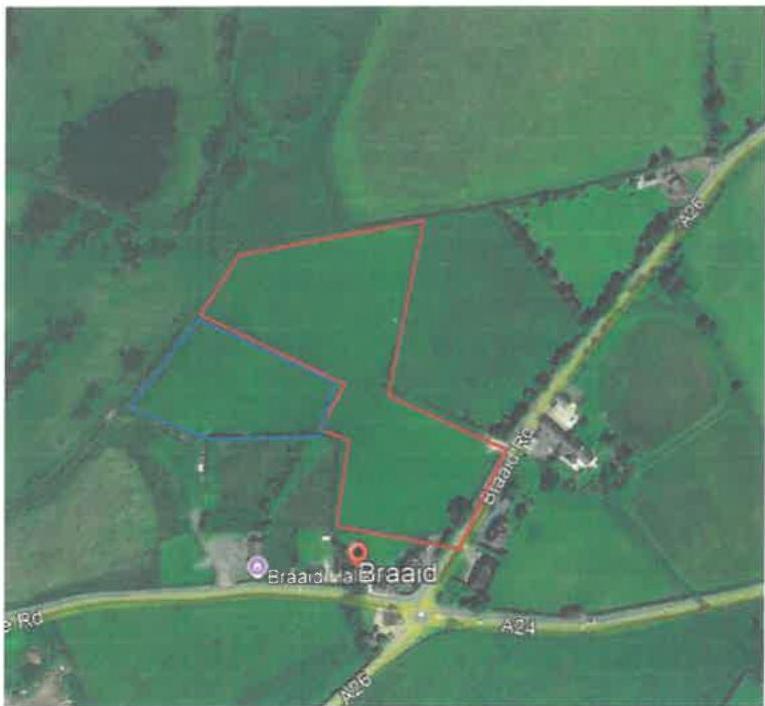
Figure 1 Location of application blue line (ownership) and red line boundary (application site)
2.1 Common Lizard Zootoca vivpara is protected under Schedule 5 of the Isle of Man Wildlife Act 1990 (as amended).
2.2 As such, a person is deemed to have committed an offence if he or she:
“intentionally or recklessly kills, injures or takes any wild animal included in Schedule 5 without reasonable excuse”
And/or
“damages or destroys, or obstructs access to, any structure or place which any wild animal included in Schedule 5 uses for shelter or protection; or disturbs any such animal while it is occupying a structure or place which it uses for that purpose”.
2.3 All wild birds are afforded protection under the Isle of Man Wildlife Act 1990 (as amended). An offence is deemed to have been committed if:
“any person intentionally or recklessly — (a) kills, injures or takes any wild bird; (b) takes, damages or destroys the nest of any wild bird while that nest is in use or being built; or (c) takes or destroys an egg of any wild bird”.
2.4 In addition, species listed on Schedule 1 of the act makes it an offence to:
“Intentionally or recklessly — (a) disturbs any wild bird included in Schedule 1 while it is building a nest or is in, on or near a nest containing eggs or young; or (b) disturbs any nest or egg of such a bird; or (c) disturbs dependent young of such a bird”.
3.1 The following recommendations address the most likely risks associated with a development of this character and scale and the proximity to habitats likely to support breeding birds and Common Lizard.
3.2 Wherever practically possible all vegetation clearance should be conducted outside of the main breeding period for species likely to occur on site, typically March to August inclusive. Where this is not possible vegetation must first be searched for the potential presence of nesting birds (including nests in the process of being built). Where present (and active) the nest should be safeguarded until all young are fledged and independent of the nest. The check should be done no more than 5 days prior to clearance works.
3.3 As birds can potentially nest at any time of year, vigilance should be exercised for signs of breeding during the whole construction period. Signs include agitated adults, adults carrying food and/or nesting material and calling young.
3.4 Schedule 1 species that may occur in this location are Song Thrush Turdus philomelos and House Sparrow Passer domesticus. Disturbance within 10m of their nests should be avoided.
3.5 If at all unsure, temporarily suspend works and seek advice from DEFA Ecosystem Policy Team to avoid an offence under the Wildlife Act 1990 (as amended).
3.6 In the context of this site the main risk is during removal of hedgebank habitat which can be inhabited by Common Lizard year-round (active and hibernation/torpor).
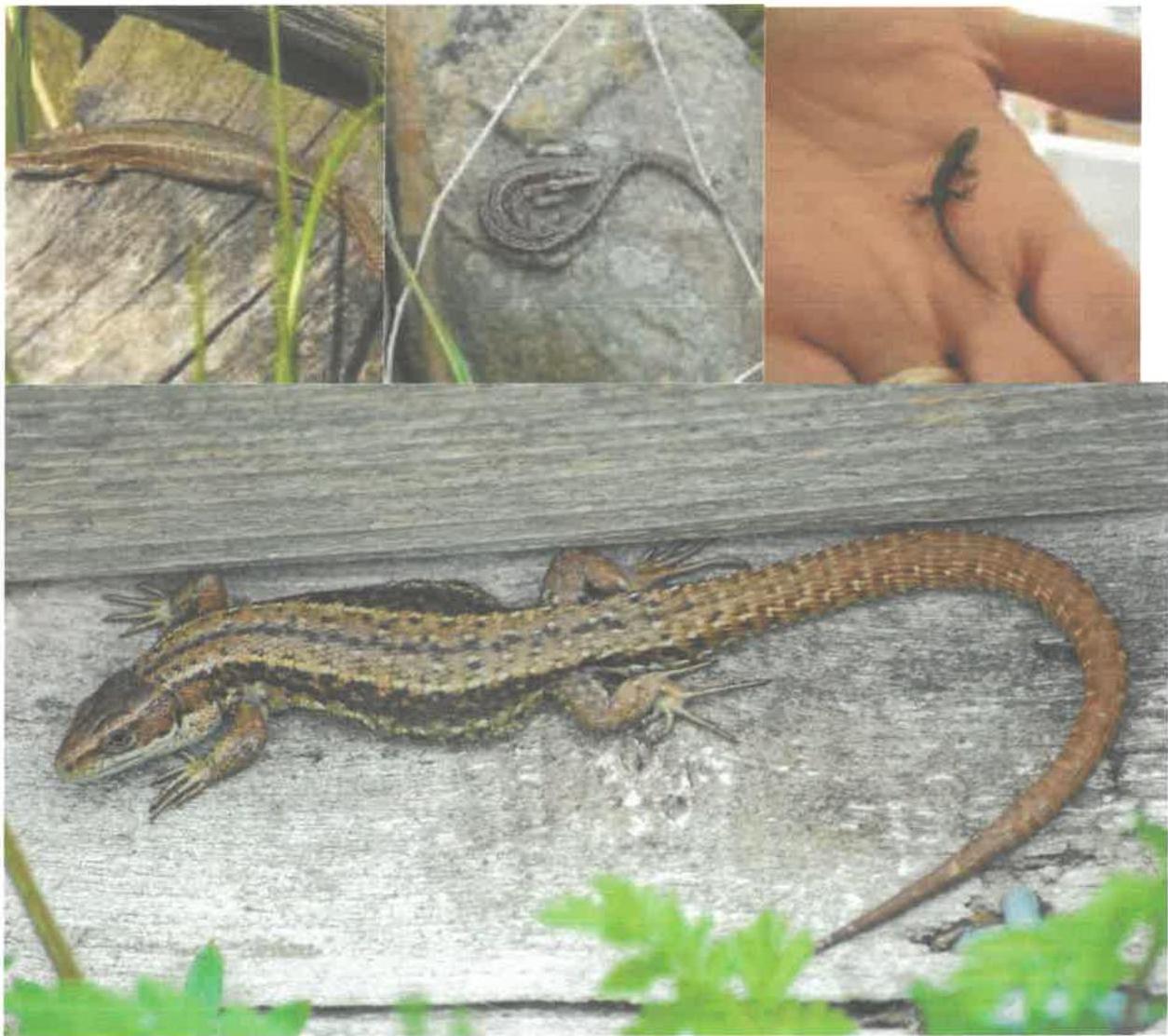
From Froglife.Org:
Adults up to 15 cm in length (including tail). Males have a larger head and slimmer body than females, and prominent swelling at the base of the tail. Usually, a shade of brown but colour variants include yellow, green and black. Pattern of spots and/or stripes down the back. Males have a yellow/orange belly with black spots. Females have a pale, unspotted belly. Often mistaken for newts. Lizards have scaly, rather than smooth, skin and move away very quickly when disturbed.
Adult lizards emerge from their hibernation sites in early spring. Mating takes place around April.
Females incubate the eggs inside themselves and 'give birth' to up to 11 live young around July/August. Juvenile lizards are tiny – less than 5cm long – and are darker in colour than the adults.
Lizards spend the next couple of months feeding up on invertebrates in preparation for winter. They feed on worms, slugs and insects and give their prey a good shake, to stun it, before swallowing.
Common Lizards hibernate, often in groups, amongst rocks or dead wood generally between November and March. They may take advantage of milder patches of weather to come out and forage.
Copyright in submitted documents remains with their authors. Request removal
View as Markdown