Loading document...
Tree Protection Plan, Arboricultural Method Statement and Site Monitoring Schedule
Site: 'Ballabeg', Glen Vine, Isle of Man
Produced for:<br>Hartford Homes<br>Middle River<br>Douglas<br>Isle of Man<br>IM2 1AL
Report produced by: Mr. Ben Brooker L4 DipArb (ABC), TechArborA Consulting Arborist Manx Roots Ltd. Tel: 07624259720 Em: [email protected]
The following Arboricultural Method Statement and Tree Protection Plan provide details on the specification and position of the required tree protection measures for this site. These protection measures will most likely form all or part of a planning condition for this development and, therefore, must be adhered to in full at all times unless agreed otherwise.
If there is any deviation from the Arboricultural Method Statement and/or Tree Protection Plan, the project arboriculturist (tree specialist) and/or planning authority must be informed immediately.
A 'Tree Monitoring Schedule' has been provided to help guide any monitoring process should it be conditioned as part of the part planning consent.
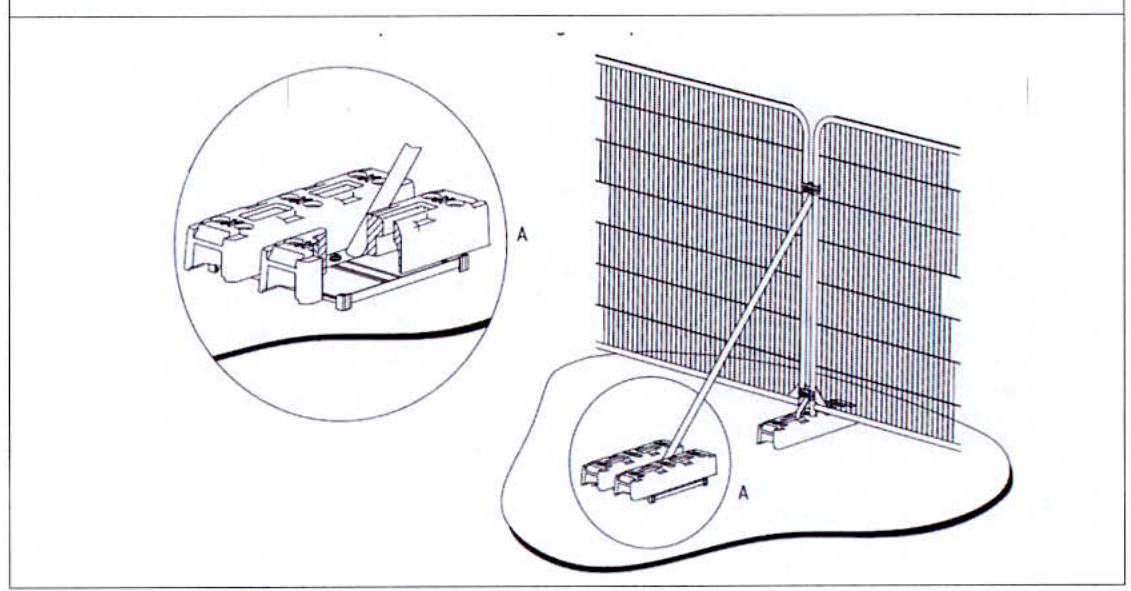
1.1. Temporary protective fencing (as shown in Fig.1) will be installed to demarcate a Construction Exclusion Zone (CEZ) represented in the accompanying Tree Protection Plans (TP-201119). 1.2. The fencing will be positioned as per the magenta line in the accompanying Tree Protection Plans (TP-201119). 1.3. The fencing will be installed for the purpose of excluding all construction activity and will consist of: heavy duty metal fencing panels fastened together and supported with manufacturer recommended ties, feet and stays unless pre-existing fencing offers a similarly robust protective barrier. 1.4. The fencing will be fully installed prior to any demolition or construction activity and remain in place and fully effective until work is complete. 1.5. All weather notices will be attached to every second panel, clearly displaying words such as CONSTRUCTION EXCLUSION ZONE - NO ACCESS. 1.6. The protective fencing will not be moved or disassembled without prior approval from the project arboriculturist. 1.7. Materials will not be stored within the CEZ. 1.8. Site personnel will not be permitted access within the CEZ. 1.9. The project arboriculturist must be invited to inspect the protective fencing prior to work commencing and the inspection documented. 1.10. The project arboriculturist must be informed by the site manager if the fencing is moved or if its specification is different from that described above.
Figure 1 shows metal (Heras-style) fencing panels.
2.1. Where possible, pre-existing hard surfaces within the root protection area (RPA) of any tree not marked for removal must be retained. 2.2. These hard surfaces will be used to provide pedestrian, plant and vehicular access within an RPA during the construction phase without the need for additional ground protection. 2.3. The suitability of the hard surface to withstand the anticipated loads will be assessed by an engineer prior to loading. Where a hard surface isn't deemed suitable to withstand the anticipated loads, an additional layer of protection will be specified by the project arboriculturist and agreed with an engineer. 2.4. A set-back will be formed at the outer edge (edge closest to the tree) using protective fencing in the manner set out in section 1 (above).
3.1. Following completion of the construction phase and commencement of the landscaping phase, the pre-existing hard surfaces used as ground protection will be removed under the supervision of the project arboriculturist. 3.2. The surface must be removed in such a way that it does not result in any decrease
in soil level beneath. 3.3. Any machinery used to break apart and/or lift the surface must be positioned and operated from the existing hard surface and must not enter onto an unprotected RPA or within a construction exclusion zone (CEZ) without prior approval from the project arboriculturist. 3.4. Once the surface has been removed, the ground conditions will be assessed by the project arboriculturist to determine the need for further protection measures, based on the presence of tree roots.
4.1. Where excavation must occur within an RPA, adequate care must be taken to minimise soil disturbance and root damage. 4.2. Excavation of any kind within an RPA will be discussed with the project arboriculturist prior to commencement. At this time the project arboriculturist will decide whether the exaction will be monitored. 4.3. Where possible, excavation within an RPA will be carried out with the use of hand tools. Where the use of hand tools is not viable, the project arboriculturist will agree an alternative method prior to commencement. 4.4. Any roots damaged or severed during excavation are to be cleanly cut back to the wall of the excavation using sharp secateurs, loppers and/or hand saw.
5.2. The Client or project manager vill formally appoint a project arboriculturist (PA) following receipt of the planning consent; 5.3. The PA will be provided with the name, email address and phone number of the project manager, site manager, planning officer and any other relevant party; 5.4. Prior to any construction activity taking place, a site meeting ('pre-commencement meeting') will be arranged by the client or project manager in which all tree related matters will be discussed. The PA, project manager, site manager and any relevant contractors or operators will be present at the meeting. In addition to discussing all the contents of the tree protection plan (TPP) and arboricultural method statement (AMS), key events and objectives in the construction process will be identified which require the presence of the PA onsite, either before, during or after the event, for monitoring purposes (herein after referred to as 'Key Events'); 5.5. The pre-commencement meeting will be documented by the PA in a 'Tree Monitoring' email which will be sent to all those in attendance at the abovementioned meeting. This email will contain a record of all the points discussed, actions agreed and a list of the key events for the site; 5.6. Good communication between the project manager, site manager and PA is critical. The project manager or site manager will be responsible for providing the PA with an up to date programme of works, specifically in relation to the key events, so that site visits can be pre-arranged to confirm compliance with the TPP and AMS; 5.7. At the pre-commencement meeting, if it becomes clear that some work has already taken place or if any of the site conditions have changed significantly since the initial survey was undertaken, the following process will be followed:
5.8. If there are any key changes in the personnel involved in the project (i.e. if a new project or site manager is appointed; if a new principal contractor is appointed) the client will inform the PA and the actions detailed in paragraphs 1.3 and 1.4 will be repeated.
5.10. It is the responsibility of the project manager or site manager to ensure that all tree protection measures and conditions are being adhered to by all site personnel, and that non-compliance is rectified within the deadlines set by the PA; 5.11. Site visits will be made in conjunction with key events and their frequency determined by the programme of works; 5.12. Details of each visit will be sent to all the relevant parties via email within 48 hours and will include: 5.12.1. The date and time on which the visit was made; 5.12.2. With whom the PA met and details of those conversations; 5.12.3. Comments on the location, specification and condition of tree protection measures; 5.12.4. Details of any instances where tree protection measures are lacking and/or where tree related conditions are not being met; 5.12.5. Details of action(s) required to rectify non-compliance, including who is responsible and the deadline for undertaking the required action; 5.12.6. Timescales of a follow-up site visit if required sooner than one month; 5.13. The project manager or site manager is responsible for informing the PA of any unexpected tree related problems which arise during the construction process or if modifications are required to the agreed tree protection measures for any reason. No modifications will be made to the agreed protection measures or construction methods without the prior agreement of the PA; 5.14. The planning authority shall be informed if any significant modifications are required to the agreed protection measures or construction methods. The PA will inform the project manager and/or site manager when they are required to contact the planning authority, but it will be the responsibility of the person(s) informed to contact the planning authority unless otherwise agreed with the PA;
5.16. Any deviation from the associated TPP and AMS, observed by the PA during a site visit, will be brought to the attention of the relevant parties via email, as set out above; 5.17. If, during the follow-up site visit, any action(s) required to rectify non-compliance have not been taken, the project manager will be informed within 48 hours by email; 5.18. If the action(s) detailed in the most recent email are not resolved within the specified deadline, the PA has the right to withdraw his or her services until satisfactory steps have been taken to address the issue(s).
5.20. Following completion of all development activity and prior to the removal of any tree protection measures, the project manager will invite the PA to carry out the final site visit; 5.21. This visit will aim to identify any damage caused to the retained trees or any noticeable deterioration in their health. The visit will also aim to identify any obvious risks posed by the trees and the requirement for remedial work; 5.22. Please find a recommended site-specific monitoring schedule below:
| Tree Protection Monitoring Schedule | |||
|---|---|---|---|
| Name | Position | Mobile | |
| Project Manager | |||
| Site Manager | |||
| Architect | |||
| Principle Contractor | |||
| Tree Officer | |||
| Planning Officer | |||
| Project Arboriculturist | |||
| Other: |
| Key Events & Objectives | Comments | Completion date |
|---|---|---|
| Prior to commencing development: | ||
| • Pre-commencement site meeting held with site manager and other relevant parties. • All tree protection measures discussed and agreed with site manager. | ||
| • Tree pruning and tree removal works carried out as per the Arb. Impact Assessment. | ||
| • Protective fencing installed as per Tree Protection Plan and Arb. Method Statement. | ||
| During development: | ||
| • Removal of existing hard surfaces within RPAs discussed with site manager and key contractor/operator prior to commencement. | ||
| • Removal of hard surfaces within RPAs carried out as per Arb. Method Statement. | ||
| • Excavation within RPA of tree no.016 discussed with site manager and key contractor/operator prior to commencement. | ||
| • Excavation within RPA of tree no.016 carried out as per Arb. Method Statement. |
Following completion of the development:
Notes:
End of AMS
Manx Roots Ltd. Ramsey, Isle of Man, IM8 3PH T: 07624259720 | E: [email protected] | W: https://trees.im
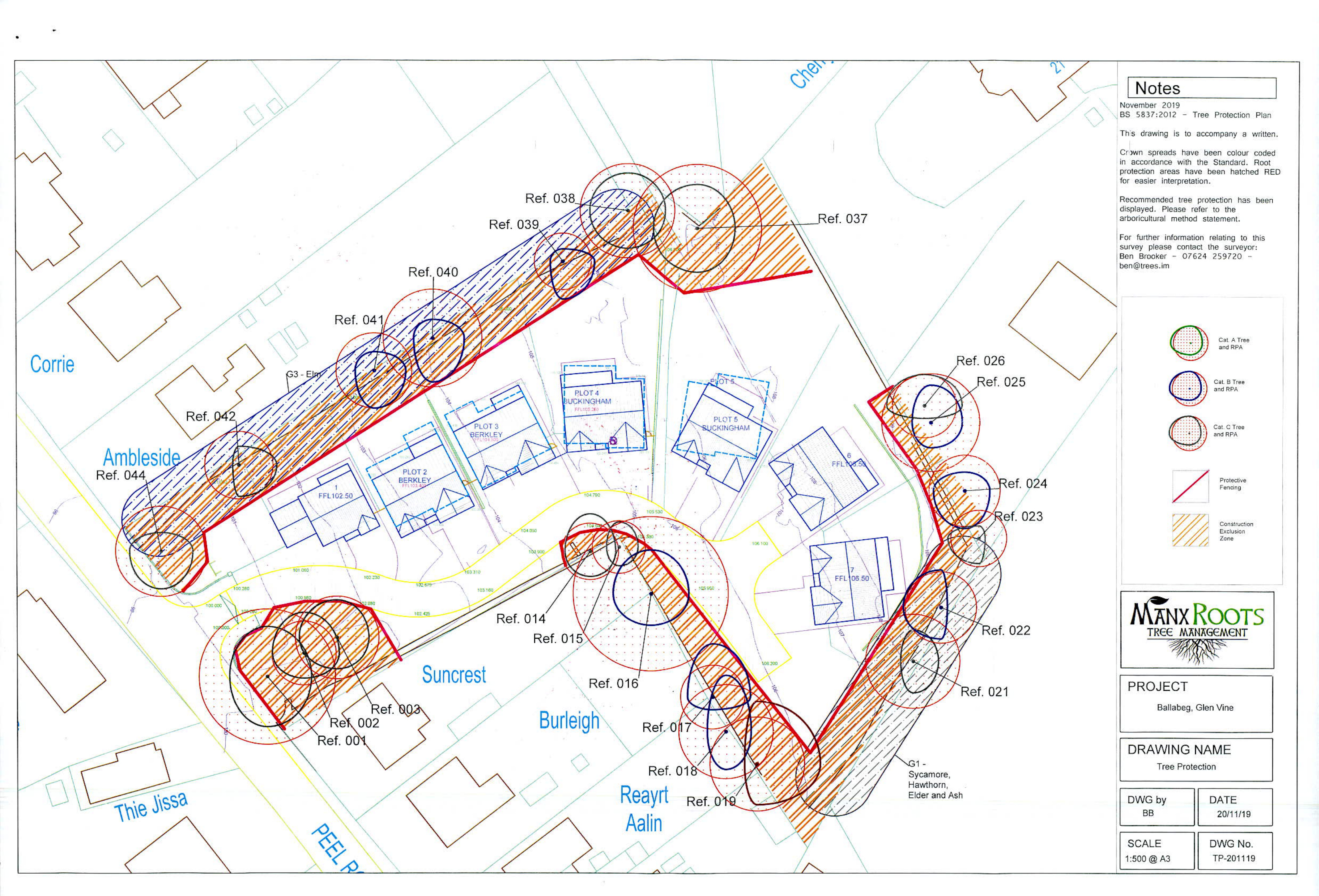
November 2019
BS 1837-2012 - Tree Protection Plan
This drawing is to accompany a written, written, or oral text of the tree protection plan. It is intended to be a complete and accurate representation of the tree protection plan. It is not intended to be a substitute for the plan. It is not intended to be a complete representation of the tree protection plan. It is not intended to be a complete representation of the tree protection plan. It is not intended to be a complete representation of the tree protection plan. It is not intended to be a complete representation of the tree protection plan. It is not intended to be a complete representation of the tree protection plan. It is not intended to be a complete representation of the tree protection plan. It is not intended to be a complete representation of the tree protection plan.
Copyright in submitted documents remains with their authors. Request removal
View as Markdown