PLANNING STATEMENT IN SUPPORT OF AN APPLICATION FOR THE ERECTION OF DWELLING ON THE SITE OF FORMER DWELLING, BALLATIKI, SHORE ROAD, BALLAUGH IM7 5AZ
1.0 Introduction
1.1 Planning approval was granted for the principle of the replacement of the former dwelling, Ballatiki, under 21/01234/A. This approval was subject to a number of conditions which applied the provisions of Housing Policy 14. At the time of the application, there were no details of siting, design, size or appearance and as such, the requirements of HP14 were applied in respect of siting, size and design.
1.2 The applicant prepared a detailed scheme in response to this and in the evolution of the design of the new house, the applicant had regard to optimising the use of the site and the proposed building - utilising as much of the available floor area as possible and trying to provide a second floor of accommodation to make the building footprint more efficient and at the same time, incorporating as efficient as possible a renewable heating and energy system all encapsulated in a modern and innovative design which responded to the size and shape and orientation of the site and the buildings around it.
1.3 In addition, the applicant wished to design a house which is suitable for occupation regardless of mobility and age and with the opportunity, should the future need arise, to
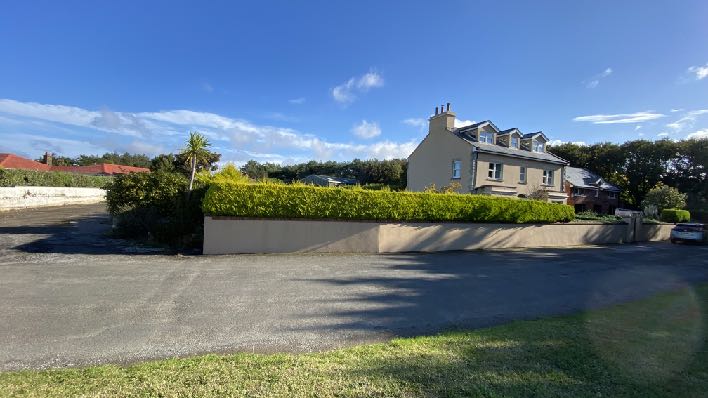
A street-level photograph showing a large detached house with dormer windows situated behind a low concrete wall and green hedge.
have a lift between floors and for the internal layout to allow assisted movement. This was (and still is) particularly important as the applicant’s wife has recently been diagnosed with osteoporosis and whilst they currently live in the adjacent property, in advancing years they may well decide to move into this property, which has less floor area, Regardless of who occupies the proposed dwelling, it should be capable of being occupied by anyone, regardless of their age and mobility.
1.4 As such, whilst aware of the siting and size constraints in HP14 and the approval in principle, the resulting dwelling was not on the same footprint as the existing and was larger than 50% greater than the floor area of the former dwelling, due to the incorporation of the first floor of accommodation as the footprint of the proposed building was almost identical in size to the original building and the incorporation of the above features.
1.5 As such, the application was not for permission for the matters reserved from the approval in principle but sought full, detailed planning approval for the erection of the new house, relying on the principle of 21/01234/A but acknowledging that it did not comply fully with all of the conditions of that approval.
1.6 That application, 22/01404/B was submitted and generated objections from five parties, the owners of Sunsets which is immediately alongside the site, and also from eight further parties who supported the application. The application was approved and an appeal was sought from the owners of Sunsets.
1.7 The appeal was the subject of a hearing and the inspector reported to the Minister, recommending that the application be refused and the Minister concurred with that. Details of this are provided in the Planning History section of this report.
2.0 The site
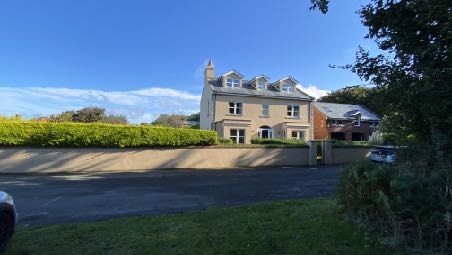
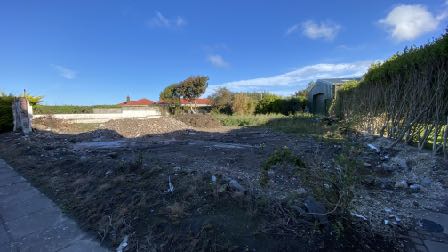
2.1 The site lies on the northern side of Shore Road which runs from its junction with the A10 road from Ballaugh Cronk to Ballaugh Bridge towards the western coast of the Island. The site is the curtilage of Ballakinnag House and a separate dwelling, the former Ballatiki which was demolished in 2021.
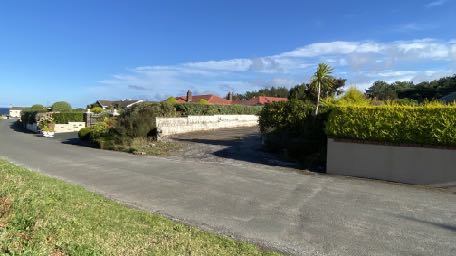
2.2 The site has to the south east the curtilage of Ballakinnag New House (the applicant’s home) which sits to the east of the site: to the immediate north is the curtilage of Sunsets, a detached, red roofed bungalow and there are a further eight properties between Sunsets and the end of Shore Road. There is no development on the other, southern side of the road and at the junction of Shore Road and the A10 is a former chapel which had planning approval for conversion to a dwelling.
2.3 Ballakinnag House is a two storey dwelling which has a linked garage with accommodation above, to the south east. To the rear is a newly built shed.
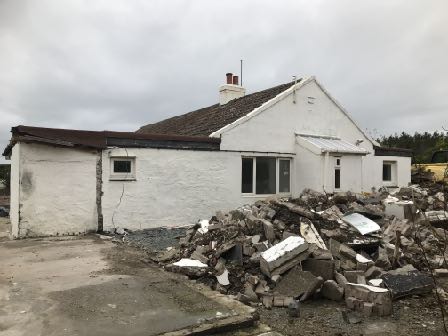
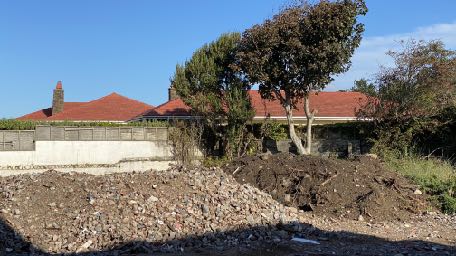
A white single-story bungalow stands behind a large pile of rubble and construction debris, indicating demolition work.A photograph showing a construction site with large piles of rubble and earth in the foreground. An existing building with a red tiled roof is visible in the background behind trees and a concrete wall.A photograph showing a paved access road or driveway bordered by a low wall and hedge, with residential houses visible in the background under a blue sky.
2.4 Ballatiki was demolished between June and September, 2021 in accordance with 21/00011/BCD. Planning approval was granted for the garage/shed under 20/00648/B but this did not necessitate the demolition of Ballatiki. The dwelling was demolished on the basis that the application for the proposed outbuilding showed the access to the new building very close to the side of Ballatiki which required a landscaping scheme to protect the living conditions of both properties from the impacts of the use of the driveway.
A photograph showing a large detached house with a pitched roof and dormer windows, set back from the road behind a hedge and driveway.A photograph showing a cleared plot of land with piles of earth and rubble in the foreground, likely the site of the former dwelling. Existing houses and a tall hedge are visible in the background under a blue sky.A site plan showing the layout of the property 'Ballatiki' with building footprints, boundaries, and surrounding land features.
2.5 It was the applicant’s intention to upgrade Ballatiki to modern standards of thermal and energy efficient however, on looking into this more closely, it appeared that to do that, it would be beneficial economically, visually and energy wise, to replace the bungalow rather than refurbish it. The applicant then considered replacing the bungalow with a summer house/garden room which was the subject of 21/00712/B. This application was withdrawn before it was determined after the applicant changed his mind and decided that the best arrangement for their family was to redevelop Ballatiki as a dwelling in which his son could live on moving back to the Island. The dwelling, Ballatiki was demolished in anticipation of either its replacement with a new dwelling or its replacement with the summer house. The applicant was not aware of the planning implications of removing the dwelling before gaining planning approval for a replacement dwelling.
3.0 Planning policy
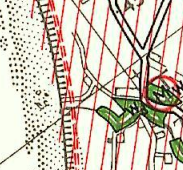
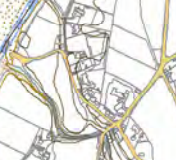
3.1 The site lies within an area designated on the Isle of Man Planning Scheme (Development Plan) Order 1982 as not for a particular purpose and within an area of an area of High Landscape or Coastal Value and Scenic Significance (below left).
3.2 The 1982 Plan is the only adopted plan for this part of the Island, although Cabinet Office are currently preparing an Area Plan for the north and west of the Island and have published the draft Area Plan which does not designate this site for a particular purpose (above right) confirming the position prior to the Area Plan’s commencement.
3.3 The draft Area Plan provides information on environmental and infrastructural constraints of which there is none which apply to the site.
3.4 The areas of an area of High Landscape or Coastal Value and Scenic Significance will be replaced by the provisions of the 2006 Landscape Character Assessment which identifies the site as being within an area of Undulating Lowland Plain - F3 Andreas and Jurby which focuses on the open, natural landscape and historical buildings and makes no direct reference to The Cronk. The preceding stage of the Area Plan included a consultation document which included the following:
“7.6 Design (including Sustainable Construction) Whilst the Isle of Man Strategic Plan gives some general design principles there is a need for the Area Plan to
A close-up view of a site plan or map showing property boundaries, green shaded areas representing vegetation, and red grid lines.Extract from a site location map showing field boundaries, roads, and the proposed development plot in a rural setting.
ensure that a high level of design is achieved at the local level. Specific Proposals which support development should reflect the local character, and take account of scale and materials where appropriate. Through the use of Development Briefs, the Area Plan will aim to identify potential sites that will allow for developments to integrate well into existing settlements and have the potential to create places which people are proud of and want to spend time in. Importantly, Strategic Policy 5 of the Strategic Plan already requires planning applications to be supported by a design statement that should illustrate how new development has been designed so as to make a positive contribution to the Island’s environment.”
3.5 This coincides with the latest advice by Department of Environment, Food and Agriculture on planning applications which should have regard to sustainable construction and the need to take into account Climate Change and biodiversity in the preparation of development proposals.
3.6 The national flood risk maps and infrastructural constraints map with the draft Area Plan show no likelihood of flood risk to or from the site.
3.7 There are no Registered trees or buildings on the site and it is not within a proposed or adopted Conservation Area.
3.8 The current status of the site is that it is not designated for development according to the Isle of Man Planning Scheme (Development Plan) Order 1982. There are provisions for developing undesignated land on the following bases:
• Re-use of an existing building of historic, architectural or social interest (Environment Policy 16 and Housing Policy 11 of the Strategic Plan )
• Replacing an existing building with lawful use (Housing Policy 14 of the Strategic Plan)
• Redevelopment of previously developed land (General Policy 3 of the Strategic Plan).
General Policy 3: Development will not be permitted outside of those areas which are zoned for development on the appropriate Area Plan with the exception of:…
(b) conversion of redundant rural buildings which are of architectural, historic, or social value and interest; (Housing Policy 11);
(c) previously developed land(1) which contains a significant amount of building; where the continued use is redundant; where redevelopment would reduce the impact of the current situation on the landscape or the wider environment; and where the development proposed would result in improvements to the landscape or wider environment;
(d) the replacement of existing rural dwellings; (Housing Policies 12, 13 and 14)…
3.9 Housing Policy 12 presumes against the replacement of houses which have lost their habitable statues and those which are of particular architectural or historic interest. The former Ballatiki was neither of those things.
3.10 Where a replacement dwelling is permitted, there is guidance on how such dwellings should be designed:
Housing Policy 14: Where a replacement dwelling is permitted, it must not be substantially different to the existing in terms of siting and size, unless changes of siting or size would result in an overall environmental improvement; the new building should therefore generally be sited on the “footprint” of the existing, and should have a floor area(1), which is not more than 50% greater than that of the original building (floor areas should be measured externally and should not include attic space or outbuildings). Generally, the design of the new building should be in accordance with Policies 2- 7 of the present Planning Circular 3/91, (which will be revised and issued as a Planning Policy Statement).
Exceptionally, permission may be granted for buildings of innovative, modern design where this is of high quality and would not result in adverse visual impact; designs should incorporate the re-use of such stone and slate as are still in place on the site, and in general, new fabric should be finished to match the materials of the original building.
Consideration may be given to proposals which result in a larger dwelling where this involves the replacement of an existing dwelling of poor form with one of more traditional character, or where, by its design or siting, there would be less visual impact.
3.11 Previously Developed Land is defined in the Strategic Plan as follows:
Previously-developed land is that which is or was occupied by a permanent structure, including the curtilage of the developed land and any associated fixed surface infrastructure.’ The definition includes defence buildings, but excludes: Land that is or has been occupied by agricultural or forestry buildings. Land that has been developed for minerals extraction or waste disposal by landfill purposes where provision for restoration has been made through development control procedures. Land in built-up areas such as parks, recreation grounds and allotments, which, although it may feature paths, pavilions and other buildings, has not been previously developed. Land that was previously-developed but where the remains of the permanent structure or fixed surface structure have blended into the landscape in the process of time (to the extent that it can reasonably be considered as part of the natural surroundings).
There is no presumption that land that is previously-developed is necessarily suitable for housing development nor that the whole of the curtilage should be developed.
4.0 Planning History of the site
4.1 The former dwelling, Ballatiki was the subject of applications for a roof light (98/01027/ B) and an oil tank (90/01416/B). 21/01234/A sought and gained planning approval for a replacement dwelling. The conditions of this approval which was issued on 7th February, 2022 were:
1. The development hereby approved shall be begun either before the expiration of four years from the date of this approval or before the expiration of two years from the date of approval of the last of the reserved matters.
Reason: To comply with article 26 of the Town and Country Planning (Development Procedure) Order 2019
2. Approval of the details of siting, design, drainage, external appearance of the building[s], internal layout, landscaping of the site (hereinafter called "the reserved matters") shall be obtained from the Department in writing before any development is commenced.
Reason: To comply with the Town and Country Planning (Development Procedure) Order 2019.
3. Application for approval of the reserved matters shall be made to the Department before the expiration of two years from the date of this approval and thereafter the development shall only be carried out in accordance with the details as approved.
Reason: To avoid the accumulation of unimplemented planning approvals.
4. The new dwelling shall be:
- the same as the previous dwelling (Ballatiki) in terms of siting, size and footprint, unless changes of siting or size would result in an overall environmental improvement;
- not more than 50% of greater than the floor area of the previous dwelling (Ballatiki) (floor areas should be measured externally and should not include attic space or outbuildings), unless it can be demonstrated that the original dwelling (Ballatiki) was of poor form and the new dwelling would be one of more traditional character, or where, by its design or siting, there would be less visual impact compared to the original dwelling; and
- designed to either be in accordance with Policies 2- 7 of Planning Circular 3/91 or of an innovative, modern design which is of high quality and does not result in adverse visual impact.
Reason: In the interest of the visual amenities of the area and as any new/replacement dwelling on land not designated for development is required to comply with Housing Policy 14.
5. The dwelling hereby approved shall be be no taller than 1.5 storey in height as set out in the e-mail of 21.01.22.
Reason: In the interest of the visual amenities of the area.
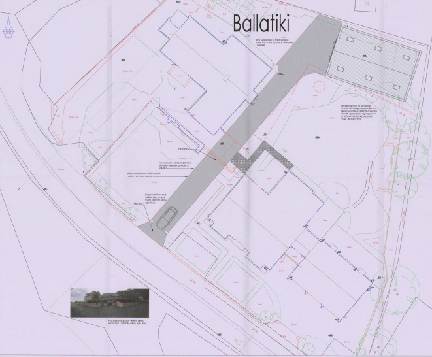
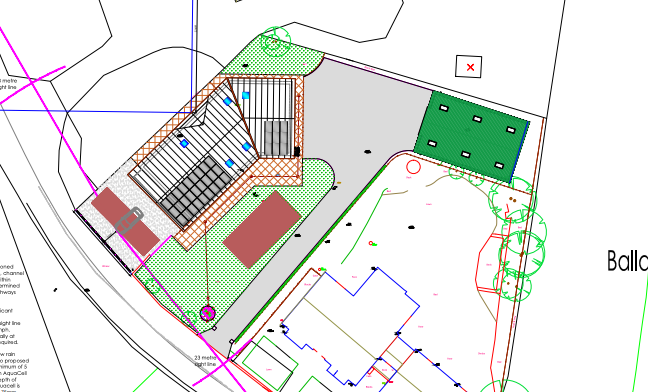
4.2 As explained in the Introduction, a detailed planning application was submitted followingthe approval in principle. 22/01404/B proposed a dwelling as shown below which showedthe proposed dwelling 1.3m from the boundary with Sunsets.
A site plan showing the proposed layout for a new dwelling, including building footprint, driveway, and landscaping features.
4.3 The proposed dwelling also included a first floor bedroom window just above the eaves in the north western roof plane.
4.4 This application was approved by the Planning Committee and an appeal was lodged by the owners of Sunsets on various grounds including the impact on their light, outlook and privacy, the design and appearance of the proposed dwelling, the principle of replacing a dwelling which no longer existed and concerns about highway safety.
4.5 The inspector considering the appeal analysed each of the objections and issues and concluded as follows with the salient points highlighted:
56. The main issues for consideration in this appeal are: the effect of thedevelopment upon the character and appearance of the countryside location; andthe effect upon the living conditions of those living nearby with particular regardto overlooking and loss of light.
Architectural drawings showing the first and ground floor plans alongside South West, South East, and East elevations of a proposed detached dwelling.
57. The proposed dwelling would not share the same footprint as the original dwelling, it would also be more than 50% larger and would be 1.5 storeys in height. In addition, it would not reflect the architecture or style of the previous bungalow or that of its immediate neighbours. Taken on their face those matters would seem to weigh against the development.
58. However, residential properties nearby are mixed in terms of size, architectural style, layout, heights and finish; there is no specific style to the locality. The proposal would be a modern addition to the street scene and that was recognised by the approval in principle as being acceptable. I see no reason to disagree; the dwelling would not come as surprise given its context within the street scene and it would mirror the building line to the south-east. There are also comparable dwellings in the Isle of Man countryside which have used modern finishes, unlike the dwellings they replaced, as evidenced by the applicant.
59. I recognise that no case is comparable, but the applicant has demonstrated that the re-use of existing stone and materials is not always possible or desirable. From the evidence before me I am satisfied that there would have been little by way of traditional materials in terms of stone and slate in any event. There is no dispute either that the previous dwelling was of poor, form design and repair.
60. Furthermore, HP14 makes provision for larger properties that would demonstrate innovative, modern design and where larger result in an overall environmental improvement. In this case alongside the design, which would be an improvement on what existed previously, the dwelling would also introduce environmental improvements beyond that which previously existed. The siting and orientation of the dwelling would ensure maximum gain for the solar panels and the dwelling would be thermally efficient. In that light I see no reason to disagree with the planning authority that the proposal would provide significant environmental improvement compared to the previous dwelling.
61. Overall, I find the proposal would accord with HP14 and would not be at odds with, or lead to unacceptable harm to, the character and appearance of the
countryside location. Given that it would also be in accordance with GP2, EP1 and EP2 insofar as they seek good design and the protection of the countryside.
62. There is no dispute that the occupiers of Sunsets are most likely to be affected by the proposed dwelling. To that end it is accepted that the proposed dwelling, whilst sitting partly on the footprint of the former dwelling, would be closer to the mutual boundary. There is an inevitability therefore that any effect on living conditions is likely to be greater than which existed previously. In addition, I accept that the nearest habitable room of Sunsets is currently used for crafting and as a guest bedroom.
63. That room is served by three windows near to the proposed dwelling. Two smaller windows facing the mutual boundary, and the other larger window looking out to the road, and sea beyond. I heard at the Hearing that curtains had been drawn for long periods and the use of the room was minimal. Although, there is no dispute that the owner of Sunsets has to spend a good deal of time indoors. Nevertheless, whilst the matter of how the property is used currently falls to be considered. I must consider all future occupiers of the property and the effect of any overlooking on this habitable room.
64. The RDG sets out that the intensity of overlooking depends on a variety of factors, such as the use of the overlooking spot, the use of the area being overlooked, the typical duration of usage, and any mitigation methods. It also states that if a distance between properties is over 20 metres, overlooking is unlikely to be a concern. In this case it was agreed that the distance between the proposed first floor gable window and Sunsets’ patio area and south facing window was more than 20 metres as identified on Drawing No 3. Therefore, in accordance with the RDG, there would be no unacceptable harm by way of overlooking.
65. I also accept that there would be no harm by way of overlooking from the rooflights which would serve ensuites and a stairwell. In addition, views to and from the smaller side windows of Sunsets are restricted given the size of windows and existing fence and vegetation serving the mutual boundary. It was also agreed that, given the configuration of the proposed south-west facing balcony, there would be no overlooking opportunity.
66. However, as evidenced and agreed at the Hearing, when a measurement is taken to the nearest west facing window (serving the craft room) the measurement is below 20 metres. When looking out from that room using the larger west facing window, it is clear to me that the new dwelling and dormer window would be in view. Whilst I accept the dormer window would serve a bedroom, where occupiers may spend less time looking out of it, there would nevertheless be views directly into a habitable room of Sunsets from less than 20 metres away. Having stood in that room I am in no doubt that such overlooking would lead to unacceptable harm to the living conditions of occupiers of Sunsets.
67. Turning to the matter of daylight and sunlight. I accept, given the size of the proposed dwelling and its proximity to the boundary that there would be an effect upon light. However, given the orientation, existing vegetation, fencing and the height and form of roof sloping away from the mutual boundary the effect is likely to be minimal and would not result in unacceptable harm. I have also considered and accept that views of the Manx Hills may be compromised but such views are already hindered by fencing and vegetation, moreover, as set out by the planning authority, loss of a view carries no weight in such circumstances. However, these findings do not outweigh the harm I have found.
68. For these reasons I find the development would not accord with the advice in the RDG and would be at odds with GP2 of the IMSP which seeks to protect residential amenity.
69. I have also considered whether or not the development should be considered
as a replacement dwelling given the argument that the previous dwelling was demolished some time ago and no longer exists. Whilst such argument is not without merit it seems to me that the principle of a dwelling being developed on the site has been established. I say that given planning permission was granted for the reserved matters scheme in the knowledge that the previous dwelling had been demolished.
From the evidence before me it appears that the planning officer, and subsequently planning committee, took the pragmatic view that the demolition,
at that time, was very recent and done without the knowledge of the potential
planning implications. Furthermore, it was recognised that the site had accommodated a dwelling for a number of decades with the existing access and curtilage in place. I see no reason to change that pragmatic approach. Moreover, it is not for me under the auspices of this appeal to determine whether or not the site has lost its residential status.
4.6 The Minister accepted this recommendation and the application was refused on 14th June, 2023 for the reason that:
The development would lead to unacceptable harm to the living conditions of the occupiers of the neighboring [sic] property Sunsets contrary to General Policy 2 of the IMSP.
4.7 Ballakinnag House has been the subject of applications for alterations and extensions (98/00006/B, 98/02016/B, 99/01063/B, 06/01282/B, 06/02068/B, 08/00873/B, 08/01612/R) two diesel tanks (98/00498/B), garage (20/00468/B, 21/00193/MCH) and the garage/shed to the rear (20/00648/B). A more recent application for a garden room and extension was withdrawn before a decision was taken (21/00712/B). An application for the erection of a dwelling with a granny flat was refused (01/01012/A) but a detailed application for this was approved shortly afterward (02/00079/A and 02/02581/B).
4.8 In other parts of the Island, planning approval has been granted for replacement dwellings where these were larger than 50% greater than the floor area of the existing, for example 22/00025 at Ballasaig Cottage, Maughold (160% - 325% increase) and 22/00385/B at Narradale, Lezayre (542% to 612% increase) with a significant reason for the increase being the thermal and energy efficiency of the new houses compared with what they would replace.
5.0 The application
5.1 Proposed here are the full details of the replacement dwelling, responding to and complying with the approval granted under 21/01234/A and in addition, acknowledging and reflecting on the reasons for refusal for 22/01404/B. Whilst the application in principle included illustrations of how the new house may appear the applicant has sought to design something of a modern and innovative style and character which responds to the need to be thermally efficient and to harness renewable energy, particularly solar energy which will be generated in roof mounted panels. The applicant sought advice on the optimal location of the panels and was advised that the orientation SW - W would generate less energy than would the orientation SE - E.
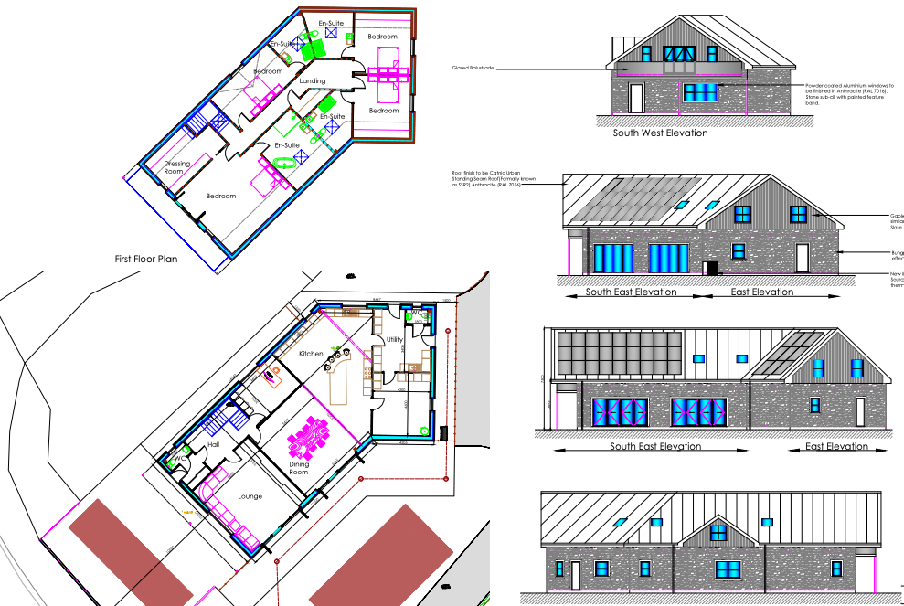
5.2 This has guided the siting, orientation and layout of the proposed house which follows the building line of Ballakinnag House and has roof planes which face south and south east (facing Ballakinnag House). The dwelling has been moved a further metre from the boundary with Sunsets such that it now sits 2.5m from that boundary (the site plan shows the footprint of the proposed dwelling from the roof and so the walls are set back further than is shown in this drawing. The dwelling is modern in design and appearance, using non traditional materials of anthracite coloured standing seam roof sheets, natural stone effect cladding and Cedar or similar timber effect cladding in slate grey. The windows and doors will be powder coated aluminium framed.
5.3 An air source heat pump is to be installed adjacent to the rear elevation of the proposed house.
5.4 The dwelling is orientated south west to north east with only ground floor door openings (no windows) in the south eastern elevation facing Ballakinnag House and two levels of windows in the south western elevation facing the road. This has a glazed balcony facing the highway and windows and doors in both levels. The elevation facing north west has only ground floor windows and the previously proposed first floor level window has been removed, with the only windows in the upper floor served by roof lights.
5.5 Parking for at least four vehicles is available within the site on the proposed hardstanding and areas of surface water soakaways in front and to the side of the house are proposed (shown in brown on the site plan). No changes to the existing access are proposed or were required in the approval in principle.
5.6 The dwelling is one an a half storeys in height as allowed for by the approval in principle but without windows other than roof lights in the first floor/roofspace.
5.7 Housing Policy 14 requires that the siting and size of the replacement should be similar to what it replaces unless there is an environmental improvement resulting from a change to either. The siting is different and whilst there is some overlap with the site of the former dwelling and the proposed dwelling is further forward on the site this is due to the orientation evolving from a desire to make the property as thermally efficient as possible and to maximise solar gain and renewable solar energy. This would result in an environmental improvement as required by the policy and whilst closer to the road, the house will follow the building line of Ballakinnag House so not be out of keeping with the streetscene.
5.8 The floor area is greater than 50% larger than the existing which is 196 sq m over a single floor of accommodation. The proposed dwelling will have a footprint of 215 sq m and an overall floor area of 365 sq m (first floor measured area over 1.5m in ceiling height) - an overall increase of 86% over the existing.
5.9 The approval in principle and HP14 allow for a larger area in certain circumstances “where this involves the replacement of an existing dwelling of poor form with one of more traditional character, or where, by its design or siting, there would be less visual impact”. The key point here is the “or” in the sentence. What existed previously is considered to have been of poor form, with its rouble Roman concrete tiles, single chimney and modern windows: what is proposed is a better design, environmentally and visually, thus complying with requirement. Whilst Ballakinnag House has traditional features, Sunsets does not and as such, a modern and innovative approach was considered appropriate, particularly with the inclusion of solar panels on the roof. The modern and innovative approach here is also considered to accord with the policy.
6.0 Conclusion
6.1 We have taken cognisance of the decision in respect of 22/1404/B and the inspector’s comments on that proposal which concluded that:
• The principle of a replacement of the former dwelling on the site was not objectionable.
• The design and appearance of the proposal would have no adverse impact on the character and appearance of the area and would satisfy HP14 and GP2 in these respects.
• There would be no unacceptable impact from the development in respect of the proposed balcony, roof lights or ground floor windows.
• There would be no adverse impact from the position of the proposed dwelling relative to Sunsets other than the incorporation of a first floor window which would or could overlook the nearest west facing window of Sunsets.
• The proposed first floor window would have an unacceptable impact on the actual and perceived privacy of Sunsets by virtue of its effect on its nearest west facing window.
• There is no issue from the development in terms of outlook or light.
6.2 The issue as we read it was the incorporation of the first floor window which has now been removed and the building has been moved even further from the boundary with Sunsets, even though that did not appear to be an issue in the previous case.
6.3 We believe that the proposal complies with the requirements of Housing Policy 14 on which the approval in principle which was granted, was based and whilst some of the conditions of the approval in principle are not being completely satisfied, what is proposed represents a modern and innovative building which harnesses renewable energy, provides satisfactory levels of amenity for its occupants without adversely affecting those of the residents of the adjacent dwellings and will result in a dwelling which sits comfortably in a street scene of mixed sizes and house types, in full accordance with the Residential Design Guide and General Policy 2 of the Strategic Plan.
Sarah Corlett 20th June, 2023
Copyright in submitted documents remains with their authors. Request removal