PLANNING STATEMENT IN SUPPORT OF THE EXTENSION OF ASHDOWNE HOUSE, BALLAVALE ROAD, SANTON IM4 1EH
1.0 Introduction
1.1 The site defined in red is the residential curtilage of Ashdowne House, a new dwelling which replaced an earlier property on the site. The land associated with the house and owned by the applicant, spans both sides of the B26 Ballavale Road and which has planning approval for and is being transformed into a botanical garden with associated amphitheatre, water cascade, glasshouse, bogland, meadows, Japanese garden, sensory garden and educational facilities (see Planning History below). The overall site has two dwellings at its periphery - Mallards and Ashdowne House, both owned by the applicant. Ashdowne House is a new dwelling which replaced the property formerly on the site and incorporates a living wall as much of its external finish.
1.2 The concept of the botanical garden here involves the creation of a botanical centre of excellence which is sympathetic to the existing topography and based upon the natural biome classification of the Isle of Man as temperate broadleaf and mixed forest and where the development utilises existing infrastructure and services, local materials and passive, environmentally friendly measures where possible and creating an interesting and diverse landscape. By expanding the typology of plants from those commonly and historically seen on the Island, the gardens are intended to provide variety, interest and visual stimulus. The scheme involves expertise from all over the world, from world leading Landscape Architect, Zen Priest and Professor at Mama Art University, Shunmyo Masuno and associations have been built with other Botanic Gardens including the Royal Botanic Gardens Edinburgh and hopefully forging new relationships with other similar facility such as New Botanic Gardens in Liverpool as well as utilising on Island expertise including that of the Arboricultural Officers in Department of Environment, Food and Agriculture.
1.3 The principles of the Japanese Garden alongside Ashdowne House involve creating a landscape which provides relief from the stress of everyday life; a miniature stylised landscape through carefully composed arrangements of rocks, water features, moss, pruned trees and bushes and the use of gravel or sand that is raked to represent ripples in water, intended to imitate the intimate essence of nature.
1.4 Ashdowne House is externally largely complete. It is currently surrounded by scaffold so clear photographs are not possible. The building is close to both Ballavale Road and the footpath leading to Santon Railway Station and from where the building is clearly visible including the living wall finish on the front elevation of the building .
2.0 The proposal
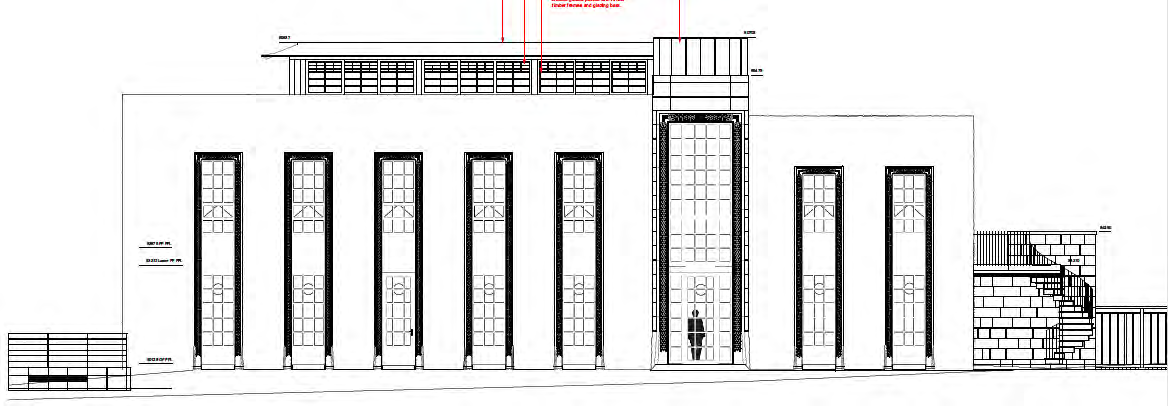
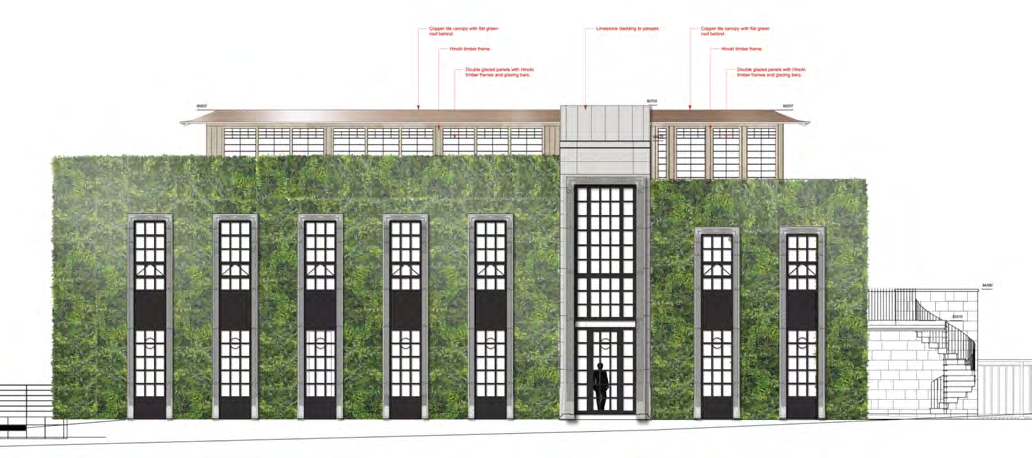
2.1 Proposed is the addition to the building of a second roof pavilion on the main part of the dwelling. The building already has a hipped roof pavilion on the southern section of the roof and it is considered that the internal accommodation would be enhanced by the addition of a second pavilion on the other side of the raised wall, as well as enhancing the appearance of the building by creating a more balanced elevation at the upper levels.
2.2 Also proposed is the finishing of the parapet between the north and south pavilions in limestone cladding rather than the copper cladding as approved.
2.3 The finishes on the new pavilion will match those on the existing pavilion - copper tiled canopy with flat tree roof behind, timber frame and double glazed panels with timber frames and glazing bars.
2.4 The new pavilion is taller than the existing but starts at a lower level so the proposed roof will be at the same level as the existing, bringing more unity to the roof level of the building.
Architectural elevation drawing showing a building facade with tall windows and a proposed roof-top pavilion extension.
2.5 The above existing and proposed elevations do not show the living wall which exists and is stillproposed as the external finish to the building.
3.0 Planning policy
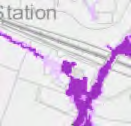
3.1 The site lies within an area not designated for a particular purpose on the Area Plan for the East adopted in 2020. Parts of the overall site are identified on the Environmental Constraints Map 1a as being of ecological importance (draft) which include the area of the house as shown below in the yellow hatching:
3.2 On the Infrastructure Constraints Map 1b the site lies just outside an area where the height of buildings is controlled in accordance with safety at the Isle of Man Airport (circular dashed line with the affected area lying to the south west).
3.3 There are no Community Constraints shown on Map 1c.
3.4 The site lies within a wider area of Incised Inland Slopes (D13) on the Landscape Character Assessment map with the following advice provided within the Written Statement of the Area Plan:
Landscape Strategy Conserve and enhance:
a) the character, quality and distinctiveness of the area, with its wooded valley bottoms and wooded horizons;
b) its scattered settlement pattern;
c) its Victorian garden and the railway.
Key Views Open and expansive views from the higher areas along the rugged coast in the east and inland towards the upland areas over Braaid. Incinerator chimney forms a notable landmark in the immediate area. Glimpsed views framed by vegetation in the valley bottoms and along the main roads where they follow the wooded valley bottoms. Views in the northern part of the area up to the Transmitting Masts on top of Douglas Head hill top. Views from Isle of Man Steam Railway.
Landscape Proposal 7 (Santon) In cases where new development is proposed, applications must demonstrate that it can be suitably integrated into the surrounding landscape setting through reasonable mitigation measures and considering siting, colours, materials, finishes and the general scale.
3.5 There are no Registered Buildings and no Registered Trees within the site and it does not lie within a Conservation Area. The highway and southern part of the house east are identified as being at risk of surface water flooding on the national flood risk maps.
3.6 Environment Policy 1 protects the countryside for its own sake and the Landscape Character Assessment provides further detailed advice about the character of each part of the Island and the important elements of it.
3.7 There is a presumption against development here as set out in General Policy 3 of the Strategic Plan. policies protect the countryside for its own sake. Whilst the exceptions listed in this policy do not include extensions to existing rural dwellings, there are policies which clearly allow this: Housing Policies 15 and 16 both allow for extensions where these are appropriate and do not have an unacceptable impact on the character and appearance of the area:
Housing Policy 15: The extension or alteration of existing traditionally styled properties in the countryside will normally only be approved where these respect the proportion, form and appearance of the existing property. Only exceptionally will permission be granted for extensions which measure more than 50% of the existing building in terms of floor space (measured externally).
Housing Policy 16: The extension of non-traditional dwellings or those of poor orinappropriate form will not generally be permitted where this would increase the impactof the building as viewed by the public.
4.0 Planning History
4.1 The following applications have been submitted on the overall site since the concept of the botanical garden was conceived: those highlighted apply to the application site.
10/01883/B - erection of a replacement dwelling - withdrawn prior to determination
11/00903/B - erection of a replacement dwelling - refused
12/00385/B - erection of poly tunnel adjure to Mallards
12/00355/B - demolition of existing buildings and erection of replacement dwelling permitted
12/01072/D - erection of hoarding - application determined to be invalid
13/00702/B - extension to existing barn
13/00830/B creation of production house and walled garden 16/00358/B - creation of terraced orchard and revised siting of greenhouse (amendment to
13/00830/B)
13/00831/B creation of water cascade and amphitheatre
13/00832/B - creation of meadow orchard, meadow, lake wetlands and glen
13/00834/B - creation of gardeners’ compound and sensory garden
14/01190/C - change of use for land from farmland to woodland in selected areas
15/00902/B - erection of a dwelling (comprising amendment to dwelling approved under 12/00355/B) - permitted
16/00160/B - erection of garden walls, garden gates, vehicular entrance, pergola and retaining walls associated with the new dwelling - permitted 16/00365/B - erection of temporary greenhouse
18/00040/B - erection of a roof top pavilion - approved
19/01106/B - alterations and extensions, Ballachrink Farmhouse
20/00225/B - alterations and erection of a single storey extension, installation of air source heat pump and roof replacement, Ballachrink Farmhouse
21/00299/B - alteration and erection of extensions to existing farmhouse to provide daily access and toilet facility for estate employees and additional use of existing living space for visiting consultants
5.0 Conclusion
5.1 Whilst the site is not designated for development there are policies which allow for extensions of existing dwellings where the test is whether the proposed extension would result in any adverse impact on the character and appearance of the area (Environment Policy 1) or increase the visual impact of the building (Housing Policy 16). The area is rural and part of the countryside but the building exists and what is proposed alters and extends it relatively modestly and, in our view, improves the appearance of the building, bringing a balance to the top level of it.
5.2 The alterations are at the top of what is a tall building and the additional pavilion is not considered to be particularly noticeable but, as noted above, any perceivable difference between what is proposed and what exists/was approved, we considered is an enhancement and beneficial both to the architectural integrity of the building and its impact on the surrounding area.
5.3 It is relevant that the 2018 application for the addition of the southern pavilion on the roof, was considered in light of Housing Policy 16 and also that that proposed addition was “not prominent or unattractive” (paragraph 6.3) and was approved by the Planning Committee.
Sarah Corlett 17th February, 2023
Copyright in submitted documents remains with their authors. Request removal